

A Real Example of Smart Website Architecture
Every now and then you encounter a business website that simply feels faster than most others. You click a menu item, information appears immediately, and there is never a moment where you feel like you are waiting for the page to catch up with you.
A good example of this is skenelaw.com.au. The site feels extremely responsive and efficient even though it is not running on some exotic hosting platform. The reason is not raw server power. The reason is architecture.
This is an important lesson for businesses looking at website speed in Maitland and across the Hunter region. Many people assume that faster websites simply come from more expensive hosting. In reality, the biggest performance gains usually come from intelligent user-experience design and disciplined front-end engineering.
A website that feels fast is usually the result of good architecture, not expensive hosting.
The Skene Law website illustrates several decisions that dramatically improve perceived performance:
- Information available immediately from the homepage, reducing unnecessary page transitions.
- Modal and pop-up navigation elements that reveal information instantly without loading a new page.
- Lean front-end payloads that keep page weight low.
- Minimal script bloat, avoiding the performance penalties common in many WordPress themes.
These choices reduce interaction friction. When a visitor clicks a button, the browser does not need to load an entirely new page. Instead, the interface simply reveals information that is already present or requires only a tiny amount of additional data.
This is what engineers often call perceived performance. The site may technically run on ordinary infrastructure, but because the interaction model is efficient, it feels instant to the user.
Perceived performance often matters more than raw server speed. When architecture is efficient, even ordinary hosting can deliver an excellent user experience.

Perceived Speed vs Measured Speed: What Most Websites Get Wrong
When people talk about website speed, they often focus on hosting location, server hardware, or bandwidth. Those factors do matter, but they are rarely the main reason a website feels slow.
The real issue is usually front-end architecture. Many modern websites are burdened by heavy themes, unnecessary scripts, oversized images, and complex page builders. The result is a bloated page that forces the browser to process far more data than necessary.
In technical terms, several things influence how fast a website actually feels:
- Payload size – the total weight of files downloaded by the browser.
- JavaScript execution time – how long the browser spends processing scripts.
- DOM complexity – the size and structure of the document object model.
- Network latency – the delay between browser requests and server responses.
Even if the server responds quickly, a heavy page can still feel slow because the browser must unpack, interpret, and render large amounts of code.
Website speed is not just about server response time. It is about how efficiently the browser can render the page.
This is why many technically well-engineered websites feel faster than their competitors. Instead of loading huge page frameworks on every click, they minimise payload size and reduce unnecessary scripts.
The Skene Law site demonstrates this principle clearly. Because much of the information is accessed through modal elements and structured navigation rather than full page transitions, the browser does less work and the user experiences less delay.
For Maitland businesses evaluating a new website, this is an important distinction. A fast-loading business website does not come from simply buying more expensive hosting. It comes from careful engineering that keeps pages lightweight and interactions efficient.
A lightweight website architecture often delivers bigger performance gains than upgrading hosting.
Why Hosting Location Isn't the Whole Story
A common belief among business owners is that a fast website simply requires hosting that is physically close to the visitor. While server location can influence performance, it is rarely the dominant factor in how fast a website actually feels.
This matters because many agencies still talk as if Australian visitors can only get a fast experience from an Australian server. That is far too simplistic. In practice, what users notice first is not server geography but how efficiently the website delivers content, responds to clicks, and avoids unnecessary delays.
In the case of skenelaw.com.au, the site sits on our tightly managed GreenGeeks VPS in Europe. That environment is not some bargain-bin free-for-all. It is actively managed virtual private server managed by us for security, bot control, and resource stability. Yet despite the server being geographically distant from Australia, the site still feels impressively fast to local users.
A lightweight website delivered from a distant server can easily feel faster than a bloated website hosted much closer to the visitor.
This is where a little engineering common sense helps. Network latency does increase with distance, but latency is only one part of the performance picture. If a website is lean, disciplined, and efficient, the browser has far less work to do after the data arrives. By contrast, a nearby server cannot rescue a page burdened by oversized assets, script bloat, clumsy layout logic, and unnecessary page transitions.
It is also worth noting that this site has not even been placed behind Cloudflare yet. In other words, the performance you see here is being achieved before adding another layer of caching, edge delivery, and content acceleration. If the site later served heavier assets such as video, those could also be pushed into a Cloudflare R2 bucket to reduce delivery overhead further.
To illustrate the point properly, we tested the site from London using GTmetrix. The result is striking because it shows that even from a distant test location, the site still performs extremely well. That is not magic, and it is not marketing fluff. It is the result of careful architecture, lean payloads, and a user interface that does not force the browser to work harder than necessary.
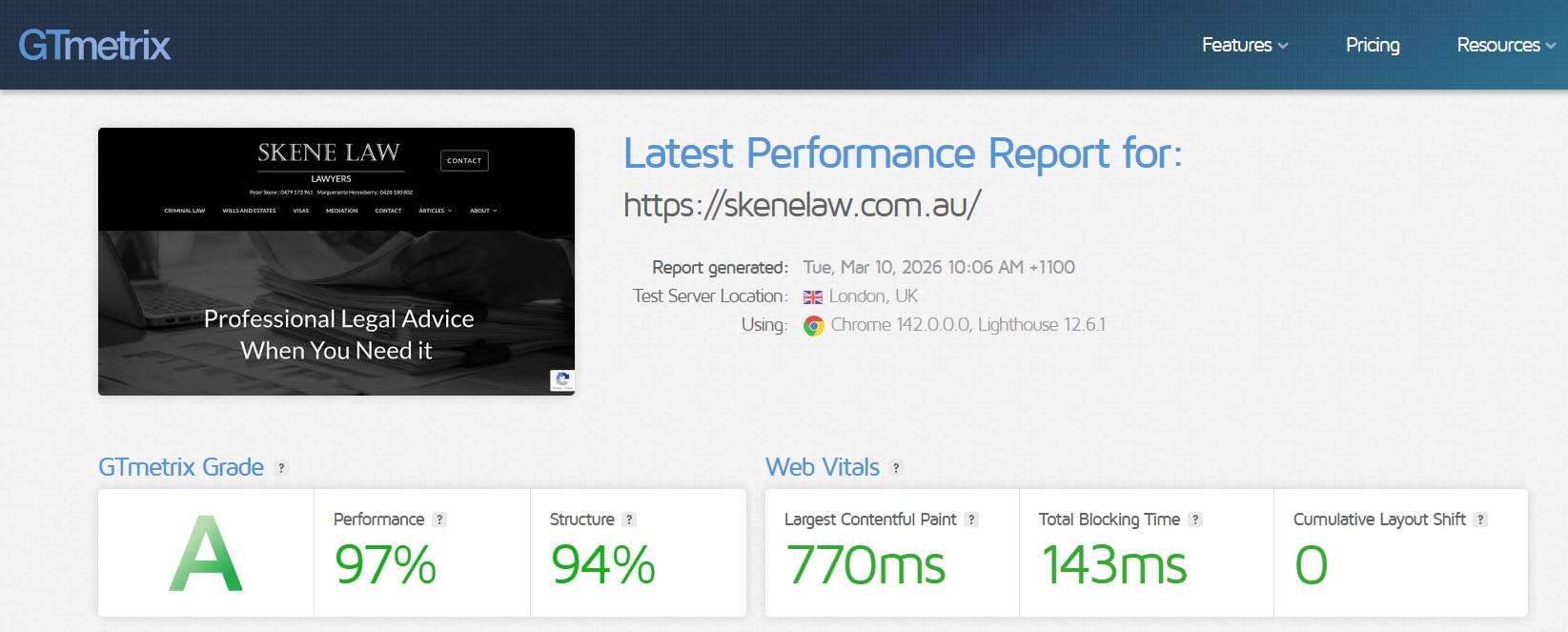
How Performance Holds Up Across Global Test Locations
The London test effectively shows the site's best-case scenario. Because the server is located in Europe, London sits relatively close in network terms and therefore experiences minimal latency.
But what happens when the distance increases? This is where things become interesting from a technical perspective. As requests travel further across the internet, network latency inevitably increases. Data packets simply have a longer journey to make.
However, latency alone does not determine whether a site feels slow. What matters just as much is how much work the browser must do once the page begins loading. If the page payload is small and the interface logic is efficient, the browser can render content quickly even when the server is thousands of kilometres away.
Distance affects latency, but payload size and interface efficiency usually determine how fast a website actually feels.
To see how the Skene Law site behaves under these conditions, we ran the same GTmetrix test from Hong Kong. This location sits significantly further from the server than London and therefore introduces additional network latency.
What matters is whether the architecture of the site can absorb that latency without degrading the user experience. In other words, does the site still feel responsive when the network path becomes longer?
The Hong Kong test provides the answer.

What Australian Visitors Actually Experience
The most important test for this article is the Sydney measurement, because that most closely reflects what visitors in Australia will experience when they open the site.
At this point it is worth remembering something important: the server running the site is located in Europe. In purely geographical terms, Sydney is on the opposite side of the world. Any request from Australia must therefore travel a considerable distance across the global network before reaching the server and returning with the page data.
Yet the GTmetrix Sydney test still shows strong performance. Even with the increased network distance, the site remains responsive and loads comfortably within the performance range that most usability studies consider “fast”.
Good architecture allows a website to remain fast even when network distance increases.
This is where the earlier engineering decisions start to pay off. Because the site uses lean front-end assets, efficient navigation, and minimal script overhead, the browser has far less work to do once the page begins loading.
Instead of downloading large frameworks or executing heavy client-side code, the browser can render the page quickly and allow the visitor to interact with the site almost immediately.
It is also worth noting that modern hosting infrastructure often uses intelligent routing techniques such as Anycast networking. This allows requests to travel through optimised global network paths rather than always following a single fixed route to the origin server. In practical terms, that means the effective network path may be shorter and more efficient than a simple “Australia to Europe” distance would suggest.
For Maitland businesses evaluating website speed, the practical lesson is clear. A carefully engineered website can deliver excellent performance for Australian visitors even when the origin server itself is located overseas.
The Sydney test below shows what that looks like in practice.
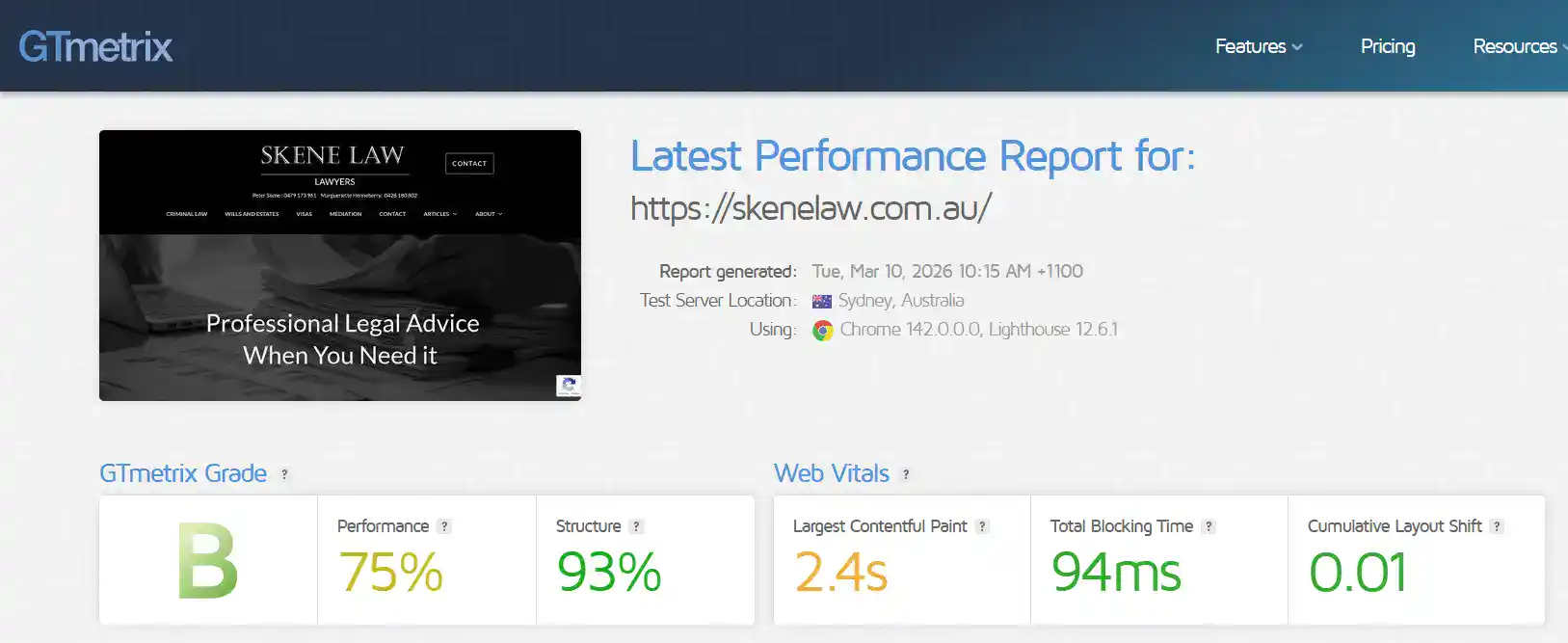
A Sydney load time of around 2.4 seconds to a European VPS is already strong performance by any sensible business-web standard. Many local business websites hosted much closer to their visitors still perform worse because they carry too much front-end weight, too many scripts, and too much layout overhead.
Could this site be made even faster? Certainly. Placing it behind Cloudflare would likely reduce effective latency further and improve static asset delivery through edge caching. If the site later carried heavier media such as video, those assets could also be pushed into a Cloudflare R2 bucket. But that is not really the point here.
The important lesson is that this site is already fast before Cloudflare is added, which tells you the underlying architecture is doing the heavy lifting.
That is the real distinction between performance engineering and marketing fluff. A well-structured, lean website can deliver excellent speed across continents. A bloated website can feel slow even when it is hosted in the same city as the visitor.
The UX Architecture That Makes This Website Feel Instant
Raw load time is only part of the story. What really makes this site feel fast is the way its user interface has been structured. Instead of forcing visitors through repeated page loads, the site exposes information quickly through buttons, menus, and modal-style interactions that reduce friction.
That matters because every full page transition carries a cost. The browser must request a new page, wait for the response, rebuild the layout, execute scripts again, and then let the user interact. Even when each of those steps are reasonably fast, the repeated stop-start effect makes a website feel slower than it really is.
A website often feels fast not because it loads once at high speed, but because it avoids making the user wait again and again.
The Skene Law site handles this intelligently. Much of the useful information is reachable from the homepage without forcing the visitor through a long sequence of separate pages. That creates a smoother experience, increases information density, and reduces the interaction cost of exploring the site.
In practical terms, this means the visitor can move from curiosity to understanding with less effort. A menu click reveals useful content. A button exposes more detail. A pop-up or modal presents information without breaking the visitor's flow. That is not just a design choice. It is a performance choice.
This is one reason why some websites with fairly ordinary hosting still outperform “premium” competitors in real-world usability. They are simply better organised. Their architecture respects the visitor’s time.
Good UX architecture reduces friction, preserves momentum, and makes a website feel quicker than its raw metrics alone would suggest.
For businesses looking for a website designer Maitland companies can rely on, this is an important lesson. A fast-feeling website is not only about speed tests. It is also about how directly the site helps real people find answers, build trust, and take action.
The same principle applies whether you are looking for a website design Thornton 2322 provider, a website designer Lower Hunter businesses can work with, a website designer Newcastle firms can trust, or help with business websites Hunter Valley companies need to perform well. The core issue remains the same: good UX architecture makes a website feel faster, easier, and more useful.
What Most WordPress Themes and Agencies Get Wrong About Speed
One of the most common mistakes in business web design is assuming that speed is mainly a hosting problem. It is not. More often, speed is lost long before the server becomes the bottleneck.
The real damage is usually done in the build itself: oversized themes, excessive plugins, bloated page builders, multiple font files, animation libraries, sliders, pop-ups piled on top of pop-ups, and too many third-party scripts all competing for the browser’s attention.
A slow business website is often designed to be slow long before anyone starts blaming the hosting.
This is where many agencies go wrong. They buy a flexible “do everything” theme, load it with visual extras, and then try to recover performance afterwards with caching plugins and server tweaks. That approach is backwards. If the architecture is heavy at the start, optimisation becomes a rescue mission rather than a design principle.
A better approach is to begin with restraint. Use only the assets you need. Keep layouts lean. Avoid unnecessary JavaScript. Reduce page transitions where possible. Make the browser do less work, not more. That is how genuinely fast websites are built.
The Skene Law example makes this contrast very clear. It does not feel fast because it is stuffed with visual tricks. It feels fast because the structure is controlled, the interface is disciplined, and the visitor can reach important information without fighting through layers of unnecessary complexity.
For businesses comparing agencies, this matters enormously. A polished mock-up or a long feature list tells you very little about how a site will actually perform once real users arrive. What matters is whether the build has been engineered to stay lean under real-world conditions.
Performance is rarely the result of one clever trick. It is usually the result of many disciplined decisions made early and consistently.
That is why a technically focused provider can often deliver better real-world speed than a more fashionable agency using heavier tools. For a business investing in a new site, especially one that depends on trust, visibility, and enquiry flow, that difference is not cosmetic. It affects usability, conversions, and long-term search performance.
What Maitland Businesses Should Take From This
If you run a business locally, the lesson is not that you need exotic infrastructure or an oversized budget. The real lesson is that website speed for Maitland businesses depends first on discipline: lean assets, efficient navigation, controlled scripts, and a structure that helps visitors get to the right information quickly.
That matters because most business websites are not judged by developers. They are judged by busy people on phones. A visitor does not care whether a delay comes from JavaScript execution, a bloated theme, or an over-complicated layout. They simply experience the site as fast, slow, clear, confusing, trustworthy, or irritating.
From a business point of view, speed is really about friction. The less friction a visitor feels, the more likely they are to stay, trust, and enquire.
That is why a technically well-built site can outperform a visually louder competitor. If the visitor can understand what you do, move around the site easily, and reach the next step without delay, the website is already doing its real job.
For businesses comparing providers, this changes the questions worth asking. Instead of asking only about page counts, colours, or how many features are included, ask how the site is being kept lean. Ask how many scripts are being loaded. Ask whether the build avoids unnecessary page transitions. Ask how the site will behave on an ordinary mobile connection in the real world.
This is just as relevant whether you are working with a website designer Maitland businesses can trust, a website designer Lower Hunter companies can rely on, or a provider serving business websites Hunter Valley firms need to perform properly. The underlying principles do not change.
Good performance is not a decorative extra. It shapes first impressions, user confidence, engagement, and conversion. In that sense, speed is not merely technical. It is commercial.
A fast business website does not just load well. It helps people reach confidence faster.
Fast Websites Are Built, Not Bought
The main lesson from this example is simple. A website does not feel fast merely because someone pays for “premium hosting” or installs a performance plugin at the end of the project. Fast websites are usually the result of many sensible decisions made early: lean front-end assets, disciplined structure, efficient navigation, careful script control, and a refusal to let visual clutter overrun the user experience.
That is exactly why the Skene Law example is so useful. It shows that a business website can remain impressively fast for Australian visitors even when the origin server is in Europe. The speed is not an accident. It is the result of architecture, restraint, and technical control.
If a website feels fast across continents, the engineering is probably doing its job.
For businesses in Maitland, Thornton, the Lower Hunter, the Hunter Valley, or Newcastle, that should be encouraging. You do not need gimmicks, bloat, or endless complexity. You need a website that respects the visitor’s time, delivers information efficiently, and is engineered to perform well in the real world.
If you are planning a new build or replacing a slow existing site, the right question is not simply “Where will it be hosted?” The better question is: How is this website being engineered to stay fast, clear, and useful?
Good UX, lean code, sensible hosting, and disciplined engineering will usually beat fashionable bloat every time.
Fast Modals in Action
Technical FAQ: UX, Hosting, and Website Speed
Is hosting location the main factor in website speed?
No. Hosting location affects network latency, but latency is only one part of the total loading experience. A browser still has to download assets, parse HTML, build the DOM, apply CSS, execute JavaScript, and render the page. If the site is bloated, slow performance can persist even when the server is geographically close to the visitor. That is why a lean website on a distant server can still outperform a heavy website hosted locally.
What makes a website feel fast even when the server is overseas?
The answer is usually perceived performance. If a site uses small payloads, efficient navigation, minimal JavaScript, and avoids repeated full page transitions, it can feel extremely responsive even when the origin server is overseas. In practical terms, the user experiences fast feedback because the browser has less work to do and the interface reveals information quickly.
What is “perceived performance” in a business website?
Perceived performance is the speed the user feels, not just the number recorded in a test tool. A website can score well in lab tests yet still feel clumsy if the visitor must keep waiting for page transitions, scripts, and layout shifts. Conversely, a site with well-structured navigation, immediate content reveal, and low interaction friction can feel very fast because the user gets answers quickly and smoothly.
Why do modal windows, pop-ups, and on-page reveal elements sometimes improve speed?
Used carefully, these patterns can reduce the cost of repeated page transitions. Instead of requesting and rendering an entirely new page, the browser can display content that is already loaded or that requires only a small additional request. This reduces interaction latency and helps the user stay in flow. Poorly implemented pop-ups can be annoying, but well-engineered modal navigation can improve both UX and perceived speed.
What usually slows down WordPress websites more than hosting does?
The biggest culprits are usually front-end bloat and poor architectural choices: oversized themes, too many plugins, multiple third-party scripts, unoptimised images, excessive webfonts, sliders, animations, and page builders generating heavy markup. These increase payload size, DOM complexity, and JavaScript execution time. In many cases, the browser becomes the bottleneck long before the server does.
How important are Core Web Vitals compared with actual usability?
Core Web Vitals matter because they provide useful signals about loading, responsiveness, and visual stability. However, they are not the whole story. A site can pass Core Web Vitals and still feel awkward if the information architecture is poor. Real usability depends on both technical performance and UX decisions: navigation logic, content visibility, interaction cost, and how easily the visitor can move from question to answer.
Would Cloudflare make a site like this faster?
Very likely, yes. Cloudflare can reduce effective latency through edge delivery, improve static asset caching, and optimise routing across its global network. If heavier media such as video were involved, Cloudflare R2 could also help reduce delivery overhead. But the important point is this: if the site is already fast before Cloudflare is added, that indicates the underlying architecture is strong. A CDN amplifies good engineering; it does not rescue poor engineering nearly as effectively.
Does Anycast networking change the simple “distance equals slowness” argument?
Yes. Modern hosting and delivery infrastructure often uses intelligent routing, including Anycast-style network behaviour, which can reduce the practical effect of geographic distance. Requests may travel through more efficient network paths than a simplistic map-based view would suggest. That does not eliminate latency altogether, but it does mean real-world performance depends on routing quality, caching, payload size, and browser workload, not just raw physical distance.
Why can a 2.4-second Sydney load time to a European VPS still be considered strong?
Because Sydney-to-Europe requests already carry substantial unavoidable network delay. If a website still loads in roughly 2.4 seconds under those conditions, it usually means the page is well controlled: lean assets, efficient rendering, limited script overhead, and sensible UX architecture. Many business websites hosted much closer to Australian visitors perform worse because their front-end build is too heavy.
What should a Maitland business actually ask a developer about website speed?
Ask technical questions, not just marketing ones. Ask what theme or framework is being used. Ask how many third-party scripts will load. Ask whether the build depends on a heavy page builder. Ask how images, fonts, and JavaScript are being controlled. Ask whether the site is designed to minimise page transitions and reduce browser work. If a provider cannot answer those questions clearly, they may be selling appearance first and performance second.
Internal Sydney Business Web Links
| Internal Page | Why It’s Useful |
|---|---|
| Online Business Engineering | Sets out the engineering-led philosophy behind fast, commercially useful websites rather than pretty-but-bloated builds. |
| Website Speed Optimisation: Video-Rich Homepage Hits 93% GTmetrix | Strong supporting article showing that even media-rich pages can perform well when payloads, caching, and front-end decisions are controlled properly. |
| Website Hosting – VPS Performance Optimisation: Why We Use a VPS and How Bots Threaten It | Useful for readers who want the server-side story behind stability, load control, and why “fast hosting” alone is not the answer. |
| Managing Bot Attacks and Building a VPS Fortress | Helps explain the less glamorous but critical background work: bot mitigation, resource protection, and keeping websites consistently responsive. |
| Cloudflare R2 Video Hosting: Faster, Cheaper, Smarter Website Videos | Ideal supporting link where you mention Cloudflare or future optimisation paths for heavier assets such as video. |
| Questions to Ask Your Web Developer | Excellent buyer-side companion piece for readers comparing agencies and trying to separate technical substance from sales talk. |
| Buying a New Business Website: What You Need to Know | Practical follow-on reading for businesses moving from “why this matters” to “what should I actually look for in a new build?”. |
| WordPress Custom Code: Why Code Still Matters in a CMS World | Reinforces the article’s technical point that speed, UX, and flexibility often come from disciplined custom work, not drag-and-drop excess. |
| Website Designer Maitland | Strong local relevance link for readers in Maitland who want the service-page version of the same performance-first thinking. |
| Website Designer Lower Hunter | Broadens the regional cluster naturally and supports the article’s Lower Hunter commercial intent. |
| Business Websites Hunter Valley | Useful for widening the geographic relevance beyond Maitland without losing the commercial theme of business-grade websites. |
| Website Design Thornton 2322 / Website Designer Newcastle | Rounds out the local cluster with your base area and the broader Newcastle market. |
External References
| External Source | Why It’s Useful |
|---|---|
| Google / web.dev – Core Web Vitals | Good official grounding for the user-experience metrics Google treats as important for modern website performance. |
| web.dev – The Most Effective Ways to Improve Core Web Vitals | Useful evidence that speed improvements come from disciplined engineering choices, not simplistic “buy better hosting” advice. |
| Google – About PageSpeed Insights | Helpful for explaining lab data versus field data and why one speed score never tells the whole story. |
| Cloudflare – Get Started with Cache | Strong official reference for edge caching, static asset delivery, and why Cloudflare can improve latency without changing the origin build. |
| Cloudflare – How R2 Works | Excellent technical reference for your discussion of heavier assets, media offload, and why R2 is useful for files such as video. |
| GreenGeeks – Going Green | Useful source for the environmental side of GreenGeeks and its renewable-energy positioning. |
| GreenGeeks – Hosting Overview | Helpful general reference when mentioning GreenGeeks infrastructure, eco-positioning, and hosting context. |
| GTmetrix – Website Performance Testing | Sensible external reference for the measurement tool used in the article’s screenshots and performance comparisons. |
CONTACT SYDNEY BUSINESS WEB NOW!