
AI Crawler Monitoring: Why It Matters for Your Business
Your website may be online, indexed by Google and performing perfectly well for human visitors. But does that mean AI systems can successfully retrieve its content?
Not necessarily. Search engines and AI systems use different crawlers, retrieval mechanisms and access patterns. A website that responds normally to a browser may still refuse, challenge or fail requests from automated systems. Without monitoring, those failures can remain invisible.
AI Visibility Begins With a Sound Website
Before discussing artificial intelligence, a business website needs the fundamentals: a logical page structure, useful content, working internal links, appropriate indexing controls and conventional technical SEO.
These are not optional foundations that AI visibility somehow replaces. They are essential parts of making a website discoverable, navigable and understandable to both people and machines.
The next question is whether automated systems can actually retrieve that information. This is where AI crawler monitoring becomes useful. Rather than assuming access is working, we can observe crawler requests and examine what happens when those requests reach the website.
One important distinction: Successful crawler access does not guarantee that an AI system will cite, recommend or even mention a business. It establishes whether a measurable technical barrier to retrieval exists — an important early step in a much wider visibility process.
What Does AI Observatory Actually Measure?
AI Observatory monitors real requests reaching a website through Cloudflare's edge infrastructure. Rather than relying on assumptions about which crawlers might visit, it records observed activity and examines retrieval outcomes.
The system distinguishes conventional search crawlers, AI search crawlers, general AI crawlers and systems that perform more than one role. It also separates different types of retrieval activity.
01. Autonomous Accesses
Automated crawler requests observed during the monitoring period. These show which recognised systems are requesting website resources and the volume of that activity.
02. Business Retrievals
Requests classified as attempts to retrieve business-relevant information. Observatory records successful and unsuccessful responses, helping identify whether important website content is technically accessible.
03. Discovery Retrievals
Requests classified as discovery activity, including access to resources used to find or explore website content. These are measured separately from business retrievals.
04. Retrieval Success Rates
The proportion of classified retrieval requests that meet Observatory's success criteria. Failure patterns can help identify access restrictions, security responses or origin problems requiring investigation.
Different Crawlers, Different Roles
Not every crawler does the same job. Googlebot and Bingbot primarily support conventional search discovery and indexing. OAI-SearchBot and PerplexityBot are associated with AI-assisted search, while GPTBot and ClaudeBot perform broader AI crawling functions.
Applebot also operates across search and AI-related services. Monitoring these systems individually is important because successful access by one crawler does not establish that all others can retrieve the same content.
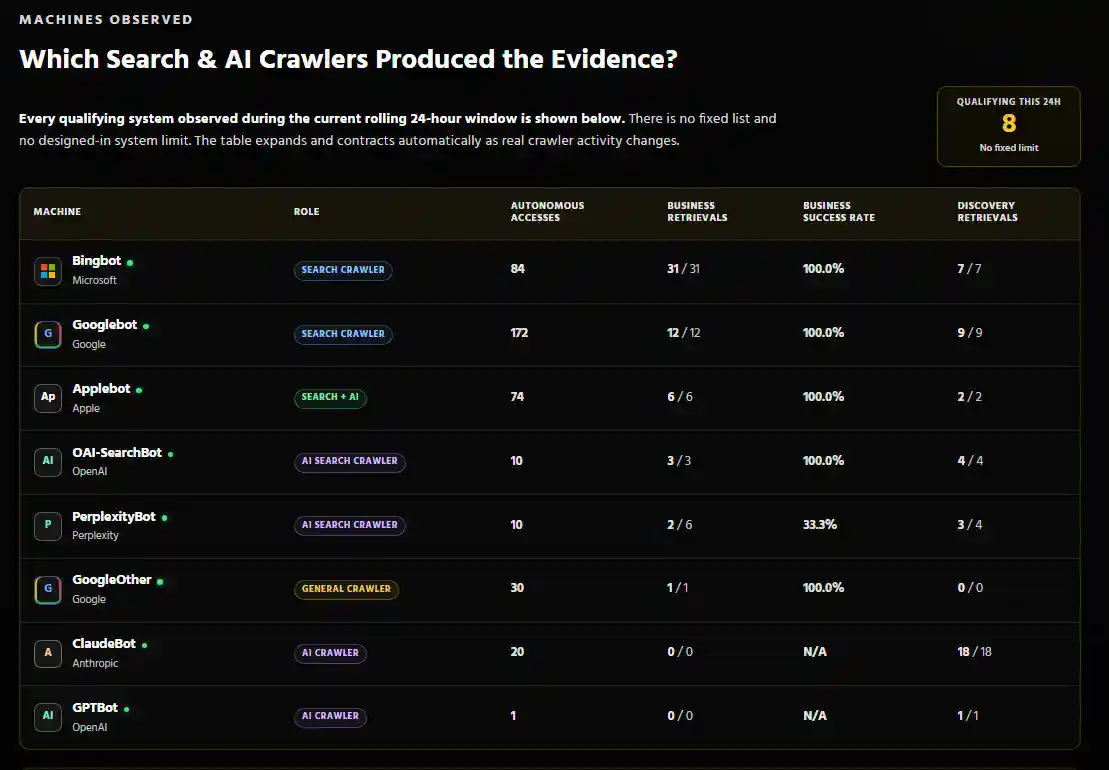
An example from the Observatory:
In the illustrated rolling 24-hour reporting window, eight qualifying crawler systems were observed. Most recorded business retrievals succeeded, but PerplexityBot returned a business retrieval success rate of just 33.3% — two successful retrievals from six attempts.
This does not establish why the requests failed or whether the failures affected an AI-generated answer. It does, however, identify a measurable anomaly worth investigating.
The value of AI crawler monitoring is precisely this distinction: replacing assumptions about website accessibility with observable evidence that can guide technical investigation.
A bot count tells you almost nothing about AI visibility. Knowing that an AI crawler visited your website does not tell you whether it successfully retrieved the business information it came looking for.
— Sydney Business Web
Businesses can spend considerable time and money trying to understand why AI systems are not finding or mentioning them, without first establishing whether those systems can successfully retrieve their website content. That is a fundamental diagnostic step, not an optional extra.
— Sydney Business Web
Retrieval Is Not the Same as AI Visibility
Once we know that automated systems can retrieve a website's content, we can investigate the next question: does that content describe a coherent, identifiable and credible business?
A crawler may successfully retrieve dozens of pages without those pages collectively explaining who operates the business, what it offers, where it operates or how its services and supporting evidence are connected.
This is why Sydney Business Web approaches AI visibility as a systems engineering problem rather than a collection of isolated SEO tricks.
Conventional SEO and Website Structure
Establish sound technical SEO, logical navigation, clear service descriptions, useful content and working internal links. These fundamentals support both conventional search and machine interpretation.
AI Observatory
Measure which crawlers are actually arriving, what they are requesting and whether classified retrievals succeed. Identify access problems before investing in more complex visibility investigations. Explore AI Observatory .
Schema Gorilla and AI Identity Diagnostic
Examine structured data and connections between business entities, services and supporting pages. Identify missing relationships, contradictions and fragmented information that may complicate machine interpretation.
Intelligent Entity Skeleton
Develop an internally coherent, machine-readable representation of the business, connecting its identity, services, locations and relevant evidence. Structured data supports the visible content; it does not replace it.
AI Credibility Footprint
Strengthen consistency between the website and independent information about the business. Relevant external references can help systems assess whether business claims are supported beyond the organisation's own website.
AI Visibility Outcomes
Test whether AI systems retrieve and accurately describe the business in relevant queries, including non-brand category searches. Record observable results without assuming that crawler access guarantees inclusion.
The engineering principle is straightforward: there is little value in diagnosing how a machine interprets information until we have established whether it can retrieve that information in the first place.
Equally, a successful retrieval is not the end of the process. The business must still present coherent information and credible supporting evidence.
Before You Invest in AI Visibility, Check the Evidence
AI crawler monitoring is not a substitute for good SEO, well-structured content or a credible business identity. It addresses a more fundamental technical question: are automated systems successfully retrieving the information your website provides?
If the answer is unknown, expensive investigations into AI visibility may begin with a significant blind spot. Identifying retrieval problems early helps establish a more reliable starting point for subsequent analysis and improvement.
A Real Example: When Security Blocks the Crawler
In a recent investigation, AI Observatory detected ClaudeBot receiving HTTP 418 responses. Further investigation traced the problem to an origin security configuration involving ModSecurity.
The website was otherwise operational, but requests from this crawler were being blocked. The problem was identified through observed retrieval behaviour rather than assumptions about crawler access.
Measure First. Diagnose Next. Improve With Evidence.
Sydney Business Web combines technical website engineering, conventional SEO, crawler monitoring, business entity analysis and external credibility assessment into a structured approach to AI visibility.
The objective is not to promise inclusion in AI-generated answers. It is to identify and address measurable weaknesses, then evaluate whether the business is being accurately retrieved and represented.
Can AI Crawlers Retrieve Your Website?
AI Observatory provides evidence of crawler activity, classified retrievals and access outcomes. It is the observation stage of Sydney Business Web's wider AI visibility methodology.
Find out what your website is actually returning to AI and search crawlers before committing to more extensive visibility work.
Explore AI Observatory →Monitoring measures observed requests and technical outcomes. It does not establish how retrieved content is subsequently used by an AI system or guarantee citations, recommendations or rankings.
Frequently Asked Questions
What is AI crawler monitoring?
AI crawler monitoring examines requests made to a website by recognised AI and search crawlers. It helps establish which systems are accessing the site and whether their retrieval requests are succeeding or failing.
Does a high AI bot count mean my business is visible to AI?
No. A high bot count shows request activity, not successful information retrieval or inclusion in AI-generated answers. Retrieval outcomes and subsequent visibility need to be evaluated separately.
Can AI crawlers be blocked even when my website works?
Yes. Firewalls, hosting security rules, bot protection systems and server errors can prevent particular crawlers from accessing content, even when ordinary visitors experience no apparent problems.
Will allowing AI crawlers improve my AI visibility?
Allowing appropriate crawler access removes one potential technical obstacle, but does not guarantee improved AI visibility. Website structure, content quality, business identity, corroborating evidence and the behaviour of individual AI systems also matter.
How does AI Observatory fit into the wider AI visibility process?
AI Observatory measures observed crawler activity and retrieval outcomes. Sydney Business Web then uses Schema Gorilla and its AI Identity Diagnostic to investigate business entity structure and coherence, followed by appropriate remediation and visibility evaluation.
Further Reading and Technical References
The following resources provide further technical background, supporting evidence and information about Sydney Business Web's AI visibility methodology.
From Sydney Business Web
AI Observatory
Our crawler monitoring platform for measuring observed automated requests, business retrievals, discovery activity and access outcomes.
Explore Observatory →AI Retrieval Evidence
Published monitoring evidence illustrating how crawler activity and retrieval outcomes can be examined rather than assumed.
View the evidence →AI Crawler Blocked by ModSecurity
An investigation into ClaudeBot receiving HTTP 418 responses caused by origin security controls, despite the website otherwise operating normally.
Read the investigation →Independent Technical Documentation
Managing AI Crawlers
Cloudflare's guidance on identifying AI crawler activity, examining unsuccessful requests and managing crawler access through security controls.
Cloudflare documentation →Overview of OpenAI Crawlers
Official explanations of OAI-SearchBot, GPTBot and ChatGPT-User, including their different purposes and website access controls.
OpenAI crawler documentation →How Google Search Works
Google's explanation of the separate crawling, indexing and search-serving stages, and why successful crawling does not guarantee visibility.
Google technical guide →