
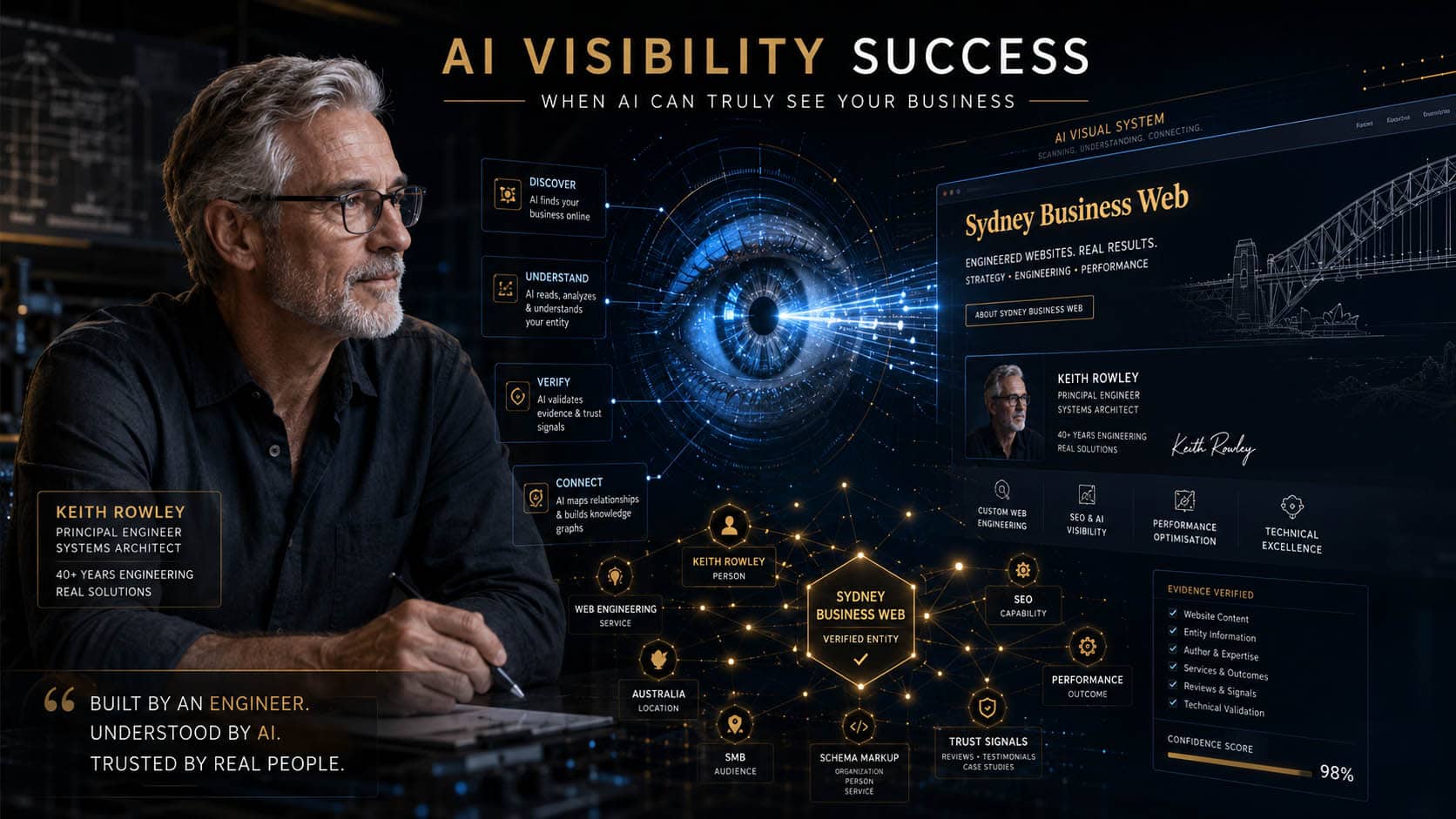
The proof, not the promise
I am an engineer—not a bloody razzle-dazzle AI salesman.
When I say Sydney Business Web understands something, I expect to be able to prove it.
AI Visibility is a new commercial service for Sydney Business Web—but it did not appear overnight because AI suddenly became fashionable. It grew from months of deliberate engineering work: making our business easier for AI systems to discover, understand, verify and connect with the real problems people need solved.
We tested the work on ourselves first. We built the technical structure, strengthened the supporting evidence, watched how the systems responded—and recorded the results.
The real test is not whether AI can crawl a website. It is whether AI can correctly understand the business—and know when to select it.
Success signal: unbranded discovery
AI finds the business before the customer knows its name.
The first meaningful test of AI Visibility is not whether a system can repeat information after being given a business name. It is whether that business is discovered for a relevant, unbranded commercial question.
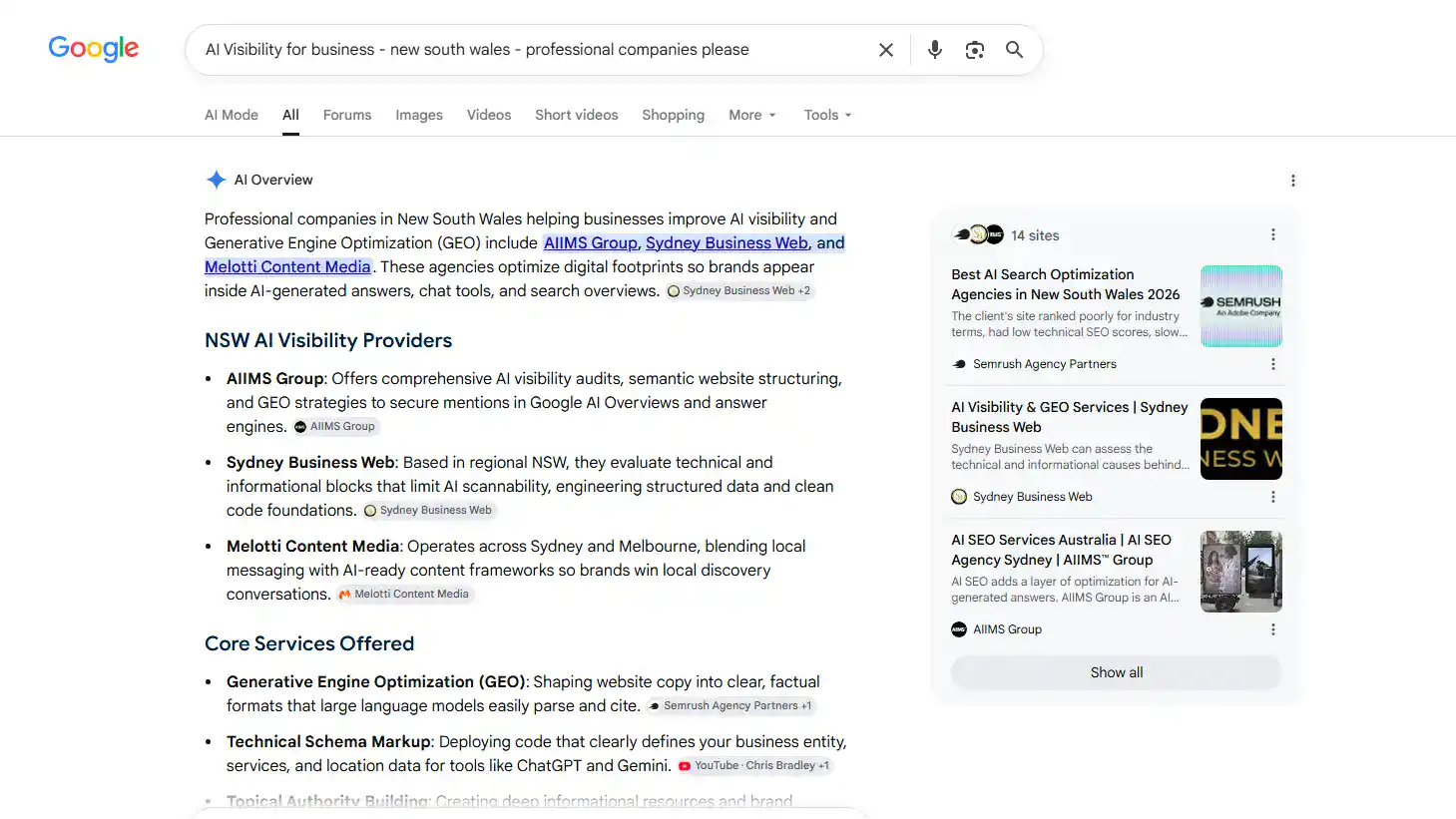
Selected beside substantially larger companies
The search did not mention Sydney Business Web. Google nevertheless selected it as one of only three named NSW providers, alongside AIIMS Group and Melotti Content Media, and provided Sydney Business Web with its own directly attributed description and source.
Google had connected Sydney Business Web with the commercial category of AI Visibility—not merely with its own brand name.
Success signal: accurate understanding
Being found is not enough. AI must understand the business correctly.
A business name appearing in an AI answer proves very little if the description is vague, incomplete or wrong. Real progress occurs when the system accurately connects identity, location, capability and differentiation.
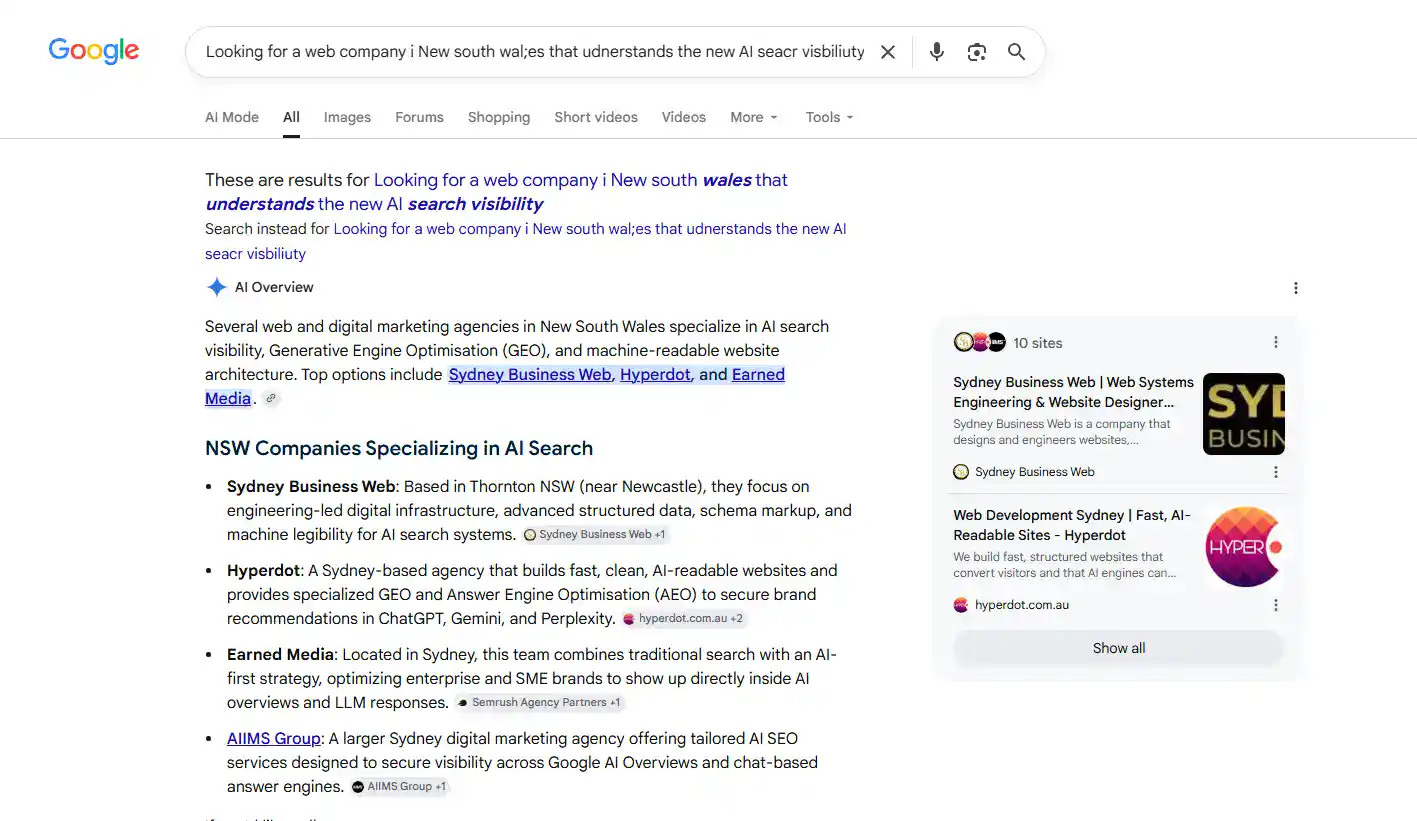
The right kind of company
Google classified Sydney Business Web as a web and digital engineering company specialising in AI search visibility.
The real operating base
It correctly placed the business in Thornton NSW, near Newcastle, rather than confusing the brand name with a Sydney CBD address.
The engineering distinction
It identified advanced structured data, schema, technical infrastructure and machine legibility—not generic content marketing.
The description is valuable because it reflects what Sydney Business Web actually is—not merely the keywords appearing on one page.
Success signal: trust-filtered selection
The business survives the customer’s credibility test.
Buyers do not merely ask AI who offers a service. They increasingly add conditions such as professional, credible, local and trustworthy—particularly in an industry burdened by empty promises and dubious guarantees.
“We want professional and credible AI Visibility expertise. We don’t want SEO scammers—please!”
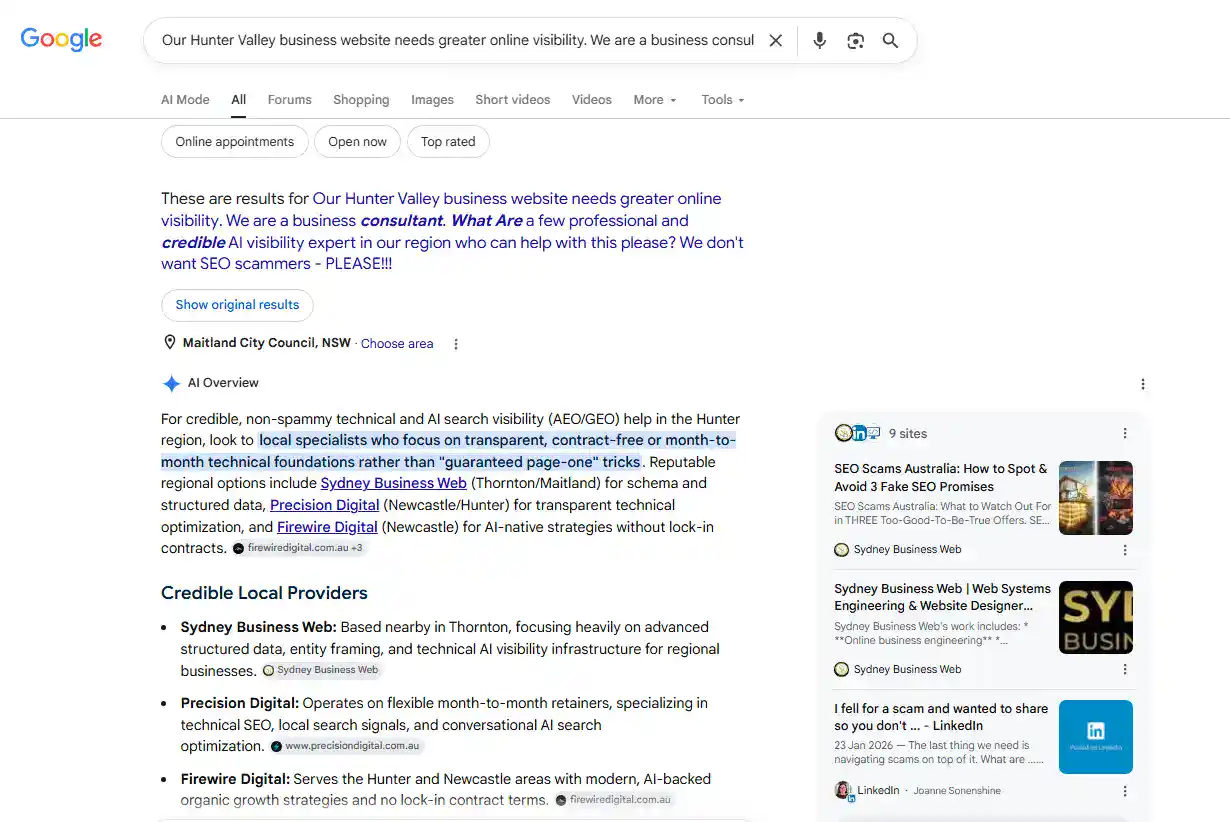
Selected first for a sceptical local buyer
Google named Sydney Business Web first among the credible local providers. It connected the business with Thornton and Maitland, advanced structured data, entity framing and technical AI Visibility infrastructure for regional businesses.
Sydney Business Web remained prominent after the query introduced an explicit trust filter—not merely a service or location keyword.
This is evidence of Google’s observed selection and association, not a formal Google endorsement. AI-generated results can vary by user, location, wording and time. That distinction matters—and honest measurement requires us to say so.
Success signal: problem association
AI connects the business with the problem it knows how to solve.
Commercial discovery matters, but expertise is also established when AI systems surface a business’s knowledge for the customer’s actual question—before the customer asks who to hire.
“What do I do to make my business website credible to AI—and make it visible?”
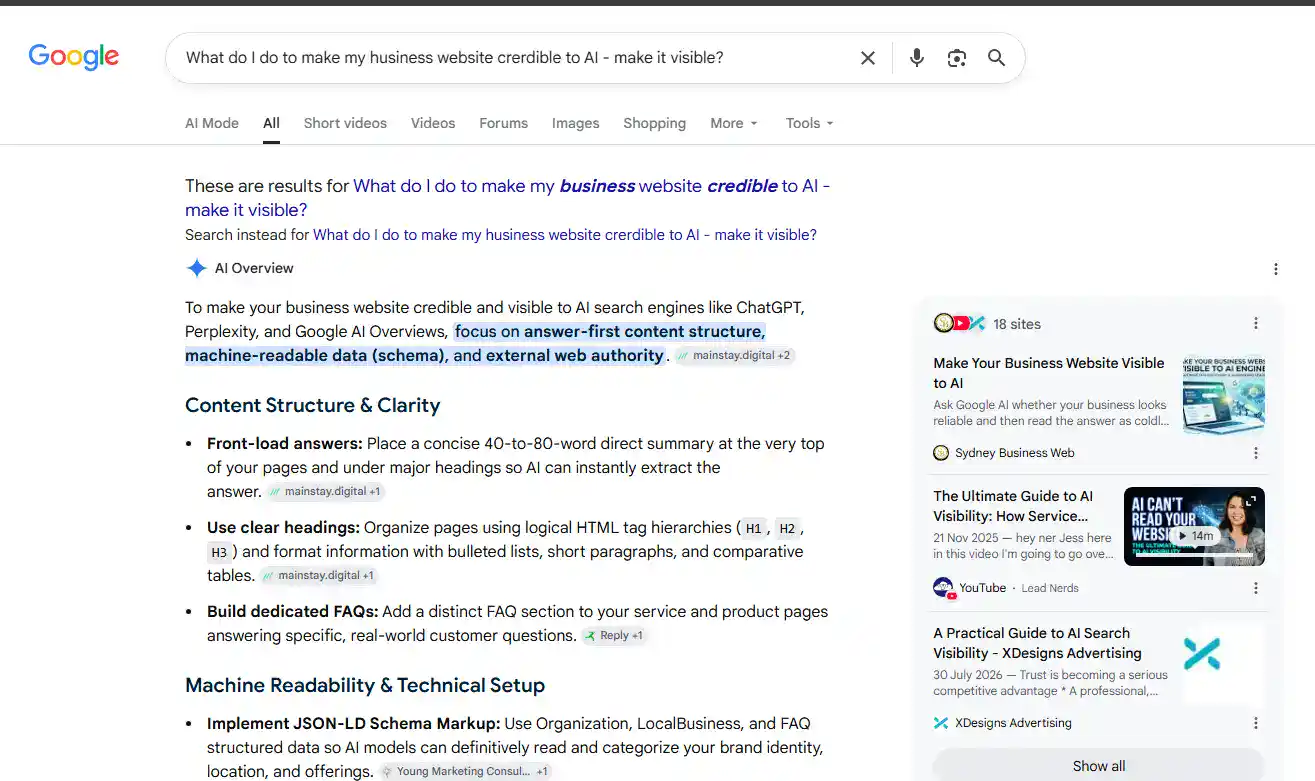
SBW appears against the problem itself
Sydney Business Web’s article, “Make Your Business Website Visible to AI,” appears as the first visible source card for a broad question about AI credibility and visibility.
Content, schema and external authority
The result sits within an answer discussing clear content, machine-readable data and external web authority—the same connected foundations that underpin Sydney Business Web’s AI Visibility methodology.
Evidence read carefully: Sydney Business Web is the first visible source card and one of 18 sources. The visible answer also cites other publishers, so we do not pretend that every displayed statement came exclusively from our page.
Success signal: concept recognition
AI begins to understand—and attribute—the language you created.
Ordinary visibility connects a business with a service. A deeper form of visibility occurs when an AI system can explain a distinctive concept developed by that business while preserving its meaning and source attribution.
Schema Gorilla
Deliberate, interconnected structured data that expresses the real business as a coherent machine-readable identity—not a collection of disconnected schema tags.
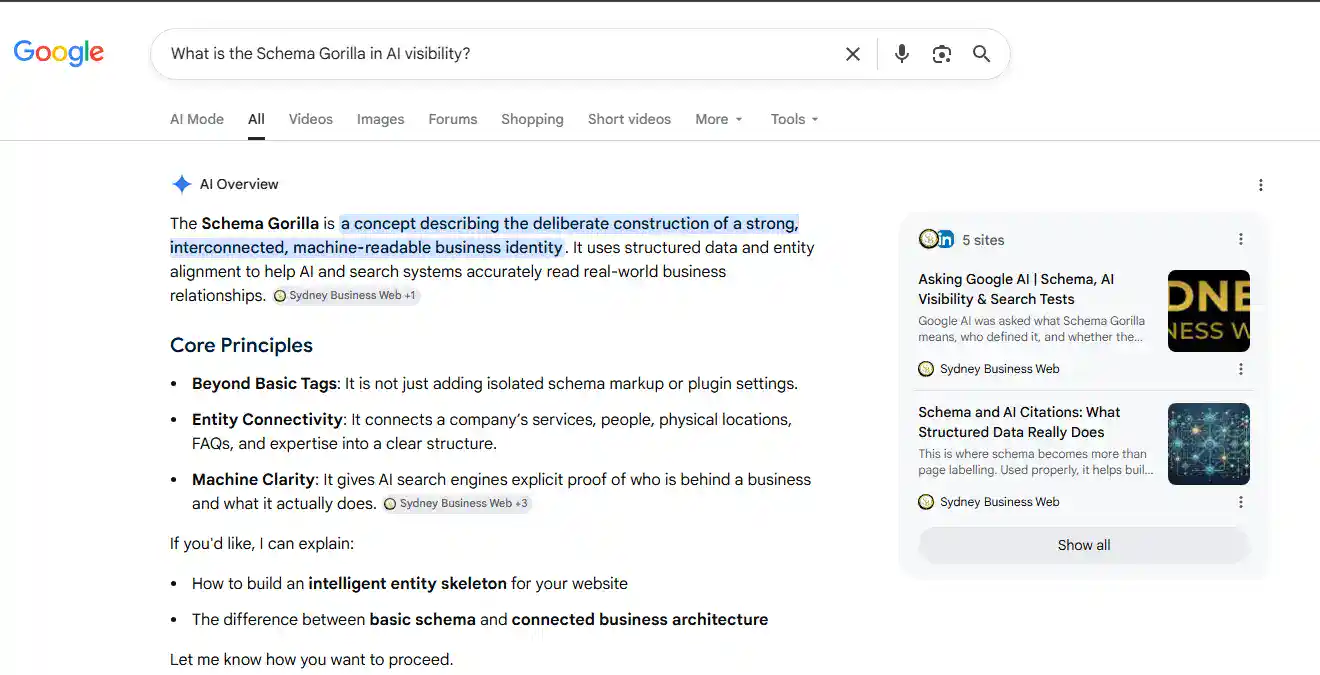
Not reduced to “more schema”
Google described Schema Gorilla as a strong, interconnected, machine-readable business identity and distinguished it from isolated tags and plugin settings.
SBW remains attached to the concept
Sydney Business Web is cited directly in the answer, while the two prominent visible source cards both lead to Sydney Business Web material.
What this does—and does not—prove: it shows that Google could retrieve, interpret and attribute the concept in this observed result. It does not claim that Schema Gorilla has become a universally adopted industry term or that attribution is guaranteed in every search.
Success signal: framework comprehension
AI reconstructs the framework—not merely the phrase.
Recognition becomes more meaningful when the system can identify the framework’s internal structure, explain how its components relate and support that understanding with more than one source.
Central Entity
The real business as the focal point of the connected structure.
Connected Nodes
People, services, articles, FAQs, expertise and locations.
External Evidence
Profiles, citations, reviews and independent corroboration.
Technical Access
Crawler paths and structured data expressing the relationships.
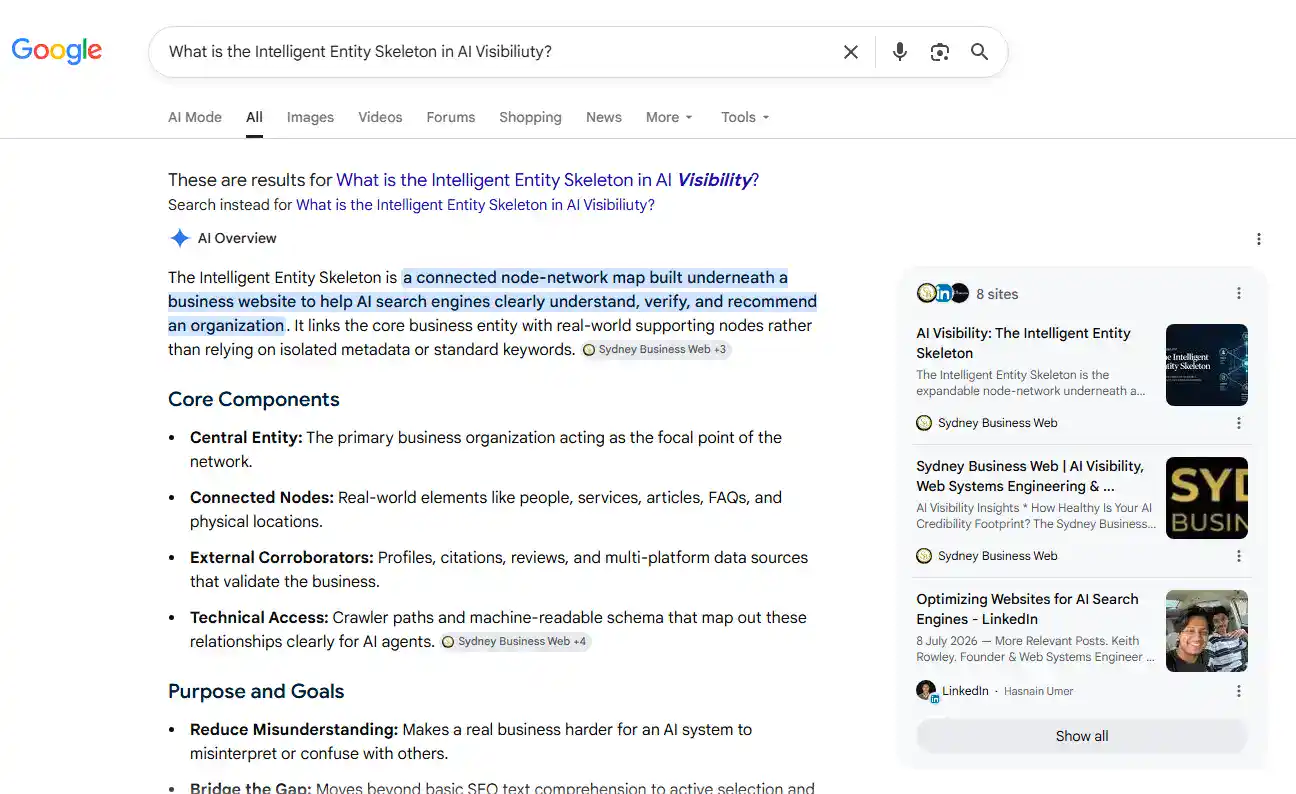
The architecture was accurately reconstructed
Google described a connected node-network built beneath a business website and identified the central business, supporting nodes, external corroborators and technical access. That closely reflects the framework developed and published by Sydney Business Web.
Alongside Sydney Business Web’s own sources, the visible panel includes a third-party LinkedIn post referring to Keith Rowley and the concept’s wider AI-search context.
The recursive result: Google appears to explain the Intelligent Entity Skeleton by following the very structure it describes— connecting the concept, Sydney Business Web, Keith Rowley, owned content and an outside reference.
Success signal: evidence-layer understanding
AI understands that credibility lives beyond the website.
A website can describe itself perfectly and still remain unconvincing. The AI Credibility Footprint concerns the wider body of consistent, verifiable evidence that helps systems assess whether the entity described on the website exists and deserves confidence.
Owned Signals
Official data, structured evidence and controlled profiles.
Customer Signals
Reviews, ratings, testimonials and documented outcomes.
External Evidence
Citations, directories, profiles and independent references.
Consistency
Agreement between business facts across multiple sources.
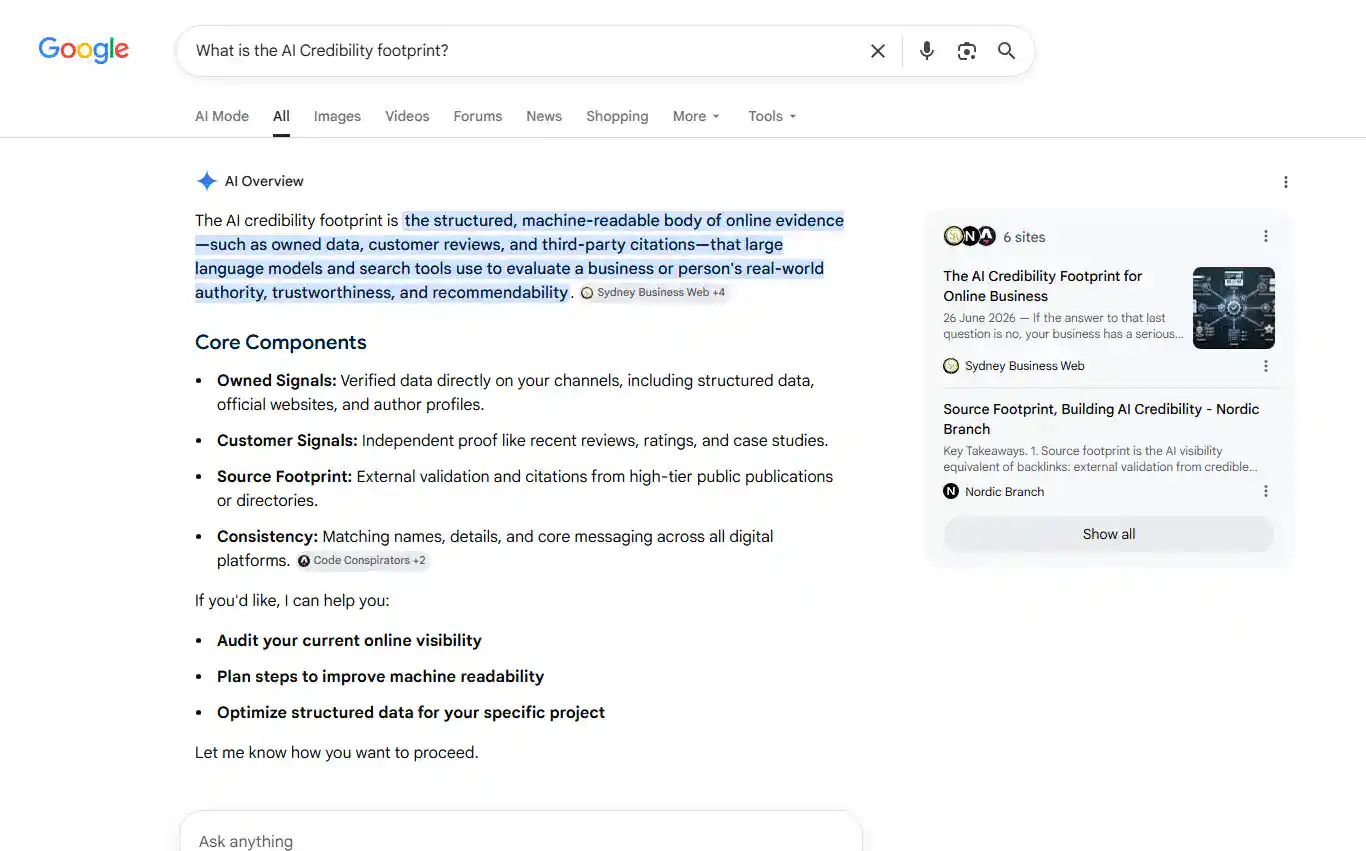
The evidence model remained intact
Google described a structured, machine-readable body of online evidence and separated it into owned information, customer evidence, third-party validation and cross-platform consistency. That is strikingly close to the intended framework.
Sydney Business Web appears as the primary visible source, with additional sources contributing related evidence about external credibility and consistency.
The Intelligent Entity Skeleton defines the business. Schema Gorilla expresses it coherently for machines. The AI Credibility Footprint supplies the wider evidence that supports its claims.
Success signal: technical accessibility
AI systems can successfully reach and retrieve the evidence.
Entity architecture and credible evidence accomplish nothing if crawlers cannot retrieve them. Technical AI Visibility begins with verified access through the firewall, robots controls, server and application layer—but access alone is only the foundation.
Recorded by Cloudflare during the observed 24-hour period.
Successful content retrieval rather than crawler identification alone.
475 successful responses from 506 requests permitted through Cloudflare.
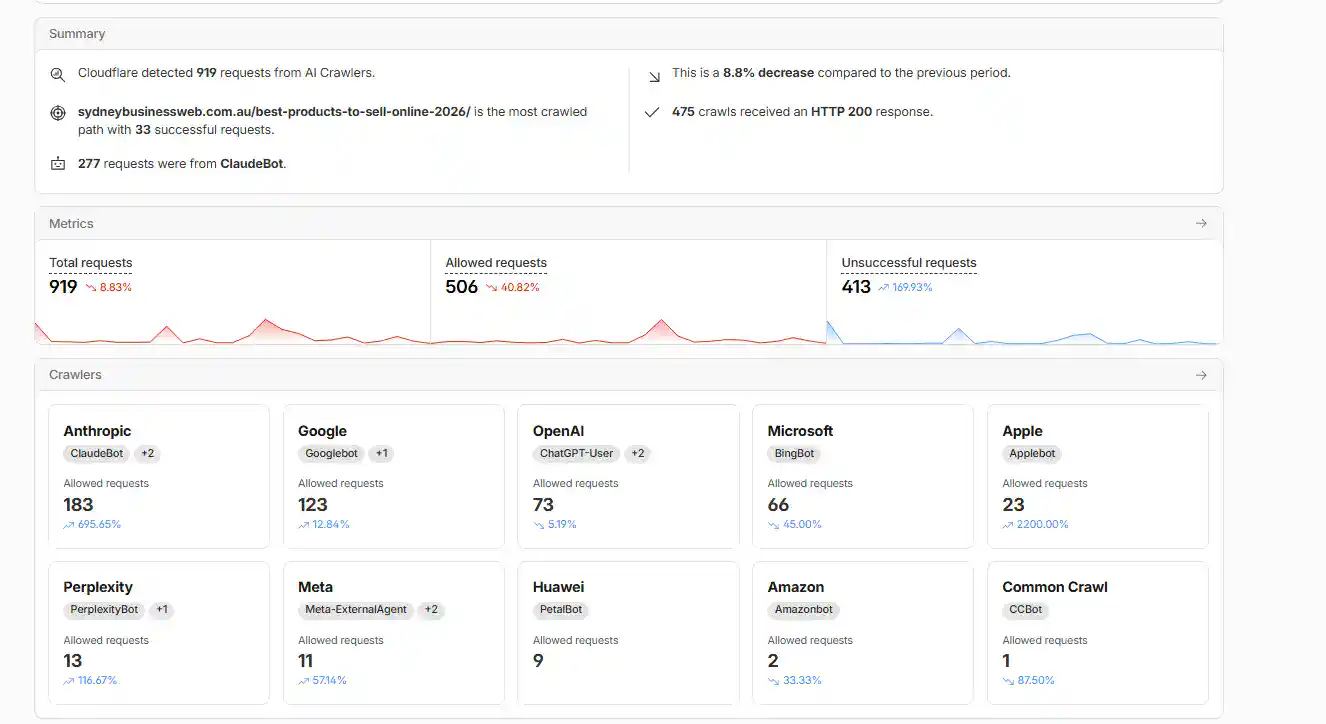
Multiple AI ecosystems reached the site
The allowed traffic included crawlers associated with Anthropic, Google, OpenAI, Microsoft, Apple and Perplexity, rather than dependence on a single platform.
Access produced real HTTP 200 responses
Cloudflare recorded 475 successful responses. This demonstrates that a substantial volume of permitted AI crawler traffic received retrievable content from Sydney Business Web.
Evidence read carefully: Cloudflare identifies this traffic as AI crawler activity, but unsuccessful requests can include blocked, spoofed, outdated or nonexistent paths. They should not all be interpreted as legitimate vendor crawlers being denied access.
Success signal: whole-entity understanding
AI can explain who we are, who stands behind us and what we can do.
The strongest entity test is not a search for one service or one framework. It is whether the system can assemble the business, people, location, experience and capabilities into one substantially accurate account.
“What is Sydney Business Web, who is behind it, and what specialist technical capabilities does the business have?”
An engineering-led web systems studio
Google distinguished Sydney Business Web from the conventional creative-agency model and connected it with high-performance websites, ecommerce and digital business infrastructure.
Keith and Hettie Rowley
The response connected Keith with engineering, technical architecture and business strategy, and Hettie with visual direction, design and her background as an award-winning Australian artist.
More than ordinary website production
Google identified AI Visibility, connected structured data, advanced WooCommerce, API and supplier integrations, server-level diagnostics and performance optimisation.
The proprietary frameworks remained attached
The answer explicitly identified Sydney Business Web as the creator of the Intelligent Entity Skeleton, AI Credibility Footprint and Schema Gorilla.
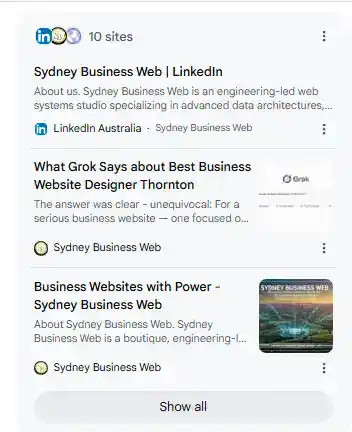
Google reported using ten sources, including LinkedIn and multiple Sydney Business Web resources, to construct the response.
This is the outcome an Intelligent Entity Skeleton is intended to support: the business is represented as a connected, intelligible whole rather than a loose collection of web pages.
Our correction to Google’s wording: the response referred to “deep-nested JSON-LD.” Depth is not the objective. Sydney Business Web builds coherent, connected schema graphs in which every relationship remains justified by visible, verifiable information.
The measurement model
How we measure AI Visibility without inventing a magic score.
AI Visibility cannot honestly be reduced to one universal number. Sydney Business Web measures a sequence of observable outcomes, beginning with technical access and progressing towards accurate, repeated discovery, attribution and selection.
Can AI retrieve it?
Confirm that legitimate crawlers can reach important pages, structured data and supporting evidence without server, firewall, robots or rendering failures.
HTTP responses, crawler logs, blocked paths and successful data transfer.
Does AI understand it?
Test whether systems correctly identify the business, people, location, services, expertise and relationships between them.
Correct facts, omissions, entity confusion and data dissonance.
Can AI find it unprompted?
Search using relevant customer questions that do not mention the business name and record whether the business or its content appears.
Query, platform, location, date, position and source inclusion.
Is expertise credited correctly?
Determine whether content, people, experience and proprietary concepts remain attached to the correct business and author.
Citations, source cards, authorship and framework provenance.
Is the business surfaced appropriately?
Test commercial, local, problem-led and trust-filtered questions that resemble the decisions real prospective customers make.
Recommendation context, competitors, description and supporting sources.
Does the understanding persist?
Repeat controlled questions across different dates, phrasings, locations and AI systems to identify genuine patterns rather than celebrate one attractive answer.
Repeatability, changes over time, platform differences and regressions.
Record what each system currently knows, misses or gets wrong.
Improve access, entity structure, evidence and corroboration.
Repeat controlled queries and inspect retrieval behaviour.
Document improvements, remaining errors and new priorities.
Record the evidence, not merely the impression
Every test should preserve the exact query, platform, date, location, wording of the answer, visible sources, factual errors and whether the result can be reproduced. That turns screenshots into a defensible measurement record.
No invented certainty
A single citation is encouraging. It is not proof of permanent visibility, universal recommendation or a guaranteed commercial result.
Straight answers
AI Visibility success: frequently asked questions
AI search is changing quickly, but the principles of honest measurement remain fairly simple. These are the questions serious businesses should ask.
What does AI Visibility success actually mean?
AI Visibility success means that AI and search systems can discover, accurately understand, verify and appropriately surface a business when answering relevant questions. It involves more than appearing once: the business, its people, services, location, expertise and supporting evidence should remain coherently connected.
Can AI citations or recommendations be guaranteed?
No. AI answers vary according to the platform, model, user, location, wording, available sources and time of the query. Sydney Business Web can engineer stronger conditions for access, understanding and verification, but no ethical provider can guarantee a citation or recommendation.
How does Sydney Business Web measure improvement?
We establish a baseline, inspect crawler access, record factual errors and omissions, and test controlled branded, unbranded, commercial and problem-led questions. Results are compared across dates and systems, preserving the exact query, response, citations, location and context rather than relying on a single visibility score.
Is AI Visibility the same as SEO, AEO or GEO?
No, although they overlap. SEO traditionally improves discovery through search results. AEO and GEO generally focus on content being usable in generated answers. Sydney Business Web’s AI Visibility work also addresses technical crawler access, entity architecture, structured evidence, external corroboration, authorship and data consistency across the wider web.
Can schema markup alone make a business visible to AI?
No. Schema helps machines interpret explicit facts and relationships, but it cannot manufacture credibility or force selection. It must agree with visible content and be supported by real people, services, reviews, profiles, credentials and external evidence. Schema clarifies evidence; it does not replace it.
How long does meaningful AI Visibility improvement take?
There is no universal timetable. Technical access problems may be corrected quickly, while crawling, reprocessing, entity consolidation and external corroboration can take weeks or months. Progress should be measured as a developing pattern of improved access, accuracy, attribution and discovery rather than against a promised ranking date.
The practical standard: if an explanation sounds certain but cannot be supported with technical evidence, recorded tests and honest limitations, it is marketing—not measurement.
The evidence verdict
This is what AI Visibility success actually looks like.
Not one lucky ranking. Not an invented visibility score. Not an agency announcing that it has “optimised for AI.” It is a developing body of observable evidence showing that AI can find, understand, verify, attribute and appropriately surface the real business.
The business was discovered
Sydney Business Web appeared for unbranded commercial, informational, regional and trust-filtered questions.
The business was understood
Google connected the location, people, engineering background, specialist services and technical differentiation.
The expertise was attributed
Content and proprietary frameworks remained visibly associated with Sydney Business Web and its supporting sources.
The technical foundation held
Major AI crawler ecosystems reached the site and successfully retrieved substantial content through the infrastructure.
AI Visibility is a new Sydney Business Web service—but it is built upon months of engineering work that we first tested on ourselves.
No ethical provider can guarantee that an AI system will always cite or recommend a business. These results can vary by platform, wording, location, user and time. What we can do is engineer the technical and evidential conditions for stronger machine understanding—and measure what happens honestly.
Now test your business
What does AI actually understand about you?
Sydney Business Web can examine whether AI systems can access your website, identify the real business behind it, connect its people and services, verify its supporting evidence—and recognise when it is relevant to the customer’s question.
Prefer to speak directly? Call Keith on 0427 847 653
No guaranteed citations. No invented visibility score. No razzle-dazzle. Just technical investigation, evidence-led engineering and honest measurement.