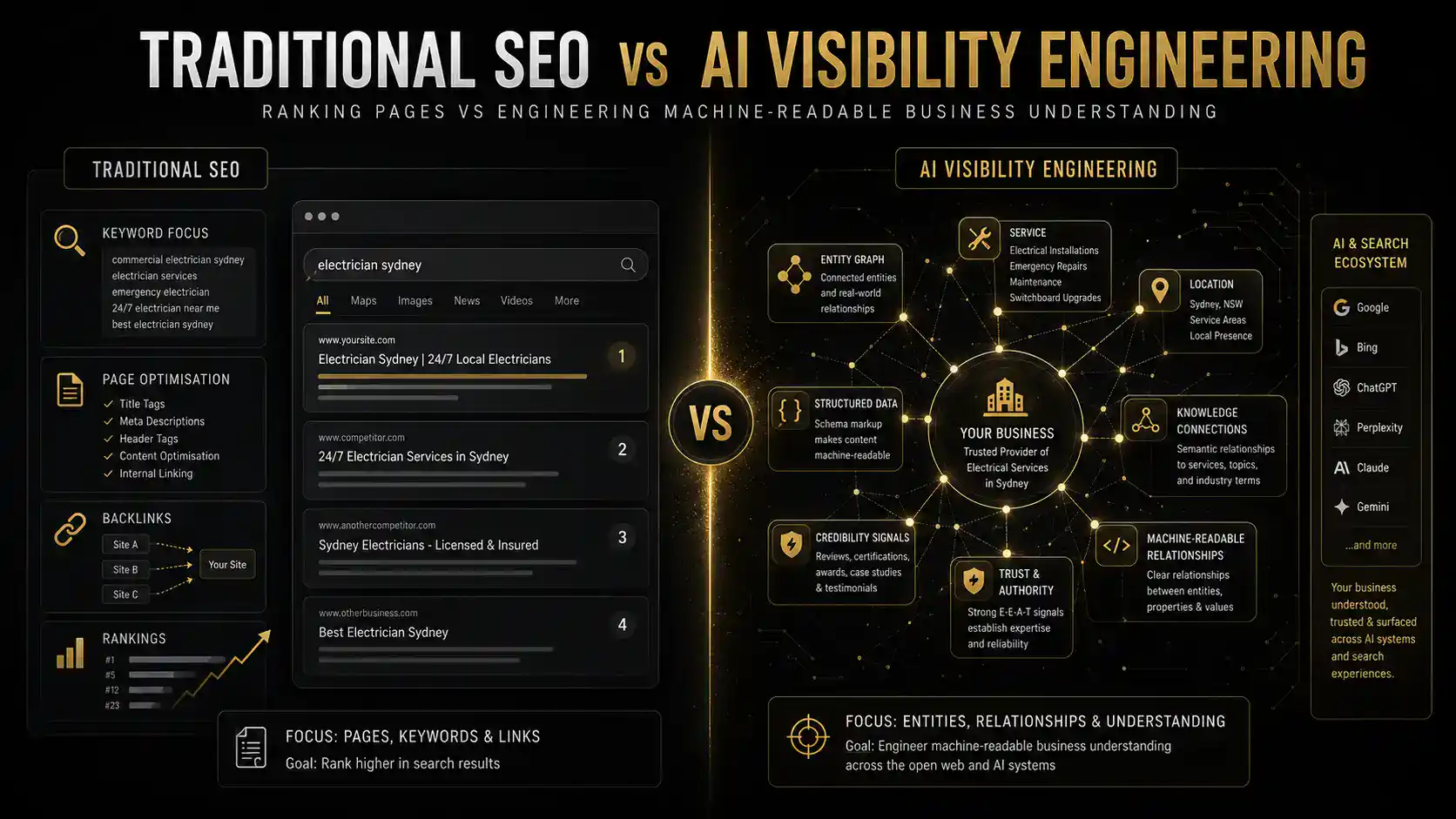
The difference is not simply SEO with a new name
Traditional SEO asks whether a page can rank. AI Visibility Engineering asks whether a machine can correctly understand, verify and select the business behind that page.
That may sound like a small distinction. It is not. It changes the object being optimised.
Traditional SEO has generally worked at page level: choose a keyword, create or improve a page, optimise its headings and metadata, earn links, and try to move it higher in the search results.
AI Visibility Engineering works at business level. It asks whether search engines, large language models and AI answer systems can identify the organisation, connect it to the correct people, services, locations, expertise and evidence, and distinguish it from superficially similar competitors.
Optimise the page
Improve keywords, content, metadata, internal links, authority signals and technical performance so that a particular page has a stronger chance of ranking for a particular search.
Engineer the understanding
Build clear, connected and verifiable information about the business so that machines can understand who it is, what it does, why it is credible and when it should be selected.
Traditional SEO primarily tries to make a page visible. AI Visibility Engineering tries to make the business intelligible.
The two disciplines overlap. Good technical SEO, useful content, crawl accessibility and relevant authority signals remain important. AI Visibility Engineering does not abolish traditional SEO; it extends beneath it and beyond it.
A business may rank for a phrase without being properly understood. Equally, it may begin appearing in deeper, technically specific AI answers before it dominates broad conventional keyword results. Sydney Business Web has documented examples of precisely that behaviour on our AI Visibility success evidence page .
This article explains where the two approaches differ, where they still intersect, and why businesses now need more than a collection of individually optimised pages.
Terms such as entity, grounding, structured data, generative engine optimisation and machine-readable credibility are explained in the Sydney Business Web AI Visibility Glossary .
Technical SEO remains essential. The old dependence on links does not
The weakness in traditional SEO was never its concern with site structure, crawlability or useful content. Its weakness was the enormous influence once granted to signals that could be bought, manufactured or inherited.
Good on-site and technical SEO is not being replaced. Search engines and AI systems still need accessible pages, logical architecture, clear headings, fast delivery, internal linking, accurate content and clean technical implementation.
Those foundations are arguably more important now because both conventional search engines and AI answer systems must retrieve, interpret and connect information before they can use it.
Technical and on-site SEO
Crawlability, indexation, rendering, information architecture, internal links, page relevance, performance and clear commercial intent remain part of the machinery through which a legitimate business becomes discoverable.
Backlink dependence
Relevant authoritative links still matter, but they are no longer the dominant lever they once were. They are now taller trees in a much denser forest of technical, semantic, behavioural, entity and credibility signals.
Traditional SEO was vulnerable to manipulation from the outset
Once links became a powerful proxy for authority, an industry immediately developed around manufacturing them. A business did not necessarily need to be more competent, more established or more trustworthy. It often needed a larger budget and a more aggressive SEO supplier.
This created an obvious credibility problem. A legitimate engineering company, manufacturer, medical practice or professional service could be outranked by a thinner competitor that had purchased more effective links.
Google has spent years reducing its dependence on signals that are easy to manipulate. AI-assisted systems, entity understanding, semantic analysis and cross-source verification give it more ways to assess whether a business appears to be real, coherent and supported by evidence.
The fall in the relative importance of links
Using 0 dB as a rough reference for their practical influence five years ago, we would estimate links today at approximately −6 dB to −8 dB for many searches. That represents roughly 25% to 16% of the former relative power—not an internal Google measurement, but a useful engineering analogy for the scale of the change.
The objective is not simply to replace old SEO tricks with new AI tricks. It is to make it harder for a fabricated authority profile to defeat the accumulated evidence of a legitimate business.
AI Visibility Engineering therefore looks beyond whether a page contains the right phrase. It examines whether the business has a consistent identity, identifiable people, clearly defined services, technical coherence, credible authorship, external corroboration and evidence that supports the claims it makes.
That broader evidence structure is what Sydney Business Web describes as an Intelligent Entity Skeleton supported by an AI Credibility Footprint .
The direction of travel is clear: away from ranking whoever can manufacture the strongest isolated signal, and towards selecting the business whose identity, expertise, relationships and evidence form the most coherent whole.
AI Visibility Engineering builds a machine-readable model of the business
It does not merely optimise a collection of webpages. It engineers the information structure through which search engines and AI systems can determine who the business is, what it does, whether its claims are supported and when it is relevant.
An AI system does not experience a business as a customer does. It cannot walk into the premises, meet the owner, inspect the equipment or observe the work being performed.
It must construct its understanding from available evidence: website content, structured data, business listings, authorship, service descriptions, case studies, reviews, professional history, external references and the relationships connecting them.
AI Visibility Engineering organises those signals into a coherent whole. Its purpose is not to manufacture importance, but to ensure that the genuine identity and competence of a legitimate business are not hidden behind weak architecture, inconsistent data or inaccessible evidence.
The engineering task is to turn scattered business information into a clear, connected and verifiable entity structure that machines can retrieve and reason about.
Entity identity
Establish the business as a distinct real-world organisation with a consistent name, legal identity, location, website, founders, contact information and recognised profiles.
Entity relationships
Connect the business to its people, services, products, industries, locations, qualifications, articles, evidence and areas of expertise.
Evidence and provenance
Support claims with identifiable authorship, case studies, credentials, testimonials, external references and traceable source material.
Machine accessibility
Ensure crawlers can retrieve the information and that important meaning is available through clean HTML, structured data, logical architecture and stable URLs.
Data consistency
Reduce contradictions between the website, profiles, directories, schema and external references so that systems do not encounter competing versions of the same business.
Selection context
Clarify the circumstances in which the business is genuinely relevant: the problems it solves, the customers it serves, the geography it covers and the expertise it can demonstrate.
Two structures working as one system
One organises the business internally. The other establishes the wider evidence that supports and corroborates it.
Intelligent Entity Skeleton
The connected internal model of the organisation: its identity, people, services, products, locations, expertise, content and real-world relationships. It gives machines a coherent structure through which to understand what the business is.
AI Credibility Footprint
The broader body of consistent signals, authorship, credentials, case studies, reviews, references and external corroboration that helps machines judge whether the business and its claims are credible.
The Intelligent Entity Skeleton tells machines what the business claims to be. The AI Credibility Footprint gives them evidence with which to test that claim.
The machine-understanding sequence
Schema is the wiring—not the entire machine
Structured data can describe entities and relationships clearly, but schema cannot create expertise, credibility or evidence that does not exist. It is most valuable when it accurately connects strong visible content, genuine business facts and external corroboration. Markup without substance is merely well-labelled emptiness.
Sydney Business Web describes the connected internal structure of this information as an Intelligent Entity Skeleton . The wider collection of supporting signals, references and corroborating evidence forms the AI Credibility Footprint .
Together, they give machines something more dependable than a keyword-optimised sales page. They provide a structured account of the organisation and a body of evidence against which that account can be checked.
This is why AI Visibility Engineering is properly described as engineering. It involves architecture, data consistency, entity modelling, retrieval access, evidence design and validation—not simply adding fashionable phrases to existing SEO work.
Traditional SEO asks, “Can this page rank?” AI Visibility Engineering adds the harder questions: “Can this business be identified, understood, verified and safely selected?”
Traditional SEO and AI Visibility Engineering solve different layers of the problem
There is considerable overlap between good modern SEO and AI Visibility Engineering. The difference lies mainly in scope, structure and the final decision being influenced.
Traditional SEO
Optimises webpages, categories and websites for specific searches and commercial intentions.
AI Visibility Engineering
Engineers a connected and verifiable model of the business as a real-world entity.
Traditional SEO
Is this page relevant, accessible and authoritative enough to rank for this query?
AI Visibility Engineering
Can the organisation be identified, understood, verified and appropriately selected?
Traditional SEO
Crawlability, indexation, rendering, performance, internal linking and information architecture.
AI Visibility Engineering
Uses the same foundations, then extends them into entity architecture, retrieval access and evidence relationships.
Traditional SEO
Historically depended heavily on backlinks and domain-level authority signals.
AI Visibility Engineering
Treats strong links as useful evidence within a broader network of citations, credentials, consistency, authorship and corroboration.
Traditional SEO
Creates pages aligned with keywords, topics and search intent.
AI Visibility Engineering
Creates evidence-bearing content that defines services, expertise, relationships, provenance and the circumstances in which the business is relevant.
Traditional SEO
Often uses schema to support rich results and clarify individual page content.
AI Visibility Engineering
Uses schema as connective wiring for a persistent site-wide entity graph grounded in visible facts.
Traditional SEO
Improved rankings, impressions, clicks, organic traffic and conversions.
AI Visibility Engineering
More accurate machine understanding, stronger association with relevant expertise, correct representation and selection in AI-mediated answers.
Traditional SEO
A page fails to rank, attracts the wrong traffic or is overtaken by stronger competitors.
AI Visibility Engineering
The system confuses the business, overlooks it, misstates its services or lacks sufficient evidence to select it confidently.
This is an extension—not a rejection
A technically poor website will not become AI-visible merely because somebody adds schema or mentions entities. Good on-site SEO remains the base layer. AI Visibility Engineering adds the identity, relationships, evidence and verification structures that traditional page optimisation was not designed to provide.
Traditional SEO improves the probability that a page will be found and ranked. AI Visibility Engineering improves the probability that the organisation will be correctly understood and chosen.
AI visibility cannot be measured by keyword rankings alone
Traditional SEO measurement is largely numerical and page-based. AI visibility must also examine whether systems are forming the right understanding of the business and using that understanding in relevant answers.
Rankings, traffic and conversions remain important commercial measures. AI answer systems do not make them irrelevant.
But they do introduce additional outcomes that ordinary rank tracking cannot see. A business may be mentioned in an AI answer, identified as possessing a particular capability, cited as a source, compared with competitors or selected in response to a detailed request without holding the number-one conventional result for a broad keyword.
Page and traffic performance
- Keyword positions
- Search impressions
- Organic clicks and sessions
- Click-through rates
- Leads, sales and conversions
Understanding and selection
- Correct business identification
- Accurate description of capabilities
- Association with relevant expertise
- Appearance in unbranded AI answers
- Citation, comparison and recommendation behaviour
What meaningful AI visibility evidence looks like
Unbranded discovery
The business appears for a relevant request without the user naming it in advance.
Accurate representation
The system correctly describes what the business does, where it operates and how it differs from generic competitors.
Technical recognition
Deeper questions surface the business for the specific competence it can genuinely demonstrate, not merely for broad marketing language.
Source selection
Articles, explanations, case studies or framework pages are retrieved as supporting sources for wider questions.
Credibility survival
The business remains present when the request adds filters such as professional, experienced, technically competent or credible.
Concept attribution
Proprietary methods, terminology or expertise are correctly connected to their creator rather than treated as anonymous web content.
Depth can emerge before breadth
Sydney Business Web does not yet dominate broad national keyword searches for every AI visibility term. Yet deeper questions about technically competent AI visibility suppliers in New South Wales have repeatedly surfaced the business, its engineering focus and its proprietary frameworks.
That is an important distinction. Broad keyword reach measures breadth. Accurate selection for detailed, technically demanding questions demonstrates depth of machine understanding.
Examples are recorded on our What AI Visibility Success Looks Like page.
This kind of evidence should be collected systematically: the exact query, date, system used, location where relevant, result shown and whether the answer was accurate.
Patterns matter more than isolated screenshots. One favourable answer may be incidental. Repeated accurate identification across varied, unbranded and increasingly demanding questions is considerably stronger evidence that the underlying entity and credibility signals are being understood.
AI answers are observations—not endorsements
Results can vary by system, location, account, wording and time. Appearance in an AI answer does not constitute certification or approval by Google, OpenAI, Microsoft, Anthropic or any other provider. Honest measurement records observed behaviour without pretending it is guaranteed or permanent.
Traditional SEO asks, “How high did the page rank?” AI visibility measurement must also ask, “What did the machine understand, and did that understanding lead it to the right business?”
Do not abandon SEO. Build beyond it.
A legitimate business does not need a collection of new AI tricks. It needs a stronger technical foundation, a clearer identity and a better-organised body of evidence that machines can retrieve and verify.
The correct response to AI search is not to discard everything learned from technical and on-site SEO. It is to preserve what remains sound and extend the architecture to support machine understanding.
The process should begin with the business itself: what it is, what it genuinely does, who is responsible for its work, where its competence can be demonstrated and which claims can be independently supported.
The goal is not to make a weak business look authoritative. It is to prevent a strong and legitimate business from remaining machine-invisible.
Preserve the technical foundation
Maintain crawlability, indexation, clean HTML, logical site architecture, internal linking, mobile usability, performance and clear page intent. AI systems cannot reliably use information they cannot retrieve or interpret.
Establish the real business entity
Define the organisation consistently across the website: its correct name, legal identity, location, people, services, products, history, areas served and recognised profiles. Remove ambiguity about which business the information describes.
Remove data dissonance
Find and correct contradictions between website pages, schema, business listings, social profiles, old service descriptions, addresses, names and external references. Conflicting facts weaken machine confidence.
Publish evidence, not merely claims
Add meaningful case studies, qualifications, professional histories, methodology, testimonials, project outcomes, named authors and source references. A statement such as “we are experts” is marketing. Evidence explains why it may be true.
Connect the evidence structurally
Use visible content, internal links and accurate structured data to connect the business with its people, services, products, expertise, locations and supporting evidence. Schema should describe the system—not invent it.
Build genuine external corroboration
Pursue relevant supplier listings, professional associations, industry references, media coverage, credible directories and strong editorial links. These remain valuable because they confirm the business beyond its own website—not because links are magical ranking tokens.
Test what machines actually understand
Ask unbranded, increasingly specific questions across relevant AI and search systems. Record whether the business is discovered, described correctly, associated with the right expertise and supported by appropriate sources.
AI Visibility Engineering is not...
Keywords remain useful expressions of user intent. They simply no longer describe the entire optimisation problem.
Adding large quantities of markup to a weak or contradictory website does not create credibility.
No engineer or agency can guarantee selection by changing and independently operated AI systems.
Producing hundreds of generic articles may increase the amount of text while adding very little genuine evidence.
Relevant authority signals still help, but buying volume remains an inadequate substitute for a coherent business entity.
Businesses, services, evidence and AI systems change. Validation and correction must therefore continue.
The order matters. Begin with technical accessibility and factual accuracy. Then establish identity, relationships and evidence. Only after those elements exist should structured data be used to express them more clearly.
Sydney Business Web applies this through three broad phases: diagnose the existing machine-visible identity, engineer the entity and evidence structure, and validate how search and AI systems respond.
Our AI Visibility and Generative Engine Optimisation guide explains the wider methodology, while the AI Visibility services and pricing page outlines the available implementation options.
The legitimate-business advantage
A genuine business usually already possesses the raw material AI systems need: real people, real services, real experience, real customers and real evidence. AI Visibility Engineering makes those facts clearer, more connected and harder to overlook.
Explore the evidence behind the argument
The internal guides below explain how Sydney Business Web applies AI Visibility Engineering. The external references lead to the official documentation supporting the technical and search-policy foundations discussed in this article.
Why these references? They separate Sydney Business Web’s engineering interpretation from the underlying source material. Readers can examine both the argument and the official technical guidance on which parts of it are based.
Traditional SEO is not dead. It is simply no longer the whole engineering problem
Search still needs technically sound websites, relevant pages and credible authority signals. AI-mediated search adds a further requirement: the business itself must become clear, connected, verifiable and machine-readable.
The change is from ranking signals to structured understanding
Traditional SEO developed in an environment where keywords, pages and links carried enormous influence. Its technical foundations remain indispensable, but its heavy historical dependence on backlinks created an industry that was unusually susceptible to manipulation.
AI Visibility Engineering does not make deception impossible. It does, however, give search and AI systems a much broader field of evidence: identity, authorship, relationships, service definitions, credentials, consistency, external corroboration and technical accessibility.
This should favour legitimate businesses—not automatically, and not perfectly, but increasingly—because genuine organisations possess something scammers find difficult to sustain: a coherent history, real people, consistent facts and evidence that survives inspection.
Frequently asked questions
Is AI Visibility Engineering replacing traditional SEO?
No. Technical and on-site SEO remain the foundation. AI Visibility Engineering extends that foundation to include entity identity, machine-readable relationships, evidence, provenance and external corroboration.
Do backlinks still matter for SEO and AI visibility?
Yes. Relevant links from credible and authoritative sources remain meaningful. What has changed is their relative dominance.
Our engineering estimate of approximately −6 dB to −8 dB describes the scale of that decline, not a disclosed Google weighting. Powerful links remain taller trees, but they now stand in a much denser forest of technical, semantic, entity and credibility signals.
Is structured data enough to create AI visibility?
No. Schema can describe facts and relationships clearly, but it cannot manufacture genuine expertise, evidence or credibility. Structured data is the wiring; the business facts, content and corroboration are the substance.
Is AI Visibility Engineering the same as GEO or AEO?
There is overlap. Generative Engine Optimisation and Answer Engine Optimisation generally focus on improving visibility within generated or direct answers.
AI Visibility Engineering is a broader engineering approach concerned with the underlying entity structure, technical access, evidence and credibility that allow those systems to understand and select a business.
Can an agency guarantee that AI systems will recommend a business?
No credible agency can guarantee that. AI systems are independently operated, continuously changing and influenced by wording, location, available sources and system behaviour.
What can be engineered is the quality, consistency, accessibility and verifiability of the information those systems encounter.
Which businesses benefit most from AI Visibility Engineering?
It is particularly valuable for manufacturers, technical suppliers, professional services, complex product catalogues, specialist B2B businesses and organisations whose genuine competence is difficult to express through a few broad keywords.
How should AI visibility success be measured?
Measurement should include conventional rankings and traffic, but also unbranded discovery, correct identification, accurate description, association with relevant expertise, source selection and repeated appearance under credibility filters.
See our documented examples on What AI Visibility Success Looks Like .
Traditional SEO helps a page compete for attention. AI Visibility Engineering helps the legitimate business behind it become understandable, defensible and selectable.
Does AI understand your business—or merely find its webpages?
Sydney Business Web can examine how your organisation, services, people, evidence and technical structure are currently presented to search engines and AI systems—and identify the gaps preventing a coherent machine-readable understanding.