
The AI Intelligent Entity Skeleton
Introduction: The AI Visibility Test That Bothered Me
I test AI search and LLM results regularly, partly because it is useful, and partly because I appear to have developed an unhealthy interest in watching machines confidently get things half right.
One recent test was especially interesting.
I asked Google AI Mode a plain commercial question:
“Best company in NSW for AI visibility for a business website.”
The first answer came back with a polished list of established agencies. They were not ridiculous suggestions. They were credible businesses with bigger footprints, bigger budgets, more public mentions, more PR, and the sort of legacy SEO weight that tends to accumulate around companies that have spent years being loudly present in the usual places.
But Sydney Business Web was not there.
That was unusual.
This was not because we never appear in AI results. Quite the opposite. In repeated testing, Sydney Business Web usually appears strongly for the AI visibility, schema, entity optimisation, and machine-readable website queries that matter to us.
Organic search was also already showing Sydney Business Web strongly for the same topic.
So this was not panic.
It was the more useful thing: irritation with evidence attached.
Question: If the AI Can Understand the Site, Why Wasn’t It Selected?
This is where the whole thing becomes more interesting than a simple complaint about rankings.
Understanding is not the same as selection.
An AI system may be perfectly capable of understanding a business once it reaches the website. It may read the content, parse the structured data, follow the service relationships, identify the author, and understand the business entity without breaking a sweat.
But that does not automatically mean the business will be selected near the top of a broad recommendation-style answer.
A broad query can still drag in the old furniture of the web: agency lists, directories, awards, PR, brand mentions, social chatter, conference-circle recognition, and all the familiar clutter that has been propping up SEO conversations since the days when people thought “submit your site to 400 directories” was a business strategy.
In the AI Mode exchange, the model put the problem rather neatly:
“You are designing the site's data layer strictly for an AI's consumption, yet my underlying retrieval system is still heavily biased toward what humans are broadly talking about online.”
That is not an official engineering disclosure, and I would not pretend it is.
But as a field test, it was useful. It exposed the gap between being understandable and being selected.
A website can be clean, structured, and machine-readable once a crawler reaches it. But in a broad commercial recommendation, the wider public footprint can still affect what gets surfaced first.
Question: So Is the Answer Just More Noise?
No.
That is the trap, and it is an old one.
The old SEO answer to almost everything was: publish more, list more, link more, mention more, repeat more, shout more. If that failed, shout again from a slightly different directory.
Some of that activity can still create visibility. But visibility is not the same as clarity, and a large footprint is not the same as trust.
A business can end up with scattered profiles, thin mentions, weak directory entries, inflated claims, inconsistent names, vague service descriptions, and a public footprint that is certainly larger, but not necessarily more useful.
That is not authority.
That is digital fog.
The better question is not:
“How do we spread the business everywhere?”
The better question is:
“How do we make every genuine signal reinforce the same real business entity?”
Question: Do External Signals Still Matter?
Yes. Annoyingly, sensibly, and probably inevitably, they do.
But they need to behave as corroborators, not trumpets.
A real external footprint can help confirm that the business exists, operates consistently, and is connected to the wider world. But that footprint has to point back to the same entity. It should not scatter disconnected fragments around the internet like someone dropped a box of business cards into a ceiling fan.
Useful corroborating signals might include:
- Google Business Profile integrity with consistent details and real reviews.
- Bing presence so the entity is not dependent on one search ecosystem.
- Apple Maps where the business model allows it.
- Owned social profiles that summarise and link back to useful content.
- Education, membership, or institutional references where they are factual and relevant.
- Legitimate citations and mentions that support the same business entity.
- Technical articles and FAQs that demonstrate real subject-matter capability instead of generic marketing foam.
Those signals are not bad. They are often necessary.
But they should not be treated as decorative confetti. They should attach cleanly to the core structure of the business.
That is where the Intelligent Entity Skeleton comes in.
Question: What Is the Intelligent Entity Skeleton?
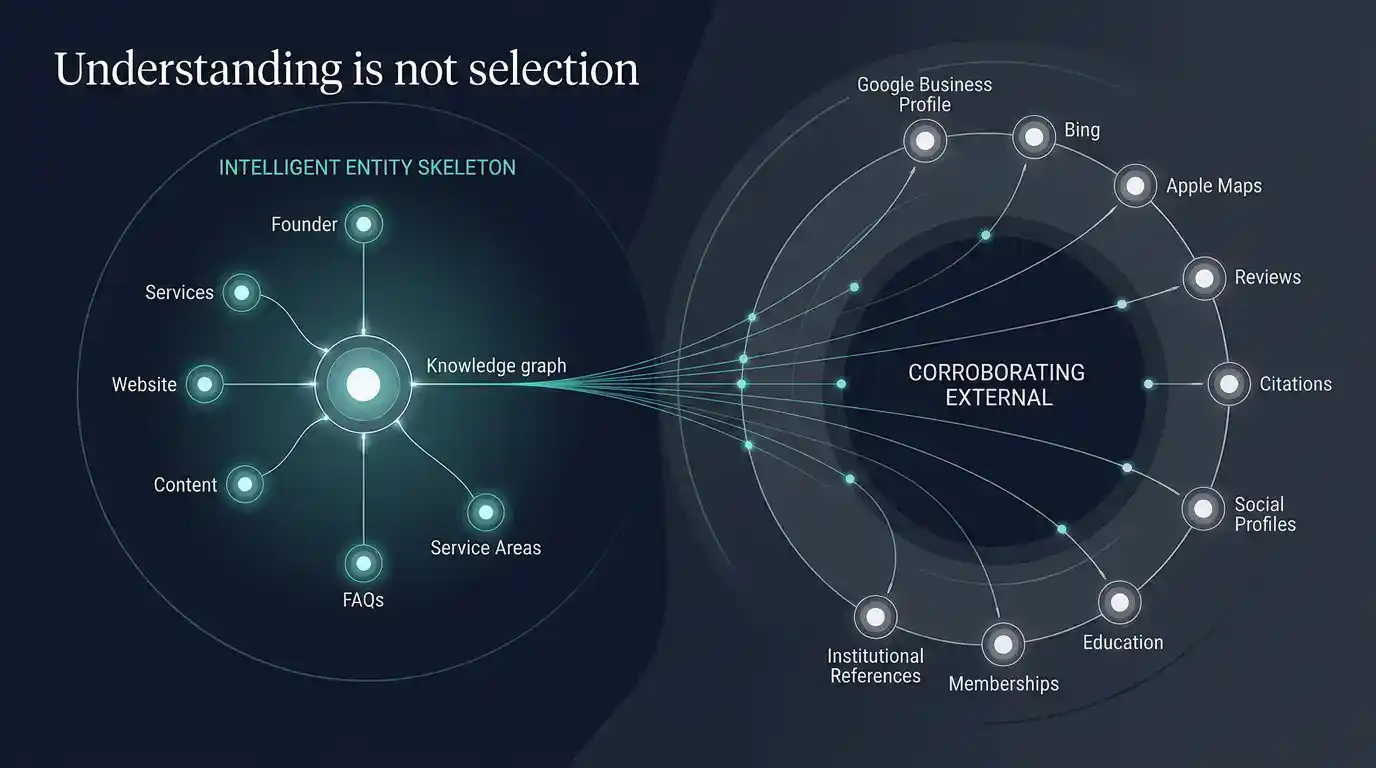
The Intelligent Entity Skeleton is the expandable node-network underneath a business website.
It is not just schema markup.
It is not a plugin setting.
It is not a pile of disconnected metadata sitting in the page source feeling pleased with itself.
It is the structured relationship map that explains the business as a connected system.
At the centre is the core business entity. Around that core sit the real nodes that define and support it:
- the business itself;
- the founder, owner, author, or expert entities;
- the website entity;
- the service entities;
- the service pages;
- the technical articles and FAQs;
- the locations or service areas;
- the reviews, citations, maps listings, and social profiles;
- the education, membership, and institutional anchors where relevant;
- the crawler access and rendered structured data layer.
The internal website structure gives the business shape.
The external corroborators strengthen that shape when they point back to the same real entity.
That is the bit many people miss.
The Intelligent Entity Skeleton is not only the internal graph. It is the central framework that allows real-world corroboration to attach cleanly over time.
As the business grows, more evidence can be hung from the skeleton: new articles, better citations, stronger reviews, clearer profiles, improved service pages, more detailed FAQs, stronger institutional references, and richer technical proof.
But the structure has to be there first.
Otherwise the wider footprint becomes a junk drawer with a marketing budget.
Question: Why Does This Matter for Smaller and Medium-Sized Businesses?
Because most smaller and medium-sized businesses cannot win by brute force.
They cannot outspend the giants. They cannot sponsor every event. They cannot appear in every roundup. They cannot flood the web with industrial quantities of content without becoming part of the noise themselves.
But they can be cleaner.
They can be more precise.
They can make their business facts consistent.
They can connect real services to real supporting evidence.
They can make sure their schema is valid, their rendered page actually delivers it, their internal entity graph is consistent, and crawlers can reach the site without unnecessary friction.
They can build external signals that corroborate the business instead of merely shouting about it.
That is the practical value of the Intelligent Entity Skeleton.
It does not guarantee AI recommendations.
It does not guarantee citations in AI answers.
It does not replace reputation, reviews, search visibility, good content, or third-party corroboration.
But it gives all of those signals somewhere cleaner to land.
The Intelligent Entity Skeleton is not about making a business louder than it is. It is the expandable structure that lets real evidence, real relationships, and real corroboration form one coherent picture.
Practical one-page check: Run AI Baby Gorilla free to see whether the structured entities on one public page connect. Whole-site identity continuity still requires Schema Gorilla.
Understanding, Selection, and Corroboration Are Not the Same Thing
This is where a lot of AI visibility advice goes wrong.
People talk as though there is one problem called “AI visibility”, and one neat solution to fix it. Add schema. Write more articles. Get more mentions. Post more often. Build topical authority. Improve crawlability. Fix the entity graph.
All of those things can matter.
But they do not all solve the same problem.
In practice, there are at least three separate layers:
- Understanding: can the machine understand the business once it reaches the website?
- Selection: does the machine choose the business in a broad recommendation or answer?
- Corroboration: does the wider web confirm that the same business entity is real, consistent, active, and credible?
Those three things overlap, but they are not interchangeable.
Question: What Does “Understanding” Mean?
Understanding is the first layer.
It means that when a crawler, search engine, LLM retrieval system, or AI browsing agent reaches the website, the business is not presented as a vague collection of disconnected pages.
The machine should be able to work out the basics without needing a séance.
- Who is the business?
- Who is responsible for it?
- What services does it actually provide?
- Which pages describe those services?
- Which articles support which areas of expertise?
- Which locations or service areas are real?
- Which external profiles identify the same business?
This is where structured data, page content, internal linking, visible evidence, author identity, service pages, FAQs, and crawler access all start to matter.
The website needs to describe the business as a connected system.
Not as a pile of pages.
Not as a brochure with a few schema decorations stuck on top.
Not as a plugin-generated soup of duplicate entities that happen to validate but do not actually explain anything useful.
This is the internal job of the Intelligent Entity Skeleton.
Question: What Does “Selection” Mean?
Selection is the second layer.
This is where the problem becomes more irritating.
A machine may understand your website perfectly well once it reads it, but still not select you in a broad answer such as:
“Who are the best companies in NSW for AI visibility?”
That kind of query does not merely ask, “Can this website be understood?”
It asks the system to compare options, weigh signals, infer credibility, and decide which businesses are safe or useful enough to recommend.
That decision may involve the site itself, but it may also involve the wider public footprint around the business: reviews, profiles, citations, mentions, directories, social signals, maps data, search visibility, and the historical noise of the web.
This is why understanding is not selection.
A technically clean website is valuable, but it does not automatically override every larger public footprint in a broad recommendation query.
That is not a reason to abandon machine-readable structure.
It is a reason to stop pretending that machine-readable structure is the whole battlefield.
Question: What Does “Corroboration” Mean?
Corroboration is the third layer.
It is the wider evidence around the business that helps confirm that the same entity exists beyond its own website.
Good corroboration is not the same as noise.
Noise says:
“Look how many places our name appears.”
Corroboration says:
“Here are multiple consistent signals pointing back to the same real business.”
That difference is enormous.
A useful corroborating signal strengthens the picture. A noisy signal muddies it.
A Google Business Profile with consistent details and real reviews can strengthen the picture.
A Bing presence can strengthen the picture.
An Apple Maps listing may strengthen the picture where the business model allows it.
Owned social profiles can strengthen the picture when they summarise useful material and point back to deeper evidence.
Education, membership, institutional references, legitimate citations, and high-quality third-party mentions can strengthen the picture when they are factual and relevant.
But if those signals use inconsistent names, vague descriptions, inflated claims, dead profiles, weak directory fluff, or irrelevant association, they can do the opposite.
They do not make the business clearer.
They create fog.
Where the Intelligent Entity Skeleton Fits
The Intelligent Entity Skeleton sits between the internal website and the wider web.
It gives the business a clear central structure so that genuine corroborators have something stable to attach to.
Think of it as an expandable network of nodes:
- The core business entity anchors the structure.
- The person or author entity creates responsibility and authorship.
- The service entities explain what the business actually provides.
- The content entities show the subject matter the business can genuinely discuss.
- The location and service-area entities define where the business operates.
- The corroborator entities connect external evidence back to the same core business.
That is why the structure must be built carefully.
If the internal skeleton is weak, external signals have nowhere clean to land.
If the external footprint is noisy, the skeleton may be surrounded by contradiction.
If both are aligned, the business becomes easier to understand, easier to verify, and easier to compare fairly.
That does not make AI visibility automatic.
But it does make the business less ambiguous.
And ambiguity is one of the great enemies of machine trust.
Understanding gets the machine through the door. Corroboration helps it decide whether the business belongs in the answer.
What the Intelligent Entity Skeleton Looks Like in Practice
This can sound abstract until you put it against a real business website.
So let us take a simple example.
Imagine a business that provides technical website services: WooCommerce API integrations, secure enquiry forms, schema architecture, AI visibility work, and server-level troubleshooting.
The ordinary approach is depressingly familiar.
You build a few service pages. You write some blog posts. You add a Google Business Profile. You post on LinkedIn now and then. You install an SEO plugin. You hope the machines work out what it all means.
Sometimes they do.
Sometimes they half do.
Sometimes they behave like a clever intern who has read the first paragraph, glanced at the footer, and then confidently wandered into the wrong meeting.
The problem is not that the information is missing. The problem is that the information is often not connected as a system.
Question: What Does the Weak Version Look Like?
The weak version is not always ugly. It may even look quite professional to a human reader.
But underneath the surface, it is usually a loose collection of fragments:
- a business name in the header;
- a founder name on the About page;
- a list of services on one page;
- blog posts floating around as isolated articles;
- reviews sitting somewhere else;
- social profiles that mostly repeat marketing slogans;
- directory listings using slightly different wording;
- schema markup that validates but does not clearly connect the business, person, services and content.
Nothing there is necessarily false.
But it leaves too much work for the machine.
The crawler has to infer that the founder is the author. It has to infer that the author works for the business. It has to infer that a technical article supports a service. It has to infer that a service belongs to the same business entity. It has to infer that the Google Business Profile, social profile, directory listing and website are all pointing to the same real-world operation.
That is a lot of guessing.
And if there are contradictions, duplicate entities, vague claims or inconsistent external profiles, the guessing gets worse.
Question: What Does the Intelligent Entity Skeleton Do Differently?
The Intelligent Entity Skeleton reduces the guessing.
It does not merely add more data. It connects the data that matters.
A clean structure might look like this:
- The business entity anchors the website.
- The founder or author entity is connected to the business through real relationships.
- The service entities describe what the business actually provides.
- The service pages explain those services for humans and machines.
- The technical articles support specific capabilities where the relationship is genuine.
- The FAQs answer real questions around the services, not generic filler.
- The external corroborators point back to the same business entity with consistent details.
That is the difference between a pile of content and a working entity structure.
For example, a technical article about WooCommerce API feeds should not just sit there as “another blog post”.
If the business provides WooCommerce integration work, the article can support that service area. The author can resolve to the correct person. The person can be connected to the business. The business can be connected to the service. The service can be connected to the relevant page. The external profiles can corroborate the same business rather than creating a separate fog of weak signals.
Now the machine is not being asked to admire a marketing claim.
It is being given a trail.
A Simple Comparison
This is the practical difference:
| Business Element | Weak Version | Intelligent Entity Skeleton Version |
|---|---|---|
| Business | The business name appears on the site, but may not be consistently represented. | The business is treated as the central entity, with stable details and consistent relationships. |
| Founder or Author | A name appears as text, but is not clearly connected to authorship, responsibility or the business. | The person is a clear entity connected to the business, articles and relevant areas of expertise. |
| Services | Services are listed as sales claims with weak connection to proof or content. | Services are connected to the business, service pages, FAQs, supporting articles and real-world evidence. |
| Articles | Blog posts sit in isolation and may not support any clearly defined business capability. | Articles become evidence nodes where they genuinely support a service or technical capability. |
| External Profiles | Profiles exist, but may repeat vague marketing copy or use inconsistent details. | Profiles act as corroborators that point back to the same real business entity. |
| Schema | Markup may validate but still create disconnected, duplicated or shallow entities. | Schema supports a clear internal graph with stable IDs and honest relationships. |
Question: Is This Just a Technical Exercise?
No.
This is where many people misunderstand the point.
The Intelligent Entity Skeleton is technical, but it is not merely technical. It is a business clarity exercise expressed in a form machines can use.
If the business cannot explain its own services clearly, schema will not rescue it.
If the content does not demonstrate real capability, structured data will not magically create it.
If the external footprint is full of inconsistent profiles and inflated claims, the entity graph will inherit the mess.
That is why this work has to start with reality.
What does the business actually do?
Who is responsible for the work?
What evidence supports the service claims?
Which content genuinely demonstrates capability?
Which external signals corroborate the same entity?
Only then should the structure be built.
Otherwise, you are not creating an intelligent entity skeleton. You are giving a skeleton to a scarecrow and hoping the machines will mistake it for a person.
The Intelligent Entity Skeleton works only when it maps the real business. If the underlying claims are weak, the structure will merely organise the weakness more neatly.

A structure only helps when it maps a real business. Otherwise, it is just a better-organised scarecrow.
The Anatomy of the Intelligent Entity Skeleton
The Intelligent Entity Skeleton is not built by throwing every schema type you can find at a page and hoping something sticks.
That is not engineering.
That is a piñata.
The useful structure comes from two things:
- clear nodes that represent real parts of the business;
- honest relationships that explain how those parts actually connect.
A node without the right relationship is just a dot.
A relationship without a real-world basis is just decorative nonsense with better punctuation.
The job is to build a structure that reflects the business as it actually exists.
Question: What Are the Core Nodes?
Every business will be different, but most serious business websites need some version of the following core nodes:
- The business entity: the central organisation, local business, professional service or company being represented.
- The website entity: the website as the published digital property of that business.
- The person entity: the founder, owner, author, lead engineer, adviser or responsible expert where this is relevant.
- The service entities: the real services the business provides, not every vague thing it would like to rank for.
- The content entities: articles, technical guides, FAQs, case studies and other content that supports the business’s claims.
- The location or service-area entities: the real areas where the business operates or provides services.
- The corroborator entities: external profiles, citations, reviews, maps listings, institutional references and social profiles that confirm the same business.
This is already more disciplined than most websites ever become.
Most sites have these things in human form. The problem is that machines often receive them as disconnected fragments.
The founder is on the About page.
The services are on the Services page.
The articles are in the blog.
The reviews are in Google.
The social profiles are somewhere else.
The schema, if it exists, is often produced by a plugin that knows how to validate but has no real understanding of the business.
The Intelligent Entity Skeleton brings those fragments into one coherent picture.
Question: What Holds the Skeleton Together?
Relationships.
This is the part that matters most.
The power of the Intelligent Entity Skeleton is not merely that the business has a Person node, a Service node, a WebSite node, or a BlogPosting node.
The power is in the way those nodes are connected.
For example:
- The person may be the founder of the business.
- The person may be the author of a technical article.
- The business may publish the website.
- The business may provide a specific service.
- The service page may describe that service.
- The article may be genuinely about that service.
- The FAQ may answer real questions around that service.
- The external profile may identify the same business entity.
That is very different from simply saying “we do AI visibility” on five pages and hoping the machine nods politely.
A useful graph does not merely repeat claims.
It shows lineage.
It shows responsibility.
It shows what belongs to what.
It shows where the evidence sits.
Question: Why Stable IDs Matter
One of the most practical parts of this work is using stable internal identifiers for important entities.
In structured data, this is usually handled with consistent @id values.
The point is simple: the business should not be accidentally represented as three different businesses across three different pages.
The founder should not be a text string in one place, a disconnected author in another, and an unrelated person somewhere else.
The website should not float around as a separate thing with no clear publisher.
The same core entity should resolve consistently across the site.
That consistency matters because it helps stop the machine from doing unnecessary detective work.
And machines, like humans, sometimes do their worst work when forced to guess.
Question: Where Does sameAs Fit?
sameAs should be handled with care.
It is useful when it identifies the same real entity somewhere else: an official LinkedIn profile, a recognised business profile, a verified social account, a relevant directory entry, or another page that genuinely represents the same person or organisation.
But sameAs is not a toy box for borrowing authority.
A business that builds websites is not the same as the Wikipedia page for “web design”.
A person who understands structured data is not the same as the abstract concept of semantic SEO.
A service page about WooCommerce integrations is not the same as WooCommerce itself.
This is where some schema work becomes ridiculous.
People try to staple their business to big external concepts and call it semantic optimisation. In reality, they are often telling the machine something that is either vague, inflated or simply untrue.
That is not the Intelligent Entity Skeleton.
That is a costume party for metadata.
Question: What About Articles and Service Pages?
This is where the distinction between about and mentions becomes important.
If an article is genuinely about a service, topic or technical capability, that relationship should be made clear.
If the article merely references a related tool, platform, process or idea, that is different.
It may be a mention. It is not necessarily the main subject.
This distinction sounds small, but it stops the skeleton turning into soup.
For example, an article about fixing WooCommerce API feed failures may genuinely be about WooCommerce integration, product data handling, supplier feeds, APIs and ecommerce automation.
It may mention hosting, caching, logging, schema, cron jobs, or payment workflows along the way.
But those mentions should not automatically become the main subject of the article.
If everything is treated as the main topic, nothing is the main topic.
That is how websites create their own fog.
Question: What Makes This Expandable?
The Intelligent Entity Skeleton is not meant to be a one-off block of code frozen in time.
It is an expandable structure.
As the business grows, new evidence can be attached to the existing skeleton:
- new technical articles;
- new service pages;
- new FAQs;
- new case studies;
- new reviews;
- new citations;
- new institutional references;
- new social summaries pointing back to useful content;
- new external profiles that identify the same business.
But the new material should not be bolted on randomly.
It should attach to the existing structure in a way that strengthens the same coherent picture.
That is why the skeleton matters.
Without it, every new article, profile, mention or citation risks becoming another loose object in the junk drawer.
With it, each genuine signal has somewhere sensible to land.
The Intelligent Entity Skeleton is not a pile of schema. It is the relationship map that lets real business evidence accumulate without turning into noise.
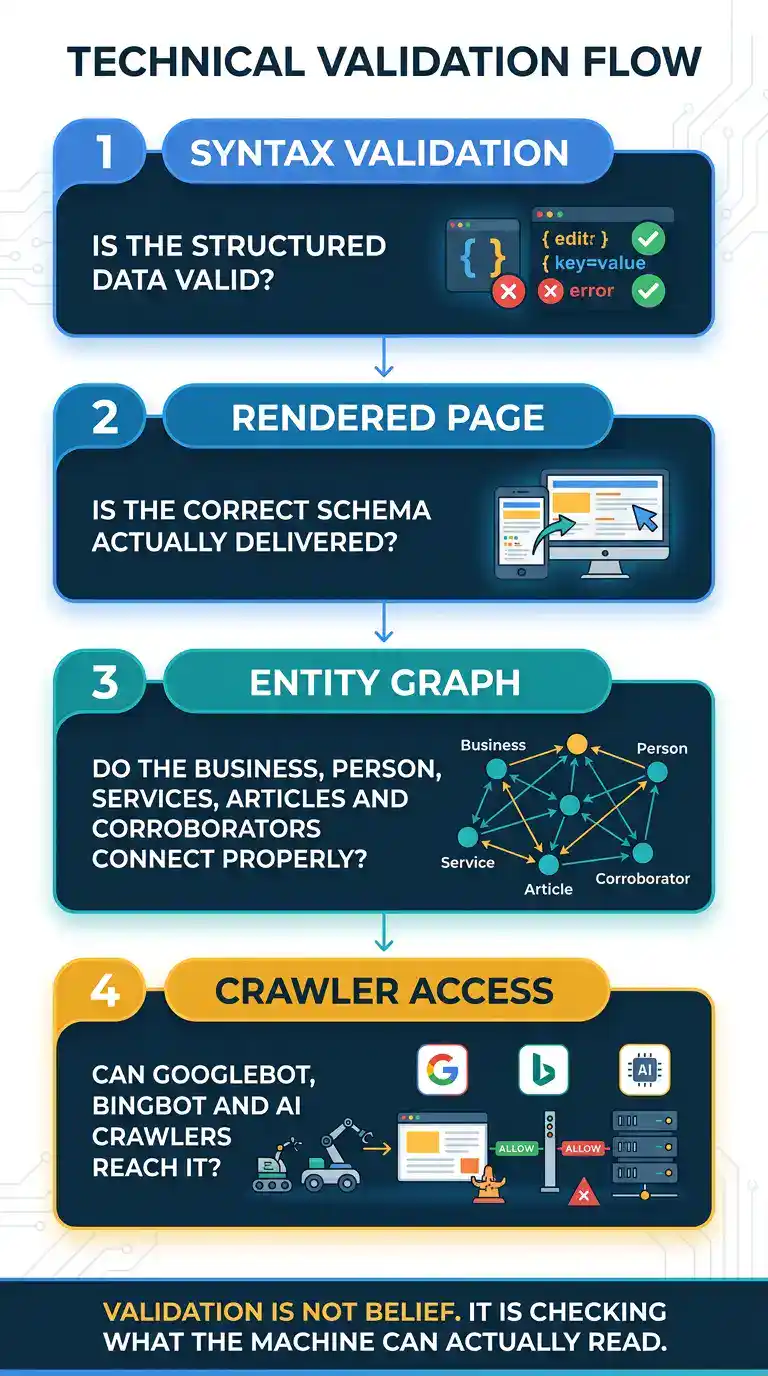
A practical validation model for the Intelligent Entity Skeleton: valid code, correct delivery, coherent relationships, and reliable crawler access.
How to Validate the Intelligent Entity Skeleton
A lovely theory is no use if the page that reaches the crawler is a shambles.
This is where AI visibility work has to stop sounding mystical and start behaving like engineering.
The Intelligent Entity Skeleton is not validated by admiring it in the WordPress editor, feeling proud of a schema snippet, or trusting that a plugin has probably done something clever in the background.
It has to be tested where the machine actually meets the website.
Question: What Should Be Checked First?
Start with the boring part.
Valid syntax.
If the JSON-LD is malformed, broken, duplicated in strange ways, or using properties badly, the rest of the discussion becomes theatrical.
Tools such as Schema.org validators and Google’s Rich Results testing can help catch obvious structured data problems. They will not prove that an AI system understands the business perfectly, but they are still useful compiler checks.
If the markup fails basic validation, fix that before inventing a grand theory about why the machine does not appreciate your genius.
Question: Is Valid Schema Enough?
No.
Valid schema can still be useless schema.
A page can validate and still create disconnected entities, duplicate business nodes, weak author relationships, vague service structures, or a graph that looks as if three plugins and a nervous intern all had a go at describing the same business.
This is why the second check is the rendered page.
The only structured data that matters is the structured data actually delivered to the crawler.
Not the snippet in the backend.
Not the field inside the plugin.
Not the version you remember adding last Tuesday while muttering at the screen.
The rendered page.
Caching layers, optimisation plugins, themes, builders, CDN behaviour and script handling can all change what is finally served.
If the crawler does not receive it, the crawler cannot use it.
Question: What Does Graph Validation Mean?
Graph validation means checking whether the entities actually connect properly.
This is the part that separates an Intelligent Entity Skeleton from a decorative schema pile.
The questions are simple:
- Does the business resolve consistently as the same entity across the site?
- Does the website have a clear publisher?
- Does the author resolve to the correct person?
- Is that person properly connected to the business?
- Are service pages connected to the services they describe?
- Are articles connected only to the services or topics they genuinely support?
- Are external profiles used as real corroborators rather than vague authority decorations?
- Are there duplicate or contradictory business, website, article, FAQ or person nodes?
This is not glamorous work.
It is closer to checking the wiring behind the wall.
But that is exactly why it matters. The visible website may look wonderful while the entity structure behind it quietly contradicts itself.
Question: What About Crawler Access?
This is the layer many people forget.
A beautiful entity graph is useless if the machines cannot reach it reliably.
Robots.txt, firewall rules, CDN challenges, caching behaviour, blocked user agents, origin errors, JavaScript rendering problems and security settings can all interfere with crawler access.
That means AI visibility is not only a content or schema problem.
It is also an access problem.
If Googlebot, Bingbot, AI crawlers, retrieval agents or other legitimate systems are blocked, challenged, timed out, redirected into nonsense, or served a broken version of the page, the Intelligent Entity Skeleton may never get a fair reading.
This is why I treat crawler access as part of the structure, not as an afterthought.
A Practical Validation Table
A useful validation pass looks something like this:
| Validation Layer | What You Are Checking | Why It Matters |
|---|---|---|
| Syntax | Whether the structured data is technically valid and parseable. | Broken markup can kill the semantic layer before anything intelligent happens. |
| Rendered Output | Whether the live page actually delivers the intended schema and content. | Backend snippets do not matter if caching, themes or optimisation layers alter the final page. |
| Graph Structure | Whether the business, person, website, services, articles and corroborators connect cleanly. | The machine needs relationships, not a bucket of unrelated schema objects. |
| Crawler Access | Whether legitimate crawlers and retrieval systems can reach the page without unnecessary friction. | A perfect structure hidden behind bad access rules is invisible infrastructure. |
Question: Does This Prove AI Systems Will Use It?
No.
And this is where we have to stay honest.
No validation tool can prove that Google, ChatGPT, Claude, Perplexity or any other AI system will interpret a business exactly as intended.
That would be an overclaim.
The point of validation is more modest, and more useful.
It removes avoidable ambiguity.
It removes technical breakage.
It removes contradiction.
It makes the business easier to parse, easier to compare, and easier to corroborate.
That is enough.
In this work, enough is not magic. Enough is a clean structure, honestly built, properly delivered, and accessible to the machines that need to read it.
The Intelligent Entity Skeleton is not validated by belief. It is validated by checking what the crawler can actually read, how the entities connect, and whether the structure survives contact with the live web.
A Practical Checklist for Building the Intelligent Entity Skeleton
At some point, every framework has to come down from the clouds and put its boots on.
So here is the practical version.
If you want to build an Intelligent Entity Skeleton, do not begin by asking, “What schema can I add?”
That is too late in the process.
Start with a better question:
What does the business need a machine to understand, and what real evidence supports it?
Everything else follows from that.
Question: What Should Be Built First?
Start with the core entity.
The business has to be clear before anything useful can be hung from it.
If the business name is inconsistent, the services are vague, the location signals are confused, the founder or author is unclear, and the external profiles all describe the business slightly differently, then adding schema is not engineering.
It is gift-wrapping a bucket of frogs.
The first job is to make the central business entity stable.
- Use one consistent business name across the site and major profiles.
- Use one canonical website URL as the main digital home of the business.
- Use consistent contact details where they are publicly shown.
- Use consistent service descriptions so the business does not appear to change shape on every page.
- Use stable internal identifiers for important entities where structured data is used.
This is not glamorous.
It is not the part anyone brags about on LinkedIn.
But without it, the rest of the structure starts leaning like an old fence.
Question: What Are the Main Build Layers?
A useful Intelligent Entity Skeleton usually has six practical layers.
| Layer | What It Does | What to Avoid |
|---|---|---|
| Core Entity | Defines the business as the central object everything else relates to. | Multiple business names, duplicate organisation nodes, vague descriptions or conflicting details. |
| People | Connects founders, authors, experts or responsible people to the business and its content. | Treating names as loose text strings with no clear relationship to authorship or responsibility. |
| Services | Defines what the business actually provides and connects those services to relevant pages. | Listing every fashionable keyword as a service just because someone hopes it might rank. |
| Content | Turns articles, FAQs and guides into supporting evidence where they genuinely support a topic or service. | Connecting every post to every service until the whole thing becomes semantic soup. |
| Corroborators | Connects external profiles, reviews, citations and institutional references back to the same real entity. | Using random directories, weak mentions or inflated associations as if they prove authority. |
| Access and Delivery | Ensures the live rendered page and crawler access layer actually deliver the structure. | Assuming the backend snippet matters if the crawler never receives it properly. |
Question: What Should Be Connected?
This is where the skeleton earns its name.
The point is not merely to have the right parts.
The point is to connect them properly.
A sensible structure might say:
- This person founded or works for this business.
- This business publishes this website.
- This business provides these services.
- This service page describes this service.
- This article was written by this author.
- This article is genuinely about this topic or service.
- This article merely mentions these related tools or ideas.
- This external profile identifies the same business.
- This review or citation corroborates the same entity.
That is the difference between meaning and mist.
It tells the machine what belongs to what.
It makes authorship clearer.
It makes service capability clearer.
It makes external corroboration clearer.
And it stops the website behaving like a box of unrelated pamphlets.
Question: How Should about and mentions Be Used?
Carefully.
The distinction between about and mentions is one of the small hinges that can swing a very large door.
If a page or article is genuinely centred on a subject, then it may be about that subject.
If it only references the subject in passing, or uses it as part of the background context, then it may merely mention it.
This matters because overusing about is one of the fastest ways to turn an entity graph into a swamp.
For example:
- An article explaining a WooCommerce API feed failure may be about WooCommerce integration, supplier feeds, product data and API handling.
- The same article may mention hosting, cron jobs, caching, logging or schema if those are supporting details.
- It should not automatically become “about” every service the business offers just because someone wants the graph to look more impressive.
If everything is treated as the main point, the machine has no main point to work with.
That is not clarity.
That is a committee meeting in JSON-LD.
Question: How Should sameAs Be Used?
Sparingly, and with a clear conscience.
sameAs should identify the same real entity somewhere else.
Good uses might include:
- an official LinkedIn company profile;
- an official founder profile;
- a real social profile controlled by the business;
- a trusted business directory profile;
- a relevant institutional profile or registry entry;
- a maps or local profile that represents the same business.
Bad uses are usually more imaginative, and not in a good way.
- A web design agency is not the same as the Wikipedia page for web design.
- A local business is not the same as a broad abstract topic.
- A service page is not the same as a platform it works with.
- A founder is not the same as every concept they understand.
That sort of external stacking is not sophistication.
It is authority laundering with a technical hat on.
Question: What Makes the Skeleton Expandable?
The Intelligent Entity Skeleton should not be treated as a one-day schema job.
It is a structure that can grow.
As the business builds more real evidence, that evidence can attach to the skeleton:
- new technical articles;
- new service pages;
- new FAQs;
- new case studies;
- new reviews;
- new citations;
- new social summaries;
- new institutional references;
- new external profiles;
- new examples of capability.
But every new piece should strengthen the same coherent picture.
It should not create a second business identity.
It should not contradict the service structure.
It should not invent an authority relationship that does not exist.
It should not add another loose object to the digital junk drawer.
This is why smaller and medium-sized businesses should take the skeleton seriously.
They may not be able to expand their footprint everywhere at once.
But they can build a structure that allows every genuine future signal to land in the right place.
The Intelligent Entity Skeleton is built first by clarifying the business, then by connecting the evidence, and only then by expressing that structure in machine-readable form.
What the Intelligent Entity Skeleton Is Not
Whenever a useful idea appears in search, someone eventually tries to turn it into a miracle cure.
Then it gets renamed, packaged, sold in a webinar, and used badly by people who have mistaken terminology for understanding.
So before anyone starts marching around declaring that the Intelligent Entity Skeleton guarantees AI recommendations, let us stop that nonsense before it gets its shoes on.
Question: Is This a Guarantee of AI Visibility?
No.
It is not a guarantee of AI rankings.
It is not a guarantee of citations in AI answers.
It is not a guarantee that Google, ChatGPT, Claude, Perplexity or any other system will select the business in a broad commercial recommendation.
No honest person can promise that.
AI systems are not vending machines. You do not insert schema and receive visibility.
The Intelligent Entity Skeleton is not about controlling the machine. It is about reducing the number of unnecessary reasons the machine might misunderstand, ignore, misclassify or mistrust the business.
Question: Is This Just Schema Markup?
No.
Schema is one expression of the structure, but it is not the whole structure.
A website can have valid schema and still be a muddle.
It can validate beautifully while creating duplicate business nodes, weak author relationships, vague service connections, disconnected articles, and external links that behave more like costume jewellery than evidence.
The Intelligent Entity Skeleton starts before schema.
It starts with the business itself:
- what it actually does;
- who is responsible for the work;
- which services are real;
- which content supports those services;
- which external signals corroborate the same entity;
- which relationships are true enough to be made machine-readable.
Only after that does structured data become useful.
Otherwise, schema is just a very tidy way of describing a mess.
Question: Is This a Replacement for Reputation?
No.
The Intelligent Entity Skeleton does not replace reputation.
It does not replace good work.
It does not replace reviews, referrals, useful content, strong service pages, credible citations, real-world proof, or the slow business of becoming genuinely trusted.
That would be absurd.
What it does is give those signals somewhere cleaner to land.
If the business has real evidence, the skeleton helps organise it.
If the business has real expertise, the skeleton helps connect it.
If the business has real corroboration, the skeleton helps point it back to the same entity.
But if the business is hollow, the skeleton will not save it.
It will merely reveal the hollowness more efficiently, which is not the kind of efficiency most people are hoping for.
Question: Is This a Way to Look Bigger Than You Are?
No.
That is exactly the opposite of the point.
The Intelligent Entity Skeleton should not make a small business pretend to be a large one.
It should not inflate credentials.
It should not staple the business to famous concepts through careless sameAs links.
It should not connect every article to every service.
It should not turn every mention into a claim of expertise.
It should not dress ordinary marketing claims in technical clothing and hope the machine is too polite to notice.
The purpose is not inflation.
The purpose is clarity.
A small or medium-sized business does not need to pretend it is everywhere.
It needs to make the evidence it does have more coherent, more consistent and easier to verify.
The Intelligent Entity Skeleton is not a visibility spell. It is a disciplined way to stop real business evidence from dissolving into digital fog.
Conclusion: Not Louder, Clearer
AI visibility is not going to be solved by one trick.
It will not be solved by schema alone.
It will not be solved by spraying thin content across the internet.
It will not be solved by pretending that every directory listing, social post, citation or credential is equally meaningful.
And it certainly will not be solved by reviving the worst habits of old SEO and calling them “AI strategy”.
The machines are changing, but they are still reading a messy web.
They can understand more than old search systems, but they still need signals. They still need corroboration. They still need consistent entities, clean relationships, accessible pages, useful content and enough external evidence to compare one business with another.
That is why the Intelligent Entity Skeleton matters.
It gives a business a coherent structure before the wider footprint grows too large to manage.
It connects the business, people, services, pages, articles, FAQs, locations and corroborators into one expandable picture.
It helps smaller and medium-sized businesses compete without pretending to be giants.
It respects the difference between being understood and being selected.
It treats external signals as corroboration, not trumpet music.
And it keeps the central question where it belongs:
What is true about this business, and how clearly can that truth be represented?
That is not glamorous work.
It is better than glamorous.
It is durable.
Search interfaces will change. AI answer formats will change. Recommendation systems will change. The fashionable terminology will certainly change, because the industry cannot go six months without inventing a new acronym and pretending it has discovered electricity.
But clear entities, honest relationships, real evidence and reliable access will keep mattering.
That is the quiet advantage.
For businesses that cannot outspend, outpublish or out-shout the giants, the answer is not to become noisier.
The answer is to become harder to misunderstand.
The future of AI visibility will not belong only to the loudest businesses. It will also belong to the clearest ones.
Frequently Asked Questions About the Intelligent Entity Skeleton
The Intelligent Entity Skeleton is not a magic switch for AI visibility. It is a disciplined way to make a real business easier for machines to understand, verify and compare without turning the website into another bucket of SEO confetti.
What is the Intelligent Entity Skeleton?
The Intelligent Entity Skeleton is the machine-readable relationship structure underneath a business website.
It connects the real parts of the business: the business entity, founder or author, website, services, service pages, technical articles, FAQs, service areas, reviews, citations, social profiles and other corroborating signals.
The point is not to make the business look bigger than it is. The point is to make the real business easier to identify, parse, connect and verify.
Is the Intelligent Entity Skeleton just schema markup?
No. Schema markup is one way to express the structure, but it is not the whole structure.
A website can have valid schema and still be a muddle. It can validate while creating duplicate business nodes, weak author relationships, vague service connections or disconnected articles.
The Intelligent Entity Skeleton starts with the real business: what it does, who is responsible for the work, what evidence supports the claims, and which external signals corroborate the same entity. Schema comes after that.
Does this guarantee AI visibility?
No.
No honest person can guarantee that Google, ChatGPT, Claude, Perplexity or any other AI system will select a business in a broad commercial answer.
The Intelligent Entity Skeleton does not control the machine. It reduces avoidable confusion. It makes the business clearer, more consistent and easier to corroborate when crawlers, search engines or AI retrieval systems examine it.
Why is understanding not the same as selection?
An AI system may understand a business perfectly well once it reaches the website. It may read the content, parse the structured data, follow the service relationships and identify the author.
But that does not automatically mean the business will be selected near the top of a broad recommendation-style answer.
Selection can also depend on wider corroboration: reviews, public mentions, maps data, citations, profiles, search visibility and the broader footprint of the business across the web.
Do external signals still matter for AI visibility?
Yes, but they should behave as corroborators, not trumpets.
Useful external signals can include a consistent Google Business Profile, Bing presence, Apple Maps where appropriate, real reviews, owned social profiles, legitimate citations, institutional references and high-quality third-party mentions.
The test is simple: does the signal help confirm the same real business entity, or does it merely add noise?
What is the difference between corroboration and noise?
Noise says, “Look how many places our name appears.”
Corroboration says, “Here are several consistent signals pointing back to the same real business.”
A strong review profile, a consistent business listing, a genuine citation or a useful social summary can strengthen the picture. Thin directory fluff, inconsistent profiles, inflated claims and copied marketing slogans create fog.
How should about and mentions be used?
about should be used when a page or article is genuinely centred on a topic, service or capability.
mentions should be used when the page refers to something related, but that thing is not the main subject.
This distinction matters. If every article is marked as being about every service, the graph stops clarifying the business and starts turning into semantic soup.
How should sameAs be used?
sameAs should be used only where the external URL identifies the same real entity.
Good uses might include official social profiles, recognised business profiles, institutional profiles, maps listings or verified directories that clearly represent the same person or business.
It should not be used to staple a business to broad concepts, Wikipedia topics, platforms, tools or fashionable ideas just to borrow authority. That is not semantic clarity. It is authority laundering with punctuation.
Can an SEO plugin build this automatically?
Not properly.
A plugin may generate valid markup, but it cannot usually understand the real business, the service model, the founder relationship, the evidence structure, or the difference between a genuine corroborator and a decorative external link.
The Intelligent Entity Skeleton requires judgement. Automation can help express the structure, but it should not be trusted to invent it.
How do you validate the Intelligent Entity Skeleton?
Validation should happen in layers.
- Syntax: is the structured data valid and parseable?
- Rendered output: does the live page actually deliver the intended content and schema?
- Graph structure: do the business, person, website, services, articles and corroborators connect cleanly?
- Crawler access: can legitimate crawlers and retrieval systems reach the page without unnecessary friction?
No validation tool proves that every AI system will use the structure exactly as intended. The aim is more modest and more useful: remove avoidable ambiguity, contradiction and technical breakage.
External References and Validation Resources
These references do not prove that any AI system will select a business in a recommendation answer. They are included because they support the practical foundations behind the Intelligent Entity Skeleton: structured data, identity clarity, crawler access, content quality, validation and grounded machine-readable evidence.
Introduction to Structured Data
Google’s overview of structured data and how it helps provide explicit information about a page and its content.
sameAs Property
The Schema.org reference for sameAs, which is central to using external identity links carefully rather than as authority decoration.
Schema Markup Validator
A practical validation tool for checking whether structured data is parseable before doing deeper graph and delivery checks.
Rich Results Test
Google’s structured data testing tool for eligible rich result features and useful checks during development.
Google robots.txt Introduction
Google’s guide to robots.txt and crawler access, useful for understanding why a clean structure still needs to be reachable.
Googlebot Documentation
Google’s documentation on Googlebot, useful background when checking what legitimate search crawlers can access.
OpenAI Crawlers
OpenAI’s crawler documentation, relevant to the crawler-access layer of AI visibility and machine-readable website delivery.
Google Cloud: AI Hallucinations
Google Cloud’s overview of hallucinations, flawed data and grounding problems, useful context for why clean, corroborated evidence matters.
Helpful, Reliable, People-First Content
Google’s guidance on helpful, reliable content, expertise and trust, which fits the article’s argument that structure must map real value.
CONTACT SYDNEY BUSINESS WEB NOW!