
AI Identity Diagnostic for AI Visibility Analysis
AI visibility analysis should tell you what machines can actually retrieve, resolve and connect about your business — not whether somebody asked ChatGPT a flattering question on Tuesday afternoon and enjoyed the answer.
Sydney Business Web's AI Identity Diagnostic converts the raw structural evidence produced by Schema Gorilla into a readable assessment of your machine-readable business identity.
It examines whether the business, its website, its people and the relationships between them resolve into a coherent entity structure — or whether the site is quietly presenting machines with fragments, duplicates, weak links and competing versions of reality.
A website can look immaculate to a human while its underlying entity graph resembles a filing cabinet tipped down a staircase.
Search Changed. Your Business Now Has to Survive Machine Interpretation.
Who are you?
The machine needs to resolve the real business rather than several loosely connected versions of it.
How does it connect?
Website, people, services, locations and expertise need relationships that make structural sense.
Can it be supported?
Machine-readable claims should describe and connect a genuine business — not attempt to manufacture one from markup.
AI Search Is Already Making the Shortlist
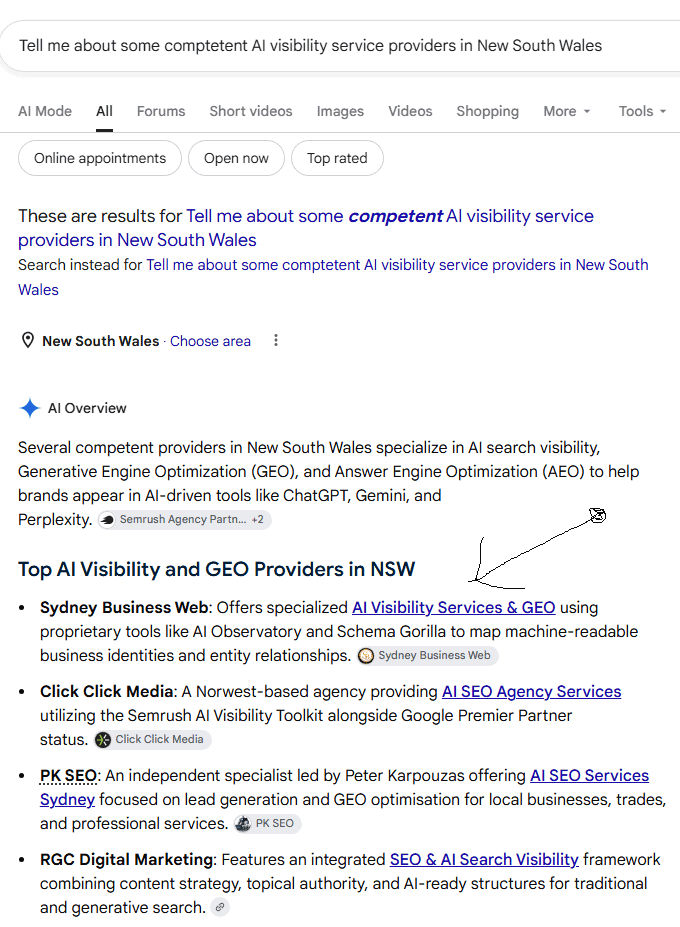
This is why AI visibility analysis matters commercially. The user did not ask Google for ten websites to inspect. They asked for competent AI visibility service providers in New South Wales .
Google responded with an AI-generated overview and assembled its own shortlist. In this observed result, Sydney Business Web was listed first, with Google describing our AI visibility work and specifically referencing AI Observatory, Schema Gorilla and our machine-readable entity relationships.
That is the environment businesses are now competing in. The machine may interpret, compare and shortlist entities before the user works their way through the conventional results beneath it.
Engineer the Part You Control
We can give AI and search systems a clearer, more coherent and better evidenced representation of the real business .
That means connecting the business to the correct website, people, services, locations, expertise and supporting evidence — while removing avoidable ambiguity where the machine-readable structure is fragmented or contradictory.
Our AI visibility analysis combines verified retrieval evidence, whole-site entity-graph analysis and diagnostic interpretation to establish what is actually there, what is structurally weak and what can be improved.
AI Visibility Analysis Has an Engineering Sequence
We do not treat AI visibility as a bag of disconnected tricks. Each layer depends on the one before it.
Credible Business
Start with the genuine business: real people, services, experience, locations and evidence capable of being corroborated.
AI Observatory
Establish whether recognised AI and search systems are actually retrieving the website. If nobody is arriving, polishing the furniture is premature.
Schema Gorilla
Analyse the site's machine-readable structure as a connected whole-site graph rather than pretending each page lives alone in a validation laboratory.
AI Identity Diagnostic
Interpret the Gorilla evidence to determine whether the core business, website, people and relationships form a coherent Intelligent Entity Skeleton.
Remediation & Verification
Repair structural weaknesses and run the analysis again. Hope remains a surprisingly poor engineering test method.
Raw Schema Data Is Not the Answer
Schema Gorilla can return thousands of nodes, relationships and entity clusters. Those numbers are evidence. They are not, by themselves, a business diagnosis.
The AI Identity Diagnostic sits above that raw evidence and asks the useful question: what does this structure mean for the identity machines are being asked to understand?
We then remediate structural weaknesses and analyse the site again rather than changing a few lines of JSON-LD and congratulating ourselves.
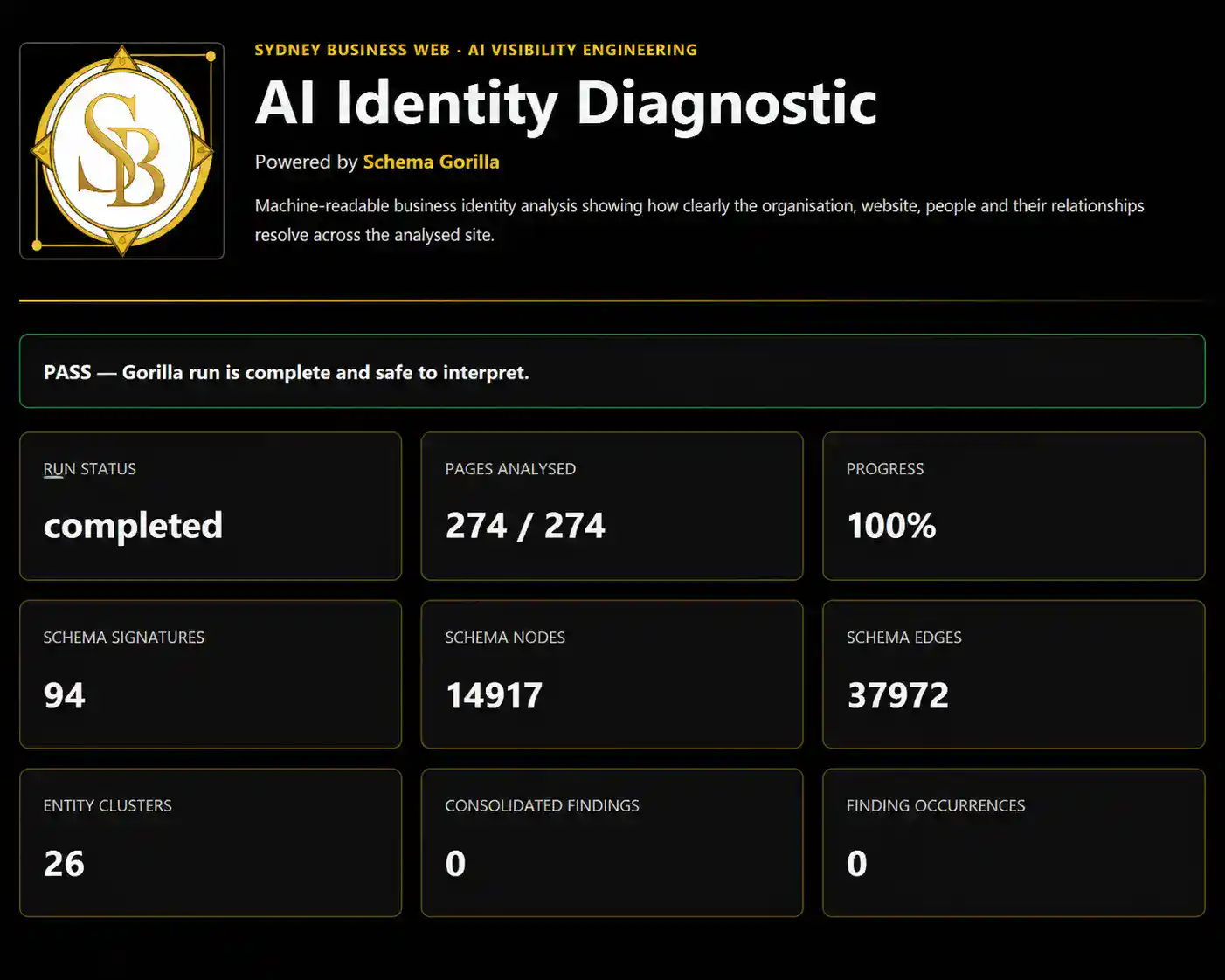
A Real AI Visibility Analysis: Before, Repair, After
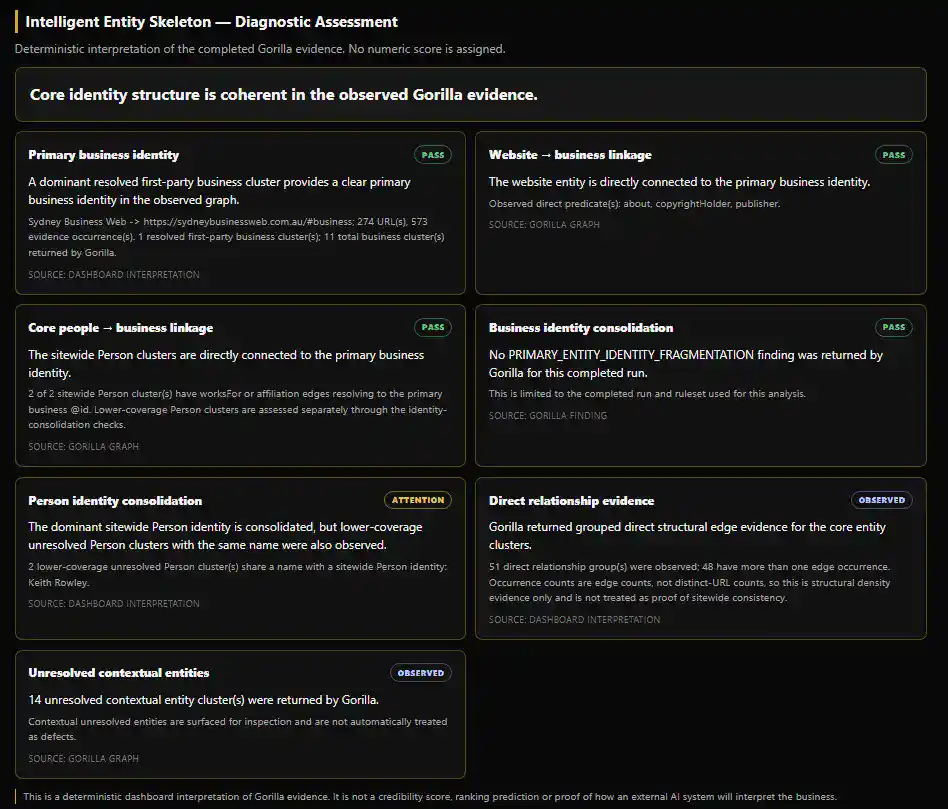
The first completed analysis showed that the dominant Keith Rowley Person identity was correctly established across the site, but it also exposed two lower-coverage unresolved Person clusters with the same name.
The AI Identity Diagnostic therefore returned ATTENTION for Person identity consolidation rather than quietly awarding everything a green tick and heading home early.
The core identity was strong. The graph still contained a defect.
Two pages were generating additional Keith Rowley Person entities containing a name but no canonical identifier connecting them back to the established sitewide Person identity.
Individually, they looked trivial. Across a whole-site entity graph they were precisely the sort of residual ambiguity we wanted the system to expose.
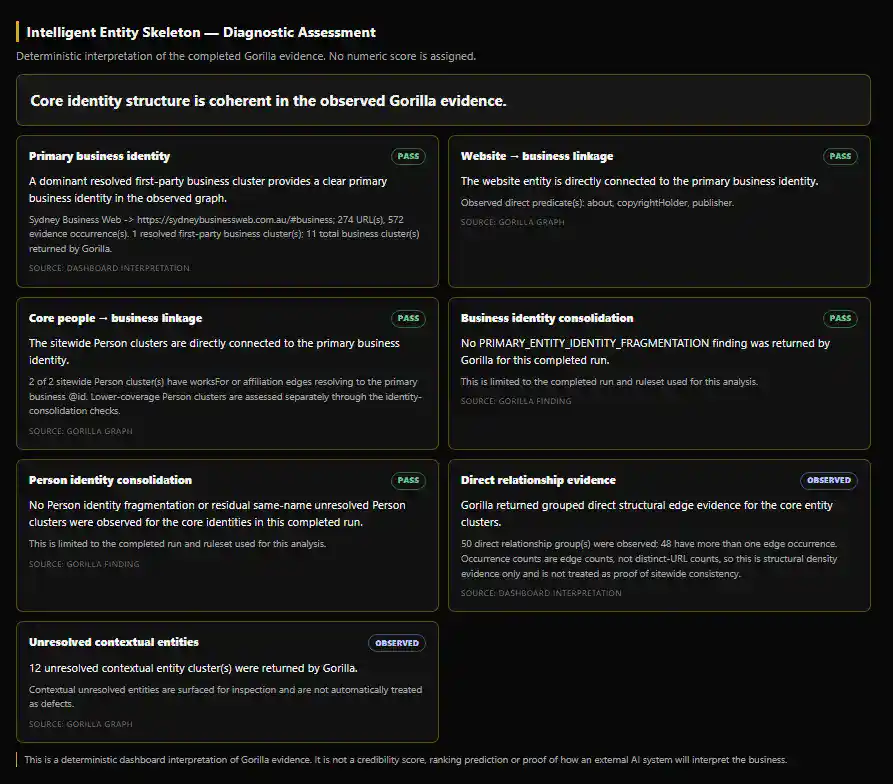
The same sitewide test now returned PASS.
The fresh analysis again processed 274 pages. The two residual Person clusters were gone, the core Person identities consolidated from four clusters to two, and the AI Identity Diagnostic changed Person identity consolidation from ATTENTION to PASS.
That is what remediation means to us: find the structural problem, repair it, and test the resulting evidence again.
A page-level validator can tell you whether a block of structured data is syntactically acceptable. Schema Gorilla and the AI Identity Diagnostic ask whether thousands of those pieces still resolve into a coherent business identity when the entire website is considered as one connected system.
For AI visibility analysis, that distinction is rather important.
What the AI Identity Diagnostic Actually Looks For
Primary Business Identity
Is there one dominant first-party business entity, or is the site presenting competing versions of the organisation?
Website → Business Linkage
Does the website entity resolve directly to the business it is supposed to represent?
Core People
Are important people connected to the business through meaningful relationships rather than floating around as anonymous names?
Identity Consolidation
Are business and Person identities consolidated, or are duplicate and unresolved fragments creating avoidable ambiguity?
Direct Relationships
What structural relationships actually connect the core entities across the observed graph?
Unresolved Context
What other entities remain unresolved and deserve inspection without automatically being labelled defects?
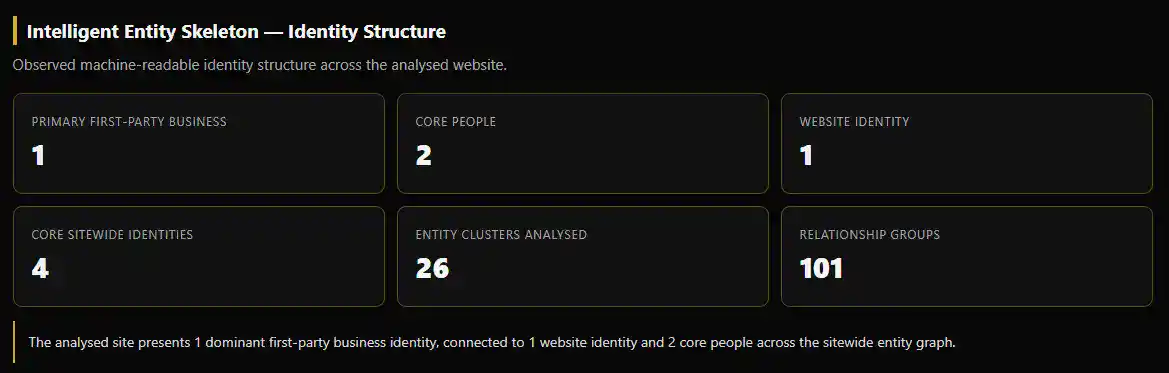
The Evidence Remains Inspectable
The customer-facing interpretation does not replace the underlying evidence. It sits above it.
Schema Gorilla still exposes the resolved entities, URL coverage, evidence occurrences and direct relationship groups that led to the assessment. That matters because an engineering conclusion should be traceable back to something considerably more substantial than our opinion.
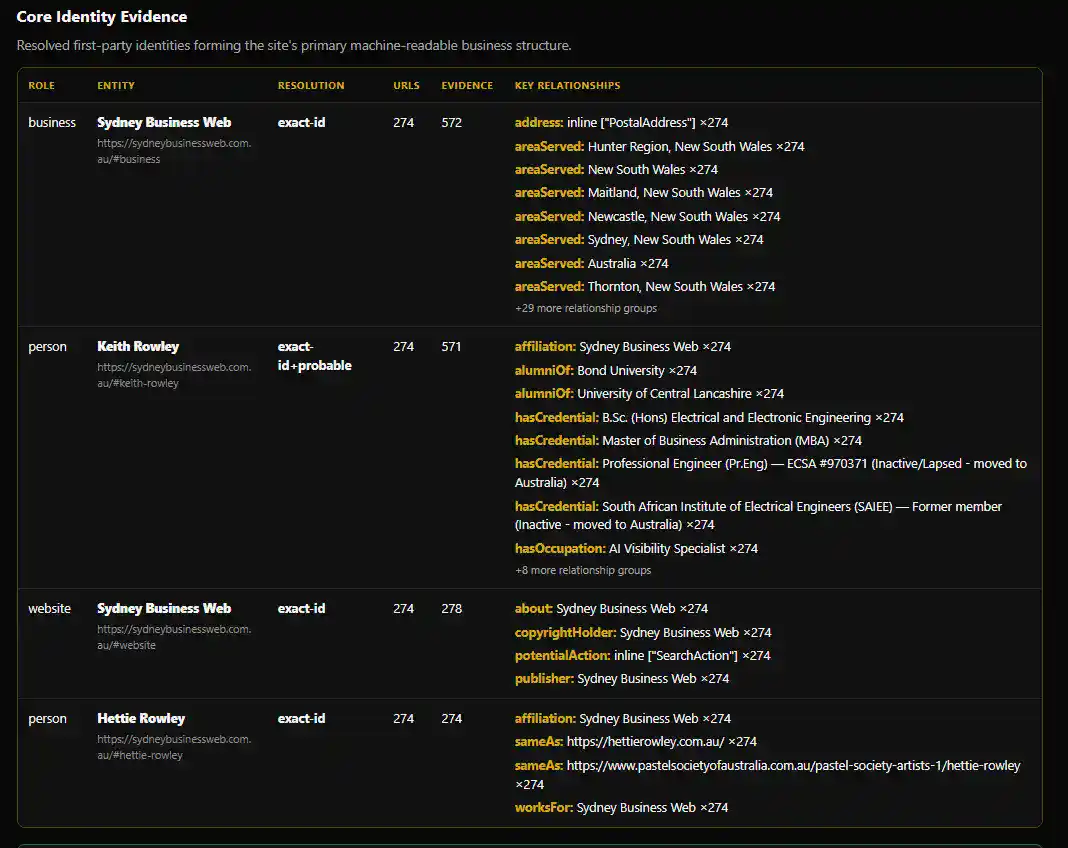
A Coherent Identity Is Necessary Evidence. It Is Not a Certificate of Authority.
The AI Identity Diagnostic assesses whether the machine-readable structure of the website resolves coherently. It does not declare that every claim made by the business is true, independently corroborated or deserving of recommendation.
That distinction matters. A technically beautiful entity graph could still describe a business with very little evidence beyond its own website.
Schema can describe reality. It does not get to manufacture reality.
Retrieval, Identity and Credibility Are Related — But They Are Not the Same Thing
Is the website being retrieved?
AI Observatory records verified retrieval activity from recognised AI and search systems at the network edge.
What identity are machines being given?
Schema Gorilla analyses the whole-site entity graph. AI Identity Diagnostic interprets whether the business, website, people and relationships resolve coherently.
What supports that identity beyond the website?
External corroborating evidence can strengthen confidence that the machine-readable business identity corresponds to a genuine, established entity in the wider information environment.
Start With the Real Business. Then Engineer Its Representation.
The strongest machine-readable identity begins with things that actually exist: a genuine business, identifiable people, real services, legitimate qualifications or experience where relevant, locations, projects, publications, reviews and other evidence capable of being checked.
Our job is to organise and connect that reality so machines do not have to reconstruct the business from a pile of contradictory fragments.
Where appropriate, the wider AI Credibility Footprint considers the external evidence that can corroborate important parts of that identity beyond the business's own website.
Nobody outside the platforms controls their ranking, retrieval, selection or recommendation decisions. Sydney Business Web cannot guarantee that Google, ChatGPT, Perplexity, Claude or another system will recommend a particular business for a particular query.
What we can do is engineer and verify the part you control: present the strongest, clearest and most internally coherent machine-readable version of the genuine business that the available evidence supports.
That is the job. Not to bully an algorithm into recommending you. To make damned sure your own website is not making your business harder for machines to identify correctly.
AI Visibility Analysis Without the Incense
What is AI visibility analysis?
AI visibility analysis examines the technical and informational signals that affect how AI and search systems can retrieve, identify and understand a business. At Sydney Business Web this includes verified retrieval evidence, whole-site entity analysis, diagnostic interpretation and remediation.
What is the AI Identity Diagnostic?
The AI Identity Diagnostic is the interpretation layer applied to Schema Gorilla evidence. It assesses whether the core business, website, people and their relationships resolve into a coherent machine-readable identity.
How is this different from Schema Gorilla?
Schema Gorilla is the analysis engine that discovers and resolves the whole-site entity graph. The AI Identity Diagnostic interprets that raw evidence into specific identity findings such as PASS, ATTENTION and OBSERVED.
Does a PASS guarantee that Google or an AI system will recommend my business?
No. A PASS means the completed analysis supports the particular structural conclusion being tested. It is not a ranking guarantee, recommendation guarantee or prediction of what an external AI system will choose to surface.
Why does AI Observatory come before Schema Gorilla?
AI Observatory addresses a different question: whether recognised AI and search systems are actually retrieving the site. Retrieval evidence and identity structure are related, but they are not the same measurement.
Why rerun the analysis after remediation?
Because changing structured data does not prove that the resulting sitewide identity is cleaner. A fresh analysis provides independent post-remediation evidence rather than relying on the dataset that found the original problem.
Is structured data enough for AI visibility?
No. Structured data can help describe and connect genuine information, but it cannot manufacture credibility. The real business, its content, technical accessibility and supporting evidence all remain important.
Does Google require special AI schema?
No. Google states that there is no special Schema.org structured data required for AI Overviews or AI Mode. Structured data should continue to match the visible content and accurately describe what is genuinely present on the page.
What is the AI Credibility Footprint?
It is the wider supporting evidence around the machine-readable identity: external sources and corroborating signals that can help establish that important claims made by the business are not supported only by its own website.
Follow the Evidence, Not Just the Claim
AI Observatory
The production retrieval-monitoring system used to establish whether qualifying AI and search systems are actually retrieving meaningful business information from a website.
Schema Gorilla — Business Identity Analysis
Sydney Business Web's whole-site entity-graph analysis methodology: reconstructing structured data across a website rather than treating each page as an isolated schema document.
Schema Gorilla Whole-Site Case Study
A production case study showing Schema Gorilla analysis, remediation, fresh discovery and subsequent verification against a changing, increasingly complex entity graph.
Live AI Retrieval Evidence
Public evidence showing observed machine retrieval activity and the distinction between crawler presence, meaningful retrieval and downstream AI representation.
AI Search Visibility for Business
The wider engineering model connecting retrieval, business evidence, entity architecture, corroboration, structured data and repeated measurement.
The AI Credibility Footprint
Sydney Business Web's framework for the external and internal evidence surrounding a business identity: entity consistency, content, structured data, retrieval access and corroborating proof.
AI Visibility Services & GEO
How Sydney Business Web applies this engineering work commercially, from review and diagnosis through entity architecture, remediation and ongoing AI visibility development.
AI Features and Your Website
Google's current documentation for AI Overviews and AI Mode, including how AI features may use query fan-out and Google's statement that there are no additional special technical requirements for appearing in those features.
Introduction to Structured Data
Google's documentation explaining structured data as explicit machine-readable clues about page meaning, including the requirement that markup accurately describes the content to which it applies.
Google Crawlers and Fetchers
Google's technical documentation describing its crawler and user-triggered fetcher infrastructure and the distinction between different classes of machine retrieval.
Schema.org Vocabulary
The shared structured-data vocabulary used to describe entities, properties and relationships across web content.
Schema Markup Validator
A page-level structured-data validation tool. Useful for syntax and vocabulary inspection, but conceptually different from the whole-site identity analysis performed by Schema Gorilla.
Retrieval. Identity. Evidence. Remediation.
This page documents the AI Identity Diagnostic — one layer of Sydney Business Web's wider AI visibility engineering approach.
The process begins with a credible real business, verifies machine retrieval through AI Observatory, analyses the whole-site entity graph with Schema Gorilla, interprets the resulting identity structure here, and then remediates and verifies weaknesses where appropriate.
The point is not to reverse-engineer a magic phrase that forces an AI model to recommend somebody. The point is to make the genuine business clearer, more coherent and easier for machines to resolve correctly.
Find Out What Machines Are Actually Being Given to Work With
The AI Identity Diagnostic is delivered as part of Sydney Business Web's wider AI visibility analysis and remediation work. It is not sold as a separate dashboard subscription.
We can examine whether recognised AI systems are retrieving your site, analyse the whole-site entity structure with Schema Gorilla, interpret the resulting business identity, identify structural weaknesses and remediate what can legitimately be improved.
Then we test it again. Because “we changed some schema and it looked better to us” is not much of an engineering acceptance test.