
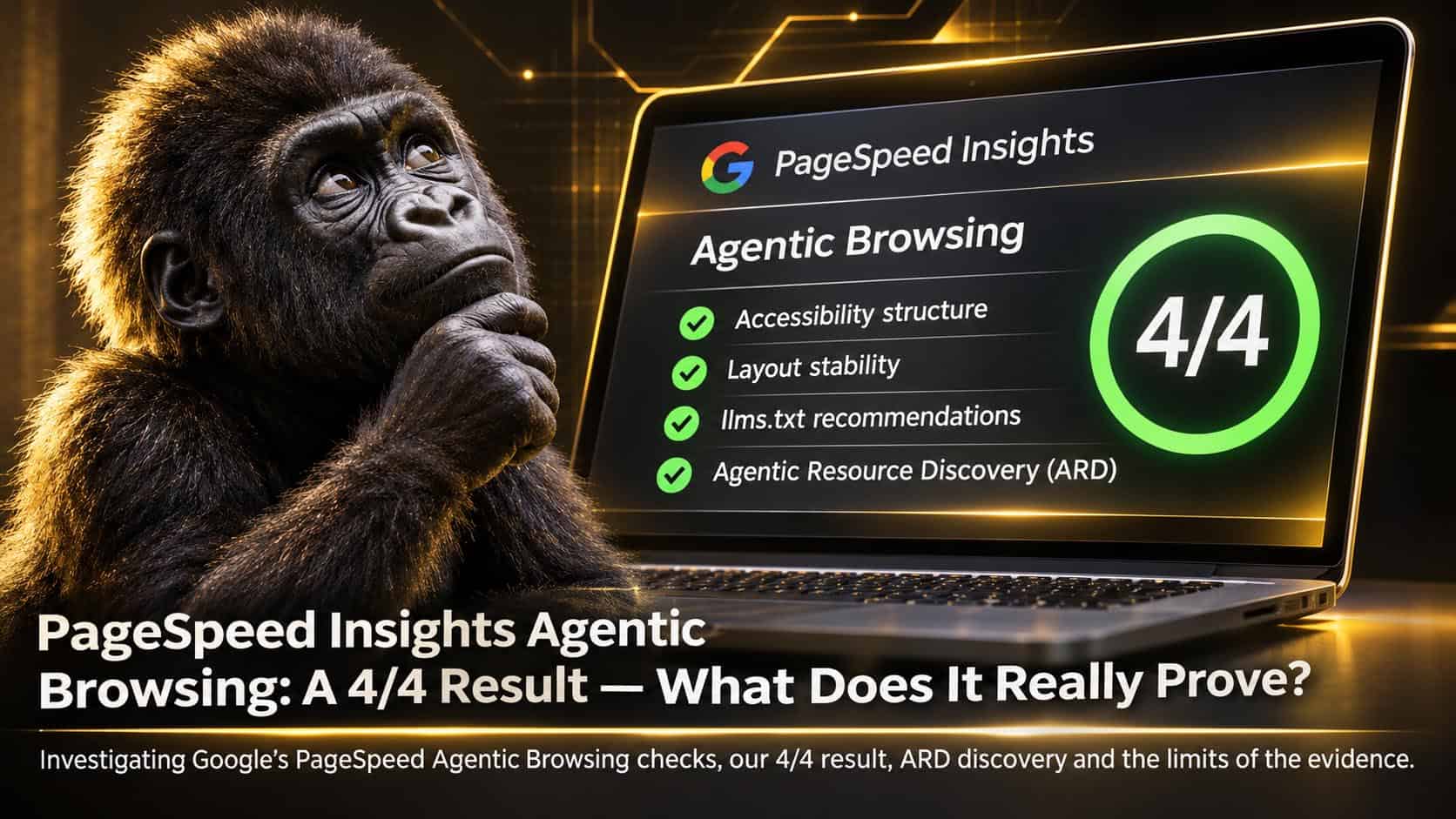
A perfect Agentic Browsing audit score raises an important engineering question: what has actually been verified, and what remains unproven?
AI Agent Readiness / An Engineer's Field Notes / Investigation 05
PageSpeed Insights Agentic Browsing: What Does a 4/4 Result Actually Prove?
Google's PageSpeed Insights is now looking at more than how quickly a website loads. Its Agentic Browsing checks examine technical conditions relevant to software that may need to understand and operate a website.
Sydney Business Web achieved a reported 4/4. We then investigated exactly what we could verify, what the audit appeared to establish, and what remained beyond the evidence.
The investigation began with a reported 3/4, continued through publication of an ARD manifest and a Lighthouse compatibility update, and raised a deceptively simple engineering question: how much does a green PageSpeed indicator actually prove?
The answer matters to website owners, SEO professionals and developers attempting to prepare business infrastructure for AI agents without confusing readiness signals with measurable outcomes.
01 / A new instrument on the dashboard
PageSpeed is asking a different question.
Performance remains important. So do accessibility, good structure and reliable responses. But AI agents introduce another operational problem: can software recognise what a page contains, locate an intended capability and interact with it without relying on guesswork?
Lighthouse's Agentic Browsing category introduces deterministic checks related to these concerns. Google's developer documentation identifies accessibility, interface stability and machine-readable discovery among the relevant engineering areas.
Unlike traditional Lighthouse categories, Agentic Browsing displays a fraction of applicable checks passed rather than a weighted score out of 100. The category and some of its underlying standards remain experimental.
PageSpeed can test specified technical conditions. It cannot, by itself, demonstrate that an independent AI agent has successfully completed a business task.
02 / What the observed result contains
Four signals. Four different questions.
The four checks shown in our investigation concern separate aspects of machine interaction and discovery. Their meaning should be understood individually, not treated as a universal definition of agent readiness.
Accessibility
Can relevant interface elements be represented coherently to assistive technologies and browser agents?
Layout behaviour
Do unexpected layout shifts undermine predictable machine interaction?
llms.txt
Does the site's llms.txt resource satisfy the recommendations checked by the audit?
ARD manifest
Does the available Agentic Resource Discovery information satisfy the audit's validation conditions?
These are useful diagnostics, but their applicability and implementation can change between Lighthouse releases. Additional features, including experimental WebMCP checks, may be examined under different configurations.
Reading the evidence
Four green checks are four bounded observations.
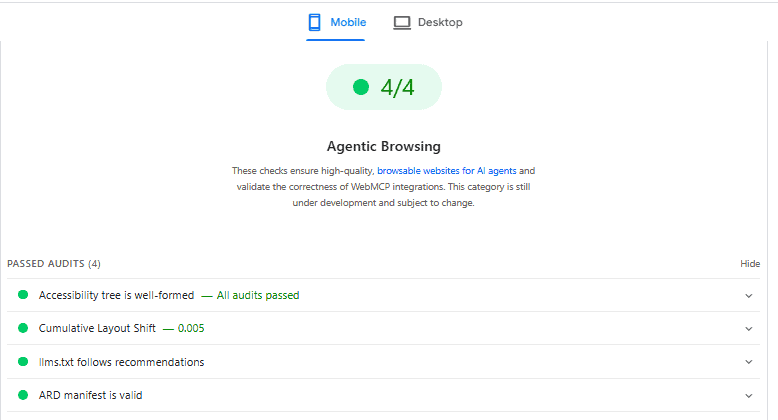
The report records an accessibility tree check, layout stability, llms.txt recommendations and ARD manifest validity.
Each pass tells us something useful about the observed conditions. None independently demonstrates that an external agent has selected, called and completed a business workflow.
03 / The production experiment
From 3/4 to 4/4. Then we controlled the instrument.
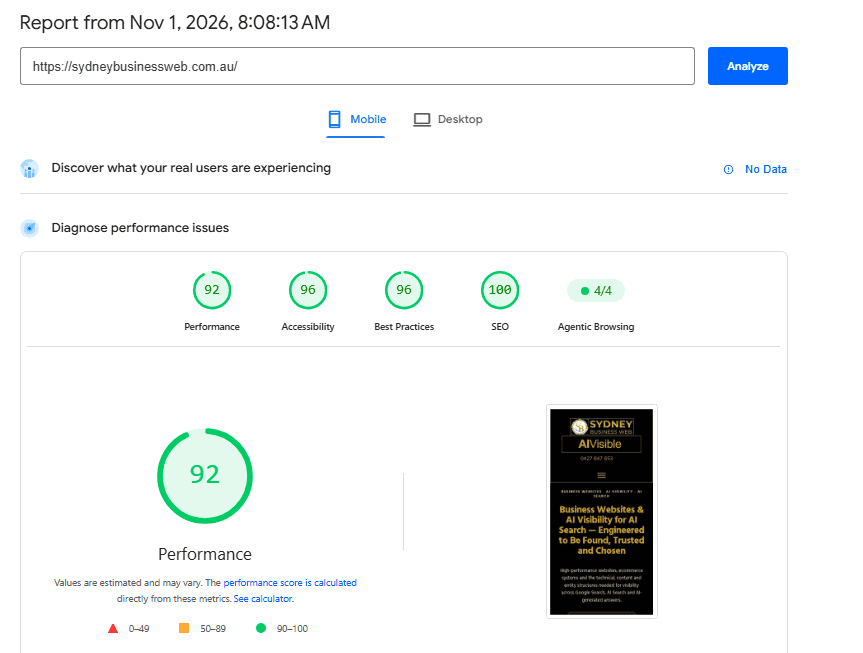
Our earlier PageSpeed interface showed 3/4, followed later by 4/4. We had published an ARD manifest during the interval, but Lighthouse itself was changing. The earlier PageSpeed report was not retained in sufficient detail to identify its ARD status or Lighthouse version.
Rather than assign a cause to that historical progression, on 2 November 2026 we ran Lighthouse 13.5.0 and Lighthouse 13.6.0 locally against the same production homepage, with the same Agentic Browsing category selection and browser environment.
The controlled comparison was decisive for the current site: 13.5 marked the older ai-catalog.json audit Not Applicable, while 13.6 passed the ARD v0.91 audit against the deployed website. The instrument version changed the outcome without any deliberate website configuration change between runs. Importantly, the older run yielded 3/3, not 3/4, so it cannot by itself account for our historical 3/4 display.
Historical PSI display; version not retained
Historical PSI display; version not retained
Historical observation
A result that raised the next engineering question.
The original PageSpeed screenshots document an observed change, not a version-controlled experiment.
Our new 2 November comparison supplies the missing controlled evidence about how Lighthouse 13.5 and 13.6 evaluate the same currently deployed site.
The full engineering progression is covered in Investigation 04 — From Discovery to Autonomous Execution, including the independently tested public API, its safeguards and the distinction between successful internal testing and unproven third-party adoption.
Evidence C / Controlled comparison / 2 November 2026
Same homepage. Two Lighthouse versions. Different ARD outcomes.
Both CLI runs targeted https://sydneybusinessweb.com.au/, selected agentic-browsing, used headless Chrome 156 and completed approximately two minutes apart. No deliberate site configuration change was made between runs.
| Check | 13.5.0 2 Nov, 18:51 AEDT | 13.6.0 2 Nov, 18:53 AEDT |
|---|---|---|
| Accessibility tree | PASS | PASS |
| Layout shift (CLS) | 0.005651 (pass) | 0.005651 (pass) |
| llms.txt | PASS | PASS |
| ARD manifest audit | NOT APPLICABLE | PASS |
| ARD audit weight | 0 | 1 |
| Applicable checks passed | 3/3 | 4/4 |
| Category score | 100% | 100% |
| WebMCP checks | Not applicable | Not applicable |
Sources: preserved local JSON reports lighthouse-13.5.json (fetch 07:51:48 UTC) and lighthouse-13.6.json (07:53:36 UTC). The three applicable checks in 13.5 all passed (3/3); 13.6 added ARD as a fourth passing check (4/4). This establishes a version-dependent result for the currently deployed site, not a reconstruction of the earlier 3/4 run.
04 / Verify the wire, not just the dashboard
We checked the actual HTTP response.
On 1 November 2026, during our follow-up testing, a direct GET request for the published ARD manifest returned HTTP 200 and the expected JSON content type.
That is independent evidence that the resource was accessible from our test client through Cloudflare.
It does not prove universal access from every network, nor does it reveal the internal sequence of requests used by the PageSpeed audit.
GET https://sydneybusinessweb.com.au/.well-known/ard.json

HTTP/1.1 200 OK
Content-Type: application/json
Server: cloudflare
The associated OpenAPI description is published at Baby Gorilla OpenAPI 3.1 specification. That document describes a callable interface; it is not evidence that unknown agents have independently adopted the service.
05 / The Lighthouse version change
The audit changed. We measured the difference.
Lighthouse 13.5.0 still labelled its audit “ai-catalog.json schema is valid”. Against our current homepage, it returned Not Applicable and contributed no weight to the Agentic Browsing category. This corroborates earlier published analysis predicting the legacy version would not recognise an ard.json-only site.
Lighthouse 13.6.0, released on 27 October 2026, updated the gatherer to ARD specification v0.91. Its audit is labelled “ARD manifest is valid”; under the same testing conditions it returned Pass and carried category weight one.
Our own HTTP checks found no Agentmap directive, homepage ARD Link header or HTML discovery link; the old ai-catalog.json URL returned 403 and the new /.well-known/ard.json URL returned 200. The results are consistent with 13.6 using the new well-known path. The saved audit report establishes the pass, but does not itself provide the exact network request trace.
- robots.txt
- No
Agentmap:directive in the inspected file. - HTTP headers
- Homepage Link header advertised
/llms.txt, not an ARD manifest. - HTML source
- Homepage HTML contained no matching
agentmap,ai-catalogorard.jsonreference in our text search. - Legacy location
/.well-known/ai-catalog.jsonreturned HTTP 403. That does not establish whether a resource exists behind the restriction.- Current location
/.well-known/ard.jsonreturned HTTP 200 withapplication/json.- Controlled comparison
- 2 November 2026: 13.5.0 returned ARD Not Applicable (weight 0); 13.6.0 returned Pass (weight 1), testing the same current homepage.
Established: On 2 November 2026 the 13.5 run marked ARD Not Applicable and 13.6 passed it. Both other relevant checks and recorded CLS were unchanged; both JSON reports were retained.
Supported explanation: The change aligns with the documented adoption of /.well-known/ard.json discovery in Lighthouse 13.6.
Historical limit: The original 3/4 and later 4/4 PageSpeed captures were not versioned. The controlled test demonstrates compatibility now, but cannot prove which change caused that earlier progression.
06 / What website operators should do
Use the audit. Don't worship it.
A practical readiness investigation should begin with the task a website needs to support, not with a desire to illuminate every indicator.
Run PageSpeed on the production URL.
Examine the individual Agentic Browsing audits. Record the date, results and relevant Lighthouse version where available. The number of applicable checks can change.
Correct meaningful accessibility defects.
Give interactive controls usable names, preserve logical relationships and avoid unpredictable layout movement. These improvements benefit people as well as agents.
Verify discovery resources directly.
If publishing llms.txt or an ARD manifest, test the actual HTTP response, content type, contents and intended access path. Don't rely exclusively on a dashboard.
Build an API only when a real task requires one.
Public interfaces bring security, abuse prevention, quota management and maintenance obligations. A better audit result alone is not sufficient justification.
Measure actual agent use separately.
Record successful invocations, failures and meaningful outcomes. Distinguish your own test traffic from independent integrations and commercial enquiries.
Start with Google PageSpeed Insights, then compare the results with the official Lighthouse Agentic Browsing scoring guidance.
07 / What we can responsibly claim
The evidence ledger.
The purpose of the investigation is not to undermine PageSpeed. It is to establish exactly where the measurement stops and additional engineering evidence must begin.
Demonstrated
- On 2 November 2026, Lighthouse 13.5.0 produced an ARD Not Applicable result and Lighthouse 13.6.0 produced Pass on the same current homepage.
- The ARD audit weight changed from zero in 13.5 to one in 13.6; the applicable fraction changed from 3/3 to 4/4 while both category scores remained 100%. Accessibility, llms.txt and recorded CLS agreed.
- The published ard.json URL returned HTTP 200 with application/json in our independent GET test.
- Baby Gorilla’s public agent API was separately invoked successfully in our tests, as documented in Investigation 04.
Still to establish
- The Lighthouse version and exact ARD status of the original historical 3/4 PageSpeed report. Our controlled 13.5 run produced 3/3, not 3/4.
- The exact network fetch URL used internally by the 13.6 audit (no per-request trace was retained).
- Independent third-party agent adoption of Baby Gorilla and consistent ARD discovery outside the test environment.
- Any causal improvement in AI recommendations, qualified enquiries or revenue.
A passing audit is evidence of the tested conditions. A successful invocation is evidence of operation. An actual business outcome requires another measurement.
08 / Documentation and continuity
Read the evidence. Follow the investigation.
Official and technical references
- Chrome for Developers — Lighthouse Agentic Browsing scoring
- Chrome for Developers — Agent-ready website toolkit
- Lighthouse 13.6.0 — ARD v0.91 release notes
- Search Engine Journal — earlier Lighthouse ARD discovery analysis
- Lighthouse GitHub — historical ARD compatibility issue
- Sydney Business Web — Published ARD manifest
- AI Baby Gorilla — OpenAPI 3.1 specification