

Online Business Engineering - Implementing profitable, scalable online businesses — end to end
Contents
- Why Most Business Websites Don’t Deserve to Exist
- First Principles: A Business Website Exists to Make Money
- Problems, Not Products: Why People Really Buy Things Online
- The Business Owner’s Real Problem (It Isn’t the Website)
- Do You Even Need a Website Yet?
- The Flow Matters More Than the Shop
- Sales vs Business Development: Stop Confusing Them
- Where Profit Actually Comes From Online
- What This Means in Practice for Business Owners
- Bringing It All Together
- Frequently Asked Questions
- Reference Links (Internal + External)
Why Most Business Websites Don’t Deserve to Exist ↑ Back to contents
Let’s begin with an uncomfortable truth — one that most agencies carefully tiptoe around: a business website that does not contribute to profit is not an asset, it is a sunk cost.
That doesn’t mean every website must sell something directly. It does mean that every business website must play a clearly defined role in the journey toward revenue. If that role cannot be articulated in plain English, the site is already in trouble.
We’ve seen this pattern repeatedly over the years: businesses commission a website because they feel they should have one. Not because it solves a defined business problem, not because it supports an existing sales flow — but because “everyone else has one”.
The result is depressingly consistent:
- a beautiful website that attracts the wrong people,
- a technically sound website with no commercial intent, or
- a content-heavy site that educates visitors… straight into a competitor’s arms.
None of this is hypothetical. We’ve written about the financial consequences of building online without doing the basic viability maths first — especially with ecommerce. If you want the practical version (costs, profit, time, break-even, and the usual traps), start here: Calculating Online Investment and Profit for an Ecommerce Business Website.
We’ve also written (again and again) that clarity up front is not “admin” — it’s the difference between a commercial asset and a slow, expensive mistake. If you’re wondering what “define it properly” looks like in the real world, this is the backbone: Business Website Specification.
In fact, one of the most common failure modes we encounter is businesses asking:
“Why isn’t our website working?”
…when the more useful question would have been:
“What job did we actually design this website to do?”
This distinction matters, because websites do not create value on their own. They only create value when they are engineered into a broader system — one that includes how customers discover you, how they decide to trust you, and how they eventually buy.
If you want the “bigger picture” framing (website as part of business development, not the whole show), this one supports the point well: Online Business Development.
A business website is not a creative project.
It is a commercial instrument.
If it cannot justify its existence in business terms, it probably shouldn’t exist at all.
First Principles: A Business Website Exists to Make Money ↑ Back to contents
Let’s now put a name to the approach we’ve been circling around. Online Business Engineering starts from a very old-fashioned idea — that businesses exist to make a profit, and that everything built in support of that business must ultimately justify its cost.
This sounds obvious. It isn’t.
In practice, many business websites are designed backwards. They begin with appearance, layout, or “brand feel”, and only later — if ever — ask how money is supposed to move from a customer’s pocket into the business.
Online Business Engineering reverses that logic. It begins with outcomes and constraints:
- What problem is being solved?
- Who actually experiences that problem?
- What is the value of solving it?
- How often does it occur?
- What does it cost — in time and money — to reach the people who have it?
Until those questions are answered, a website is just an expense contributing nothing to your top line, but hitting your bottom line every day of its useless, parasitic life.
We’ve seen this most clearly in ecommerce, where enthusiasm regularly outruns arithmetic. Before a single product page is designed, a business must understand margins, logistics, customer acquisition costs, and break-even points.
This is why we’ve repeatedly urged businesses to do the uncomfortable work first — the kind that involves spreadsheets rather than screenshots. If you’re considering selling online, this guide lays out the numbers plainly: Calculating Online Investment and Profit for an Ecommerce Business Website.
None of this is intended to discourage online ventures. Quite the opposite. When the numbers make sense, the confidence with which a business can invest — in SEO, content, email, or ecommerce — changes completely.
The website then stops being a gamble and starts becoming a component in a larger, engineered system — one that can be tested, adjusted, and improved over time.
Online Business Engineering exists for one reason:
To design profit into your system.
Everything else is decoration.
Problems, Not Products: Why People Really Buy Things Online ↑ Back to contents
If you’re running a business, here’s a truth you can use immediately: customers don’t buy products — they buy a change in their situation.
Nobody wakes up and says, “Today I’ll purchase a website.” They wake up and say, “I’m losing money / I’m in pain / I look amateur / I’m stuck / I need this sorted by Friday.”
So when someone tells you, “Just build a shop and run ads,” it’s worth asking: what problem does the customer believe they’re solving, and what conditions make them hit ‘Buy’?
Here’s the real-world map. Keep it close — it saves money.
| Customer problem (the real one) | What they buy (the “solution”) | Type of purchase | Typical customer |
|---|---|---|---|
| “I’m bored, scrolling, and my brain wants a treat.” | Novelty items (yes… we sold dog hats). |
Impulse Low cost, low risk, easy delivery, instant gratification. |
Casual browsers, gift buyers, late-night shoppers, “why not?” personalities. |
| “This hurts / I’m worried / I need relief.” | Medicine, health products, trusted guidance, reassurance. |
Relief / risk reduction Trust-heavy, proof-heavy, clarity matters, fear punishes vague claims. |
Anxious, time-poor, often researching; wants credibility and safety signals. |
| “Something is broken and I need it fixed now.” | Emergency trades / repairs / locksmith / electrician. |
Urgent High intent, fast contact, speed beats elegance, friction kills conversions. |
Stressed buyer, phone-in-hand, wants reassurance + quick booking. |
| “I’m not being taken seriously in my role.” | Professional clothing, brand presentation, credible presence. |
Status / identity Style + trust signals; social proof matters; returns/fit policies matter. |
Career-driven buyers, business owners, client-facing roles, reputation-sensitive. |
| “I’m wasting time / I can’t keep up / this process is chaos.” | Tools, automation, systems, training, better workflows. |
Efficiency Needs a clear mechanism; onboarding matters; measurable before/after. |
Operators, managers, overwhelmed founders — allergic to vague promises. |
| “I’m losing money and I don’t know where it’s leaking.” | Diagnosis: SEO strategy, conversion fixes, tracking, optimisation plan. |
Decision support Requires proof, clarity, prioritisation; ‘mystery’ is not a feature. |
Existing business owners with real revenue — and real frustration. |
Now, here’s the part that’s oddly liberating: your website doesn’t “create demand”. Demand already exists (or it doesn’t), and the website either connects you to it — or sits there like a glossy brochure nobody asked for.
This is why Online Business Engineering starts with the problem, then designs the mechanism that matches: the customer’s intent, urgency, risk tolerance, and decision speed.
Or, in plain language: we don’t start with the shop. We start with the headache. Because that’s where the money is.
Customers don’t buy what you sell.
They buy a way out.
Your job is to make the exit obvious.
The Business Owner’s Real Problem (It Isn’t the Website) ↑ Back to contents
Once you stop pretending the website is the hero of the story, something interesting happens.
The spotlight moves — where it belongs — onto the business owner.
Because while customers have problems they want solved, business owners have a different, more persistent problem: they must turn a solution into reliable, repeatable income.
This is where advice aimed at “starting an online business” often becomes actively unhelpful. It talks about tools, tactics, funnels, and platforms — but skips the uncomfortable reality of operating a business in the real world.
A business owner’s problem usually looks something like this:
- I have something valuable, but too few people know about it.
- I’m getting enquiries, but not the right ones.
- I’m busy, but revenue isn’t growing.
- I’m spending money online and can’t clearly see the return.
- I don’t know which lever to pull next — and pulling the wrong one is expensive.
Notice that none of those problems are solved by “a better homepage”.
They’re solved by clarity: understanding what stage the business is at, what constraint is limiting growth now, and which action actually moves the needle.
We learned this the hard way when we first stepped out of the corporate world and into small business. In a startup, sales keep the lights on. Business development builds the future — but confusing the two is costly.
We’ve written about this distinction in detail before, particularly how chasing leads can quietly strangle long-term growth if it becomes the default survival strategy: Business Development vs Sales for Small Business.
This is also why we insist on proper definition before building anything substantial. When a website, campaign, or ecommerce build is poorly specified, it doesn’t just run over budget — it locks the business into the wrong assumptions.
If you want to see what “definition” looks like when taken seriously, this is the backbone we return to again and again: Business Website Specification.
Online Business Engineering exists precisely to address this gap. Not by handing business owners a pile of tools, but by helping them answer the harder questions first:
- What is the fastest path to cashflow right now?
- What must be built later — and what should wait?
- Which channels fit the business model, margins, and customer intent?
- How do we avoid doing something clever that doesn’t pay?
When those questions are answered, the website stops being a gamble. It becomes one component in a deliberate, staged system — designed to support the business, not distract from it.
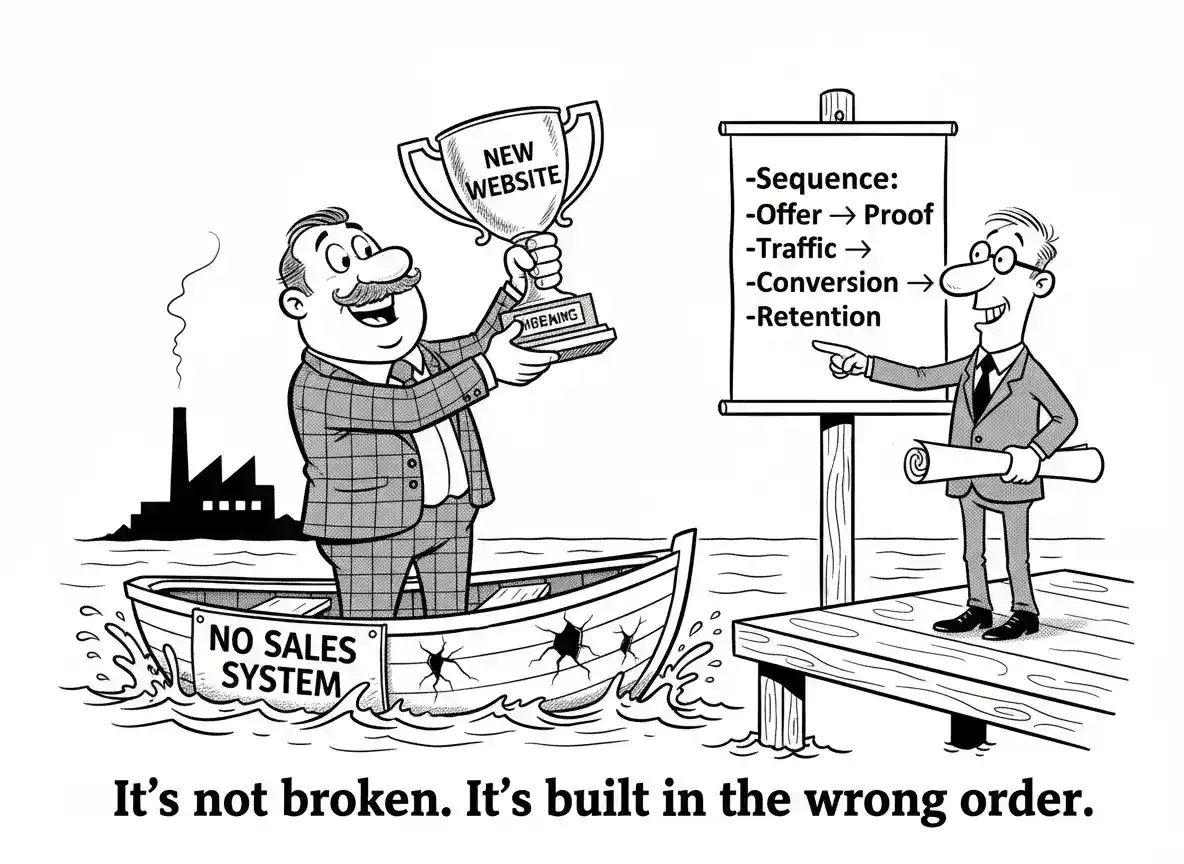
Most business problems are not technical.
They are sequencing problems.
Get the order wrong — offer, audience, channel, website —
and it doesn’t matter how well the website works.
Do You Even Need a Website Yet? ↑ Back to contents
This is the question almost nobody asks — mostly because the answer can be inconvenient.
No, you do not automatically need a website.
That usually sounds heretical coming from a web agency, but it’s true. There are stages of business where a website is useful, stages where it’s secondary, and stages where it is simply the wrong tool.
The mistake we see repeatedly is businesses building a website as a substitute for thinking.
If you’re early-stage, cash-constrained, or still validating an offer, a website can become a very polished way of avoiding the harder questions — the ones about pricing, demand, and who will actually buy.
Before building anything substantial, there are a few questions that matter more than design, platform, or features. We ask these every time — and we suggest you do too.
The “Should We Build Anything Yet?” Checklist
- Can you clearly describe the problem your customer is trying to solve?
- Do you know who has that problem — not “everyone”, but a specific group?
- Have people already paid (or tried to pay) for a solution like yours?
- Do you understand how urgent the problem is?
- Do you know how people currently find solutions to this problem?
- Can you reach those people without a website?
- If a website disappeared tomorrow, would the business still function?
If several of those questions are hard to answer, building a website now is unlikely to fix that. It will more often delay learning while consuming time and money.
There is another question that matters just as much — and it is often ignored: Where does your customer already go when they look for a solution?
If the answer is “Amazon”, “eBay”, “Facebook Marketplace”, “a comparison site”, or “Google reviews”, then building a standalone shop may be the wrong first move.
We have seen businesses build beautiful online stores for products that can be bought anywhere — cheaper, faster, and with more reviews — only to discover that traffic is not the problem. Commoditisation is.
In those cases, the opportunity is rarely the product. It is the service wrapped around it — installation, expertise, bundling, local support, configuration, integration. If that service is not engineered into the channel, the website becomes invisible.
Online Business Engineering begins with this discipline: build where intent already exists — or create intent deliberately. Do not assume a website creates it.
We’ve seen businesses do better with:
- a single, well-placed landing page,
- direct outreach and conversations,
- existing marketplaces or platforms,
- or even manual processes that feel “unscalable” — but prove demand.
None of that is glamorous. It is, however, cheaper than discovering — six months later — that the website works perfectly but nobody wants what it offers.
When the answers to those questions are clear, a website stops being a risk. It becomes an amplifier.
That’s when Online Business Engineering earns its keep: by helping you decide what to build, when to build it, and just as importantly, what to leave alone for now.
A website should amplify clarity.
Clarity of offer.
Clarity of audience.
Clarity of channel.
Clarity of economics.
It should not be used to search for any of that.
The Flow Matters More Than the Shop ↑ Back to contents
One of the most persistent myths in online business is that the website is the centre of everything.
It isn’t.
In reality, a website is usually just one stop — sometimes a brief one — in a longer decision journey. People arrive with context, expectations, doubts, and often half a decision already made.
When businesses struggle online, it’s rarely because the website is “bad”. It’s because the website has been dropped into the wrong place in the flow — or expected to do jobs it was never designed for.
Here’s a simplified version of what most buying journeys actually look like:
- Something triggers awareness of a problem.
- The person looks for reassurance or options.
- They compare, delay, ask someone else, or do nothing.
- They return when urgency or confidence increases.
- Only then do they buy.
The important point is this: the website does not control the flow — it participates in it.
This is why “funnels” are so often misunderstood. They’re treated as mechanical devices — pour traffic in the top, collect money at the bottom — when in reality they’re maps of human behaviour, full of hesitation and diversion.
A shop placed too early in the journey feels aggressive. A shop placed too late feels unnecessary. A shop placed without trust signals simply leaks traffic.
We’ve seen this play out repeatedly in ecommerce projects where businesses assumed that launching a catalogue would create momentum. In practice, customers arrived curious, unconvinced, and unready — and quietly left.
This is exactly why we make every effort to understand the flow before designing the site. What comes first — education, proof, conversation, or urgency — depends entirely on the type of problem being solved. To be candid: some clients don’t want that discussion. They already have a mental picture and they want to march straight to the build. That’s fine — we’ll execute what you ask. We’ll just also tell you, plainly, when we believe a small amount of business thinking up front could save you money and improve results.
If you want a deeper look at how this affects online investment decisions, this analysis connects the dots between flow, cost, and return: Calculating Online Investment and Profit for an Ecommerce Business Website.
Online Business Engineering treats flow as a design constraint. The website is shaped to support it — not to replace it, override it, or magically fix it.
When the flow is right, even simple websites convert well. When the flow is wrong, no amount of optimisation can compensate.
You can optimise a page forever.
You cannot optimise a journey that doesn’t make sense.
Both matter. Mixing them up is what causes burnout.
Sales vs Business Development: Stop Confusing Them ↑ Back to contents
If you’ve run a small business for any length of time, you already know this distinction — even if no one ever named it for you.
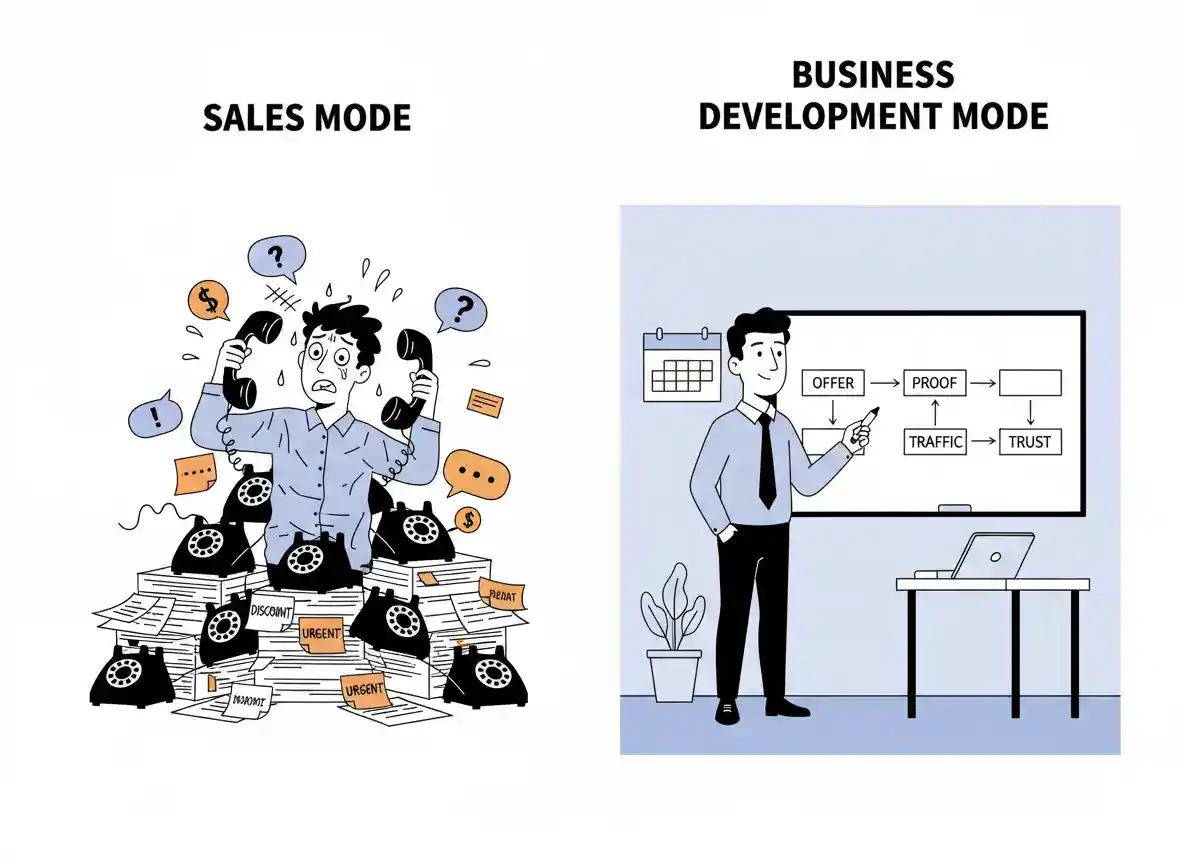
Sales keeps the lights on. Business development builds the building.
Both matter. Confusing them is where things start to go wrong.
Sales is immediate. It is about converting intent that already exists. When the phone rings and someone wants a quote, that’s sales. When you follow up an enquiry, that’s sales. When you discount to close a deal before Friday, that’s sales too.
Business development is slower and far less dramatic. It’s about shaping how future customers find you, understand you, and decide to trust you — often months before they’re ready to buy.
In the early days of a business, sales must take priority. Rent, wages, and groceries are not paid with “brand awareness”.
The problem begins when short-term sales tactics quietly crowd out everything else.
We’ve lived this mistake ourselves. Paying for leads can feel like progress because activity increases — quotes go out, phones ring, calendars fill. But over time, something unpleasant happens:
- time is consumed responding to low-intent enquiries,
- price sensitivity increases,
- margins erode,
- and the work that would reduce future dependence on leads never gets done.
This is not a moral failing. It’s a structural one.
We wrote about this at length after learning the lesson the expensive way — why paid leads can stall real growth, and why some businesses should use them while others absolutely should not: Business Development vs Sales for Small Business.
The key insight is timing.
Sales answers the question: “How do we get cash in the door this month?”
Business development answers a different one: “How do we avoid having this same conversation next year?”
Online Business Engineering treats these as separate but coordinated activities. Sales is used deliberately, not desperately. Business development is protected time, not something squeezed in “when things quieten down”.
When businesses fail to make this distinction, they tend to oscillate: panic-driven selling followed by exhaustion, followed by a brief recovery, followed by panic again.
When they get it right, something almost boring happens. Revenue stabilises. Decisions slow down. Work becomes more predictable.
And boring, in business, is usually another word for profitable.
Sales keeps you alive.
Business development keeps you sane.
Mix them up and you guarantee stress.
Sales and business development are not just activities — they dictate which channels you can responsibly use at any given moment. If cash is tight, urgency is high, or margins are thin, certain channels are survival tools. Others are long-term assets. Confuse the time horizon, and you misallocate effort.
The matrix below translates that principle into something practical: channel choice under business constraint.
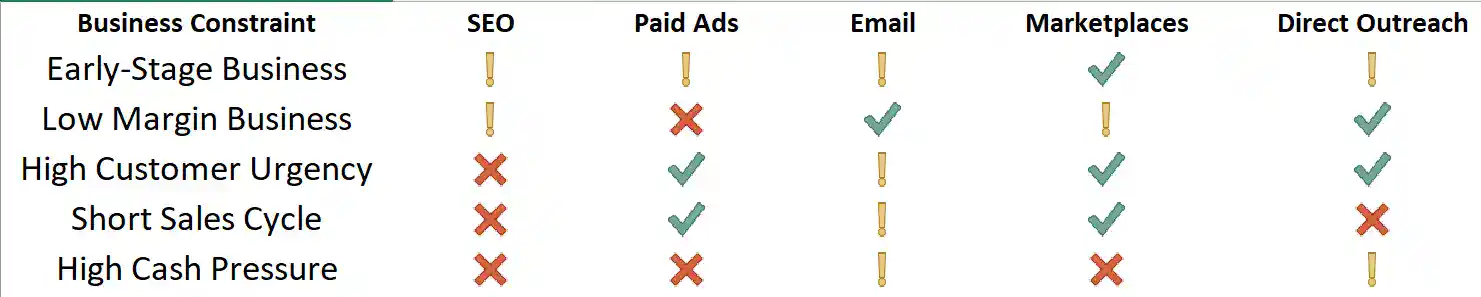
Quick note on the matrix above: it’s a deliberately simple “rule of thumb” chart — not scripture. The goal is to prevent the most expensive mistake in online marketing: trying to run every channel at once, regardless of margin, urgency, sales cycle, or cash pressure.
Read it as:
- Green tick: a natural fit for that constraint.
- Yellow warning: possible, but conditional — it can work if your numbers, timing, and execution are solid.
- Red cross: usually a poor fit — it tends to punish you, especially under pressure.
And one important clarification (because it’s a common and costly misunderstanding): SEO is a compounding long-term asset — it is not an “urgent cash” lever. If you need revenue quickly, you generally prioritise high-intent channels first, then build SEO in parallel once the business can breathe.
Profit appears when the problem, the offer, and the channel fit the constraint.
When they don’t, activity just burns cash.
Where Profit Actually Comes From Online ↑ Back to contents
After all the diagrams, channels, and careful distinctions, it’s worth stating something unfashionably simple:
Profit online does not come from traffic.
Traffic is an input. Attention is a prerequisite. Neither is a business outcome. From an Online Business Engineering perspective, confusing these ideas is one of the most common causes of disappointment.
Profit comes from a much narrower set of conditions lining up at the same time:
- a real problem that somebody already wants solved,
- a solution that does the job without introducing new pain,
- a price that leaves room for error,
- and a path to purchase that doesn’t require heroics.
Miss any one of those and the website will still work perfectly — just not commercially. This is why Online Business Engineering starts with economics and behaviour, not design or traffic.
This also explains why so many online businesses sound busy but feel broke. They optimise pages, tweak copy, run campaigns, install tools — yet profit remains elusive.
From an Online Business Engineering standpoint, that’s not a mystery. It’s a system producing exactly the outcome it was designed to produce.
Revenue Is a Lagging Indicator
Revenue shows up at the end of the chain, not the beginning. If you focus on it directly, you tend to apply pressure in the wrong places.
Businesses that approach growth through Online Business Engineering tend to focus upstream instead:
- clarity of offer,
- fit between channel and buyer intent,
- and friction removal at the decision points that actually matter.
This is why we often push clients to slow down at the start. Not because speed is bad — but because direction matters more.
We’ve laid this out in detail elsewhere, especially when helping business owners decide whether an ecommerce site even makes financial sense in the first place: Calculating Online Investment and Profit for an Ecommerce Business Website .
Why “More” Rarely Fixes a Broken Model
When profit is missing, the default reaction is to add things:
- more products,
- more pages,
- more channels,
- more automation.
Occasionally this works by accident. More often it increases operating cost while leaving the underlying economics unchanged.
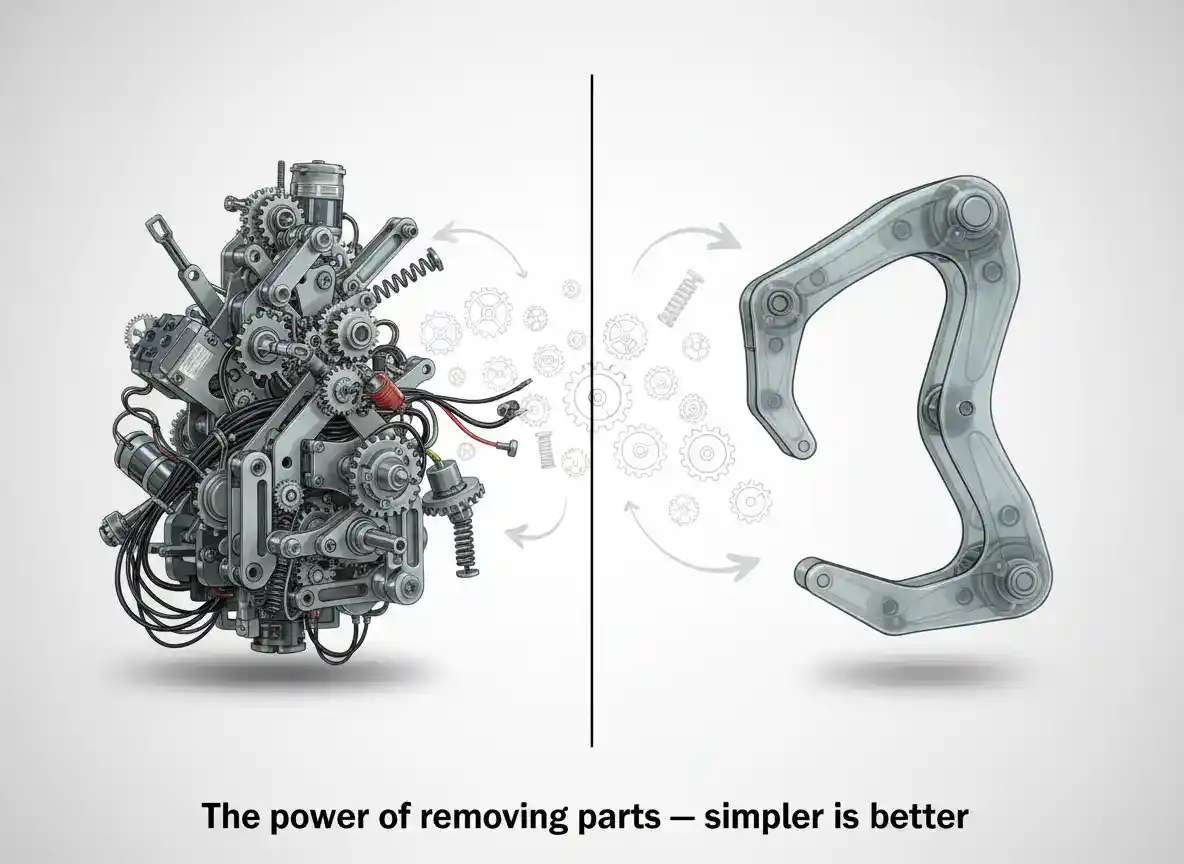
Online Business Engineering goes the other way. You remove moving parts until the relationship between effort and return becomes visible. Only then does scaling make sense.
That restraint is uncomfortable. It feels slow. It looks unimpressive on a pitch deck.
It is also where profit tends to appear.
Profit doesn’t reward activity.
It rewards alignment.
What This Means in Practice for Business Owners ↑ Back to contents
Up to this point we’ve talked about flow, channels, sales versus business development, and where profit actually comes from. This is where Online Business Engineering stops being a theory and becomes a set of decisions you can act on.
If you are a business owner — especially one who has already tried “going online” — the question is not whether the ideas make sense. It’s whether they change what you do next.
The Online Business Engineering Reality Check
Before spending another dollar or redesigning another page, we suggest answering the following honestly:
- What specific problem does my business solve — and for whom?
- How urgent is that problem in real life?
- Where do customers already go when that problem becomes uncomfortable?
- Which channel fits that behaviour now, not in an ideal future?
- Is my website supporting that channel — or pretending to support all of them?
These are not marketing questions. They are Online Business Engineering questions. They deal with constraints, behaviour, and sequencing — not trends.
What to Do on Monday Morning
Most advice collapses at this point into “it depends” and quietly exits. So here’s a more concrete starting point.
- If cash pressure is high, prioritise direct, high-intent activity before long-term assets.
- If margins are thin, avoid channels that charge you for attention before trust exists.
- If urgency is low, stop trying to accelerate decisions that customers aren’t ready to make.
- If the sales cycle is long, design your website to educate and reassure — not to rush.
This is the difference between assembling tools and engineering a system. Online Business Engineering does not reject marketing; it places it where it belongs.
Why This Feels Different (and Often Uncomfortable)
Engineering approaches tend to remove options before adding them. That can feel limiting — especially in an online world full of “growth hacks” and shiny platforms.
But limitation is what creates clarity. When you stop trying to be everywhere, the work that actually matters becomes obvious.
This is also why businesses that adopt Online Business Engineering often report an unexpected side effect: less noise, fewer tools, and calmer decision-making.
That calm is not a lack of ambition. It’s the absence of self-inflicted complexity.
Engineering doesn’t remove creativity.
It removes confusion.
Simple is better. Reliability comes from removing parts.
Bringing It All Together ↑ Back to contents
If there’s a single idea running through this entire piece, it’s this: most online business failures are not caused by lack of effort, creativity, or tools. They are caused by poor alignment.
Websites are built before channels are chosen. Channels are chosen before the problem is properly defined. And complexity is added long before the basics are working.
Online Business Engineering exists to reverse that order.
It starts with reality: the customer’s problem, the urgency of that problem, the business’s constraints, and the economics that sit underneath everything else. Only then do channels, websites, content, and automation make sense.
This is why two businesses can use the same platform, the same tools, and even the same agency — and end up with wildly different outcomes. One is assembling parts. The other is engineering a system.
When done properly, Online Business Engineering does not feel frantic. It feels calmer, more deliberate, and often surprisingly simple.
That simplicity is not a lack of ambition. It is the absence of self-inflicted complexity.
Good systems don’t shout.
They work quietly in the background.
Frequently Asked Questions about Online Business Engineering ↑ Back to contents
These are the questions we hear most often from business owners who are trying to make their website (and their online marketing) actually pay for itself.
What is Online Business Engineering, in plain English? +
Online Business Engineering is the discipline of designing your online business as a system that produces profit reliably. It combines customer problem definition, channel selection, website structure, measurement, and sequencing — so you build the right things in the right order, instead of adding tools until you run out of patience or money.
How is Online Business Engineering different from “digital marketing”? +
Digital marketing is usually focused on tactics: ads, SEO, social, funnels, email campaigns. Online Business Engineering is focused on constraints and outcomes: what your business can afford, how customers decide, what channel fits the situation, and what changes will actually move profit — not just activity.
Do I need a full website to start an online business? +
Not always. Many businesses are better off starting with a single landing page, a marketplace listing, direct outreach, or a simple “proof and enquiry” page while they validate demand. Online Business Engineering avoids building large websites too early because they can become expensive substitutes for clarity.
Can SEO help if I need sales quickly? +
Usually no. SEO is a compounding long-term asset — not an “urgent cash” lever. If you need revenue quickly, Online Business Engineering typically prioritises high-intent activity first (direct outreach, marketplaces, carefully controlled ads), then builds SEO in parallel once the business can breathe.
What if my business has low margins — can paid ads still work? +
Sometimes, but it’s risky. Low margins usually mean you don’t have room for expensive experimentation. Online Business Engineering will normally push you toward lower-cost, higher-control channels first (email to an owned list, direct outreach, partnerships, marketplaces where appropriate), and only introduce paid ads when the economics are proven.
How do you decide which marketing channel is “right”? +
We start with constraints: customer urgency, sales cycle length, margin size, cash pressure, and business stage. Then we choose the smallest set of channels that can work now, and design the website to support those channels properly. That selection process is a core part of Online Business Engineering.
What does a website need to do to support Online Business Engineering? +
It depends on the chosen channel and buyer intent. A website built to support SEO needs depth, structure, and trust signals. A website supporting direct outreach needs clarity, proof, and fast conversion paths. Online Business Engineering treats the website as a component in a larger system — not the system itself.
How long does it take to see results from Online Business Engineering? +
Some improvements are immediate (clarifying the offer, removing friction, focusing channels). Others compound over time (SEO, reputation, content depth, email list growth). The aim of Online Business Engineering is not “instant miracles” — it’s building a system that produces reliable results and gets stronger month by month.
Is Online Business Engineering only for ecommerce? +
No. It applies to service businesses, B2B, local businesses, consultants, and ecommerce. Any business with a customer journey, a channel strategy, and a need for profit can benefit from Online Business Engineering.
What’s the first step if I want to apply Online Business Engineering to my business? +
Start by identifying your most painful constraint (cash pressure, low margin, long sales cycle, low urgency, weak differentiation). Then stop adding tools and ask: “What is the smallest change that improves alignment?” That mindset shift is the beginning of Online Business Engineering.
If your website isn’t making money, it’s not “broken”.
It’s usually just doing the wrong job.
Reference Links (Internal + External) ↑ Back to contents
Internal References (Sydney Business Web) ↑ Back to contents
| Link | Why it matters for Online Business Engineering |
|---|---|
| Online Business Engineering (Foundational article) | Original definition and top-down profit-centre framing of Online Business Engineering. |
| Calculating Online Investment & Profit | Break-even analysis, margin logic and ROI modelling before committing to ecommerce spend. |
| Email Marketing | Owned-audience strategy: retention, repeat purchase and long-term asset building. |
| Business Website Specification | Requirements-first website engineering — clarity before construction. |
| Business Development vs Selling | Sales sequencing under constraint — the “rent is due” reality check. |
| The Ten Worst Products to Sell Online | Product viability, impulse vs considered buying, and margin reality. |
| Business Websites, eCommerce & SEO (Archive Hub) | Supporting articles reinforcing channel alignment and system design. |
| Business Team (Credentials & Experience) | Professional background, engineering pedigree and commercial experience. |
| Sydney Business Web FAQ | Practical answers to implementation, timelines and commercial structure. |
External References (Research, Frameworks & Authority Sources) ↑ Back to contents
| Source | Relevance to Online Business Engineering |
|---|---|
| Google Search Central — SEO Starter Guide | Primary-source SEO fundamentals. System design begins with platform reality. |
| Harvard Business Review — Jobs To Be Done | Functional, social and emotional job framing — why customers actually buy. |
| Nicholas Kusmich — Paid Media & Buyer Psychology | Constraint-driven offer positioning and high-intent messaging architecture. |
| Ehrenberg-Bass Institute — Evidence-Based Marketing | Empirical research on how brands grow — discipline over superstition. |
| Seth Godin — Permission Marketing | The conceptual backbone of owned audiences and list equity. |
Align the problem with the offer.
Align the channel with the constraint.
Align the economics with the goal.
Then profit follows.
CONTACT SYDNEY BUSINESS WEB NOW!
get started online NOW with your ONLINE BUSINESS ENGINEERING