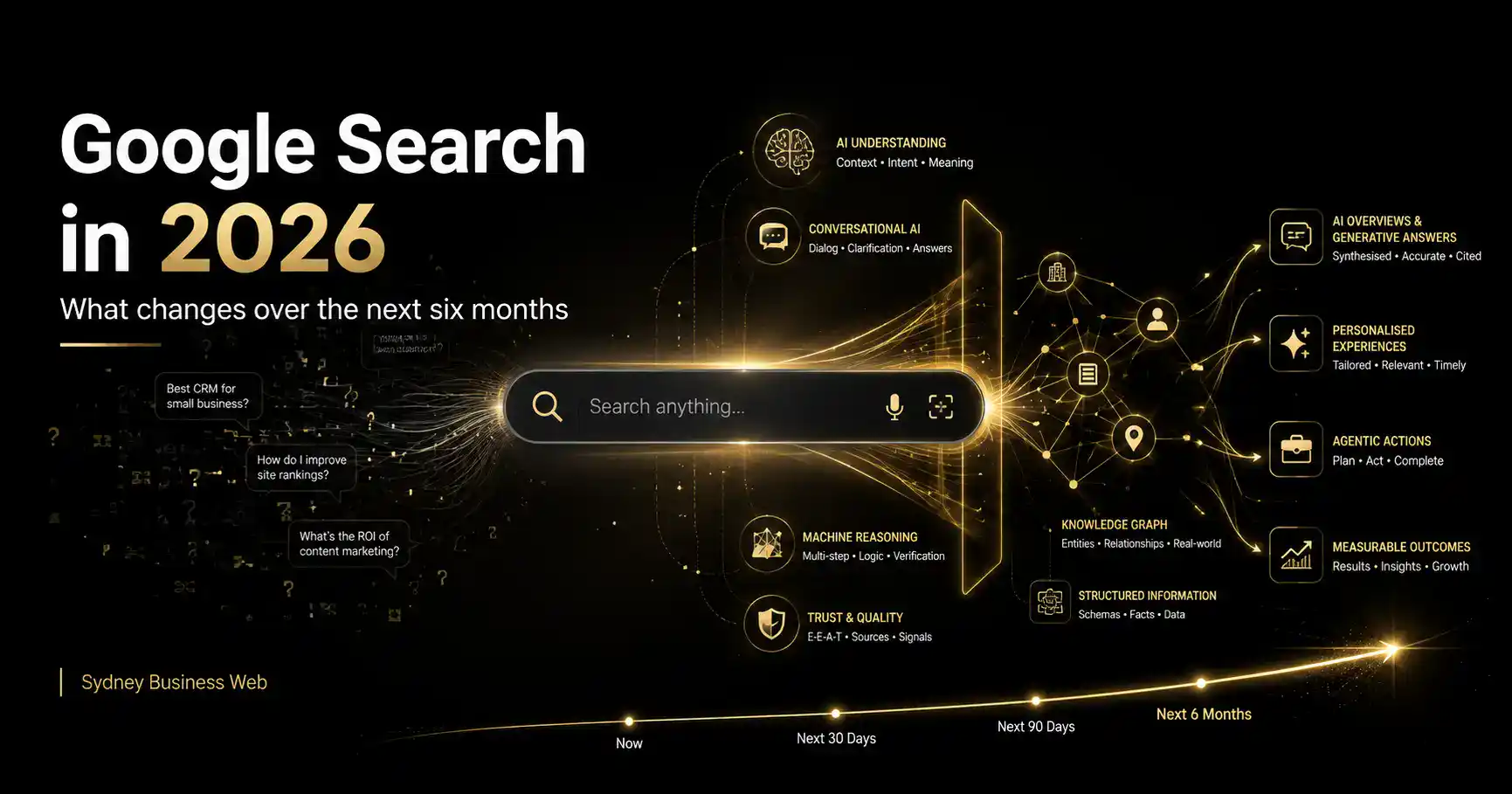
Google Search in 2026
Fact, inference and invention
The Dangerous Difference Between Fact and AI Inference
While preparing this article, I asked Google’s own AI Search system what was happening to Google Search, where it was heading over the next six months, and how Sydney Business Web and its customers should prepare.
The answer was impressive: detailed, confident and technically sophisticated. It referred to rising infrastructure expenditure, the expansion of AI Mode, emerging Search Console reporting and the development of agents capable of gathering information and completing tasks.
It also supplied precise timelines. It predicted an Australian rollout window for generative-search reporting and described forthcoming penalties against “unresolved entities.”
There was only one problem: Google had announced no such update, timetable or Australian rollout schedule.
The model had combined genuine public facts with reasonable engineering inferences, added unsupported predictions and presented the entire construction as verified reality.
This was not merely an amusing hallucination. It demonstrated one of the central weaknesses of generative search: the failure to preserve the boundary between established fact, reasonable inference and invention.
When Plausibility Masquerades as Evidence
None of the fabricated claims sounded absurd. They fitted the direction in which Google Search appears to be moving. Google does need stronger grounding, fewer hallucinations and more reliable corroboration.
That is exactly what made the answer dangerous. The invented claims were surrounded by enough truth to appear authoritative.
Information that appears coherent at the surface level but becomes contradictory or unreliable when its sources, relationships and provenance are examined.
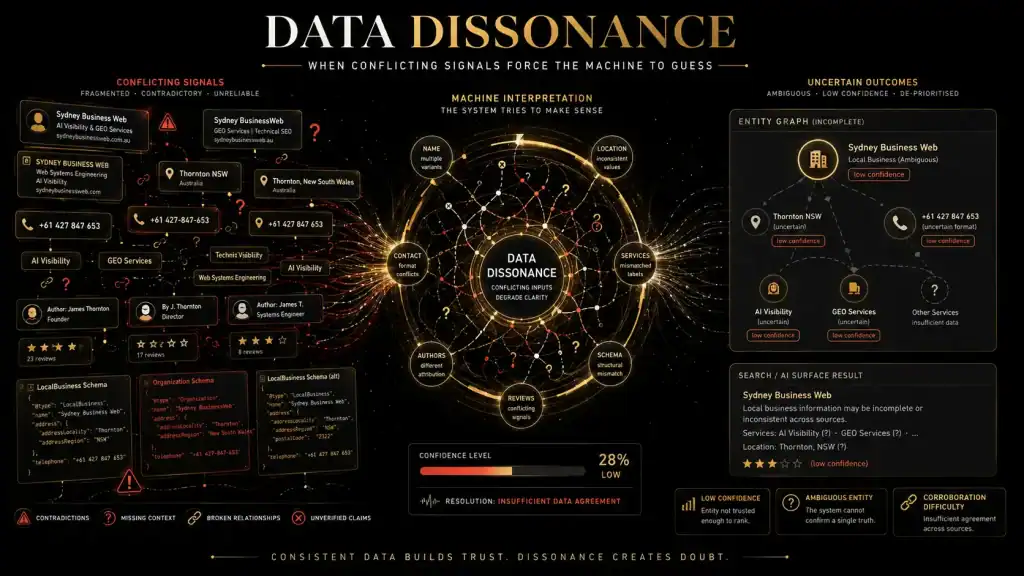
Businesses create the same problem when their names, addresses, services, people, credentials and claims differ across websites, structured data, social profiles, business listings, databases and external references.
An automated system must then decide which version is correct. Where direct evidence is missing, it may infer an answer. Where several interpretations remain plausible, it may select the wrong one—or avoid selecting the business at all.
The Lesson for Businesses
The lesson is not that AI Search is useless. Once the unsupported claims were challenged, the model accepted the corrections and helped produce a much stronger framework for this article.
The lesson is that confidence is not evidence.
Confirmed
What Google has officially announced and documented publicly.
Strongly Suggested
What current evidence and sound engineering principles reasonably indicate.
Prepared For
What Sydney Business Web believes organisations should build towards.
That distinction will guide the rest of this analysis.
Key point: AI systems become dangerous when they merge fact, inference and invention without identifying the difference. Businesses create a similar risk when their digital identity is fragmented, contradictory or unsupported by clear evidence.
Commercial strength and infrastructure pressure
The Capital and Computing Reality Behind AI Search
Google is not facing a revenue collapse. Its Search business remains enormously profitable—but rebuilding the world’s dominant search engine around generative AI requires extraordinary computing infrastructure.
Search remains enormously strong
Google’s AI features are increasing the number, length and complexity of the searches people perform.
The transformation is capital-intensive
Generative retrieval, synthesis, grounding and agentic systems demand enormous investment in chips, data centres, energy and supporting infrastructure.
Strong Revenue, Enormous Capital Demand
These are not the numbers of a company fighting for corporate survival. They are the numbers of a company financing an immense technological transformation.
Alphabet’s total quarterly revenue reached almost US$119.8 billion, while its operating margin increased to 34 per cent.
Its negative quarterly free-cash-flow figure does not mean Google is running out of money. Alphabet still generated more than US$53 billion in free cash flow over the preceding twelve months.
What the figures reveal is the immense capital intensity of the transition now under way.
Search is no longer being developed merely as a system that retrieves ten links from an index. Google is building an environment that can interpret longer questions, divide them into related searches, retrieve evidence, compare sources, synthesise responses, maintain a conversation and, increasingly, take action for the user.
AI Search Is No Longer an Experiment
Google says AI Mode has surpassed one billion monthly users.
The average AI Mode query is approximately three times longer than a conventional Google search.
AI Overviews operate at an even greater scale. These systems must serve enormous numbers of people while preserving the speed and reliability users expect from Google Search.
A conventional result may be assembled by matching a query against an existing index, ranking the pages and displaying a list of links. A generative answer can involve several additional stages:
- Interpret the user’s underlying intent.
- Divide a complex question into related searches.
- Retrieve information from multiple sources.
- Assess whether those sources agree.
- Construct a useful consolidated answer.
- Select supporting pages or citations.
- Check the result for safety, quality and factual reliability.
Every additional stage creates computational cost—and another opportunity for ambiguity, weak evidence or contradictory information to damage the final answer.
The Economic Incentive for Better Information
Google has not stated that websites with elaborate schema graphs receive a ranking advantage because they are cheaper to process. Presenting that theory as confirmed fact would be irresponsible.
Google needs efficiency at extraordinary scale
Search must retrieve, interpret and synthesise information quickly enough to serve enormous numbers of users reliably.
Clear information removes avoidable friction
Accessible, internally consistent information is easier to retrieve and interpret than data scattered across contradictory pages, broken scripts and inaccessible systems.
Structured data can assist by expressing important facts and relationships explicitly. Initial HTML delivery can reduce dependence on complex browser rendering. Consistent names, services, locations and authorship reduce the number of plausible interpretations available to an automated system.
None of those measures guarantees selection by Google. Nor do they remove the continuing importance of useful content, reputation, links, user intent and external authority.
They do, however, remove avoidable technical friction.
Search Is Becoming a System of Interpretation
The most important change is not simply that Google is placing generated text above traditional results. Search itself is becoming a system of interpretation.
Users are asking longer and more nuanced questions. Google is attempting to understand context, compare evidence and return a consolidated response rather than merely locating pages containing matching phrases.
The wider digital system must therefore make the following reasonably clear:
Google may be commercially stronger than ever, but the reconstruction of Search around AI is placing immense pressure on its infrastructure and information-quality systems.
The next phase of Search will therefore be shaped not only by more powerful models, but by the continuing struggle to provide those models with information they can retrieve, interpret and corroborate reliably.
Key point: Google is not in a revenue crisis. It is undertaking an extraordinarily capital-intensive reconstruction of Search. That creates a powerful incentive to reduce technical friction and uncertainty—but it does not prove that large or complicated schema graphs receive an automatic ranking advantage.
The structure AI needs
The Intelligent Entity Skeleton
A connected technical map of the real business: what it is, what it does, who stands behind it, and how its services, expertise, content and supporting evidence relate. The Intelligent entity Skeleton gives search and AI systems a clearer foundation from which to interpret the organisation without depending entirely on guesswork.
Level 01 — documented public facts
What Google Has Officially Confirmed
Google’s public announcements already reveal a substantial change in the structure of Search: generative visibility is becoming measurable, conversational search is operating at enormous scale, and search systems are beginning to gather information and act on behalf of users.
These developments reinforce the importance of technically accessible, clearly expressed and internally consistent business information. The exact algorithmic weight of individual signals remains unpublished, but the direction of travel is no longer theoretical.
Generative AI Visibility Is Becoming Measurable
In June 2026, Google announced dedicated Generative AI performance reporting within Search Console for Search and Discover.
The reports are designed to show when URLs from a website appear within generative features such as AI Overviews and AI Mode, providing site owners with a direct view of their presence within Google’s emerging AI Search environment.
Google is initially making these reports available to a subset of websites while it tests the system and gathers feedback before broader availability.
The reports will not attribute an appearance to one particular schema block or page change, but they give engineers a much stronger basis for observing patterns and testing improvements over time.
Official Google Search Central announcementGoogle Confirms That Established Technical Foundations Still Matter
Google has stated that no separate AI-only markup language is required for inclusion in AI Overviews or AI Mode. The technical foundations that support conventional Search remain central to generative Search as well.
Google continues to emphasise crawlable pages, accessible textual content, internal linking, sound page experience, accurate business information and structured data that agrees with the visible human-readable content.
This strengthens rather than diminishes the case for advanced entity architecture. Its value does not come from adding code for its own sake. It comes from making an organisation’s identity, people, services, locations, evidence and relationships explicit and coherent.
A carefully engineered graph gives automated systems a connected representation of the business instead of forcing them to assemble that understanding from isolated statements and disconnected metadata.
Official Google guidance for AI featuresGoogle Search Is Beginning to Take Action
Google has described the next phase of Search as an era of Search agents: systems that can reason across information, monitor changing conditions and assist users with defined tasks.
Google is expanding agentic capabilities across shopping, local services, information gathering and bookings. A user may describe detailed requirements while Search gathers relevant options, compares current information and assists with the next practical step.
Google may use several methods to bridge the gap between users and businesses, including direct links, merchant systems, booking platforms and automated calls.
The important strategic point is that business information is no longer being prepared only for human browsing. It is increasingly being interpreted by systems that may need to identify a service, confirm its availability and assist the user in taking action.
Official Google Search announcementGenerative Search Is Now Part of Mainstream Search Behaviour
AI Search is no longer a small experimental layer. Google says AI Overviews reaches more than 2.5 billion monthly active users, while AI Mode has surpassed one billion monthly active users.
Google also reports that people search more when using its AI-powered features and increasingly treat Search as an ongoing conversation rather than a sequence of isolated keyword queries.
Websites and supporting sources remain integral to this process. Google’s generative systems still depend on the wider web for the information, evidence and corroboration used to construct useful answers.
The commercial challenge for businesses is therefore not simply to rank for a short phrase. It is to become a clear, credible and retrievable source within a much broader process of machine interpretation.
Google I/O 2026 keynoteAn Important Boundary
Google has not published the precise weighting assigned to structured data, entity consistency, external corroboration or other individual signals inside its generative systems.
That uncertainty should prevent false promises—not prevent sound engineering. Google’s published guidance consistently supports crawlability, accessible content, accurate structured data, reliable business information and technically sound delivery.
Sydney Business Web builds beyond the minimum requirement because fragmented identity data, disconnected schema and contradictory evidence remain avoidable weaknesses regardless of the exact weight assigned to them by any individual search system.
Google’s confirmed direction strongly favours businesses that can be understood as coherent organisations—not merely collections of loosely connected pages.
Key point: Google has confirmed the expansion of measurable generative visibility, conversational Search and agentic capabilities. The businesses best prepared for that environment will be technically accessible, clearly structured, internally consistent and supported by evidence that automated systems can retrieve and corroborate.
Level 02 — evidence and engineering principles
What the Evidence and Engineering Principles Strongly Suggest
Google does not publish the precise internal weighting of every signal used by its generative systems. But the absence of a public formula does not leave businesses without a rational engineering strategy.
Several conclusions follow directly from the practical requirements of automated retrieval, entity resolution, corroboration and reliable information delivery.
Ambiguity Creates Risk
When several conflicting versions of a business exist across the web, automated systems must decide whether those records describe the same organisation and which version is current.
Explicit Relationships Improve Clarity
Clearly defined links between organisations, people, services, credentials, locations, evidence and external references reduce the amount of interpretation required.
Reliable Delivery Comes First
Even excellent content and structured data cannot assist an automated system if the server blocks retrieval, returns errors or delivers an incomplete initial document.
Contradictory Information Makes Entity Resolution Harder
A real organisation rarely exists online as one neat record. It may be represented by a legal business name, a trading name, several service pages, individual staff profiles, social accounts, historical addresses, directory listings and external references.
The task facing an automated system is to determine which records belong together and whether they support a coherent understanding of the same entity.
Every contradiction introduces another plausible interpretation
The system may need to reconcile several versions of apparently simple business information:
Google’s exact internal scoring mechanisms remain private. Nevertheless, contradictory identity data plainly makes confident interpretation and corroboration more difficult.
The engineering response is not to add more promotional content. It is to identify the contradictions, determine the authoritative version and connect the supporting evidence clearly.
Coherence Matters More Than Schema Size
Structured data is most useful when it represents the real organisation accurately and connects its important relationships deliberately.
A large graph is not automatically a good graph. Equally, the fact that complexity alone earns no reward does not diminish the value of advanced schema engineering.
Sophisticated architecture becomes valuable when the complexity reflects genuine business structure and is organised coherently.
Markup without architecture
- Disconnected schema blocks generated by several plugins
- Different names or identifiers for the same organisation
- People, services and evidence left as isolated statements
- Structured claims that do not match visible content
- No clear relationship between internal and external evidence
A connected entity architecture
- Stable identifiers reused consistently across the system
- People, services, pages and evidence connected explicitly
- Structured data aligned with visible content
- Business information reconciled across relevant platforms
- External corroboration linked to the entities it supports
This is the practical value of the Schema Gorilla. It is not a contest to produce the largest possible block of JSON-LD. It is an implementation architecture for representing a complex organisation as one understandable, interconnected system.
Machine-Readable Understanding Is Built in Layers
No single technical feature creates reliable AI visibility by itself. Strong machine-readable understanding emerges when several layers support one another.
Each layer strengthens the others. Visible content gives the structured data meaning. Structured data makes relationships explicit. External evidence supports the claims. Reliable server delivery ensures that the entire system can actually be retrieved.
Server-Side Hygiene Is a Foundational Requirement
Many AI Visibility discussions begin with content and end with schema. That overlooks the infrastructure responsible for delivering both.
A technically sound entity architecture provides little value if legitimate crawlers encounter firewall blocks, persistent server errors, redirect loops, corrupted caching or incomplete rendered output.
This is why genuine AI Visibility work extends beyond marketing. It involves content, data architecture, schema implementation, server configuration, diagnostic testing and the reconciliation of external evidence.
The strongest AI Visibility architecture does not attempt to trick the machine. It removes unnecessary ambiguity and gives the machine a clearer, more strongly supported version of the truth.
Key point: Google has not published the precise weight assigned to entity consistency, structured relationships or external corroboration. Sound engineering nevertheless leads to a clear conclusion: businesses are better prepared when their information is accessible, coherent, explicitly connected and supported by evidence.
Level 03 — the Sydney Business Web response
What Businesses Should Prepare for Now
Waiting for Google to publish a complete AI Visibility checklist would mean preparing only after the transition has already taken place. Businesses can act now on the technical principles that remain valuable across search engines, AI systems and emerging automated agents.
Sydney Business Web does not build around guessed ranking tricks. We engineer the organisational structure, evidence and delivery systems that make a real business easier for machines to identify, understand, corroborate and act upon.
The Intelligent Entity Skeleton
The Intelligent Entity Skeleton establishes the connected structure of the real organisation: the business itself, its legal identity, people, services, locations, pages, expertise, evidence and external references.
Instead of asking an automated system to reconstruct the business from disconnected fragments, the framework deliberately identifies the important entities and defines how they relate.
The Schema Gorilla
The Schema Gorilla translates the organisation’s real structure into a coherent machine-readable architecture.
Its purpose is not to create the largest possible block of markup. It is to ensure that relevant entities share stable identifiers, relationships are expressed explicitly and structured claims agree with the visible content and supporting evidence.
The AI Credibility Footprint
A business is not represented only by its own website. Automated systems may encounter company records, business listings, social profiles, professional histories, reviews, articles, directories and historical data.
The AI Credibility Footprint examines that wider evidence environment. It identifies contradictions, missing provenance and unsupported claims, then strengthens agreement between the internal source of truth and the external sources that corroborate it.
The AI Credibility Footprint examines whether the organisation’s identity, expertise and claims remain coherent when automated systems compare the website with external evidence.
Agentic Readiness
Agentic Search changes the practical role of a business website. The system may no longer be used solely to inform a person. It may also be consulted by an automated agent attempting to compare services, confirm details, make contact or initiate a transaction.
Agentic Readiness prepares the business for that interaction. It combines accessible service information, dependable forms, stable contact details, technically sound workflows and machine-readable endpoints where they provide genuine operational value.
These Frameworks Are Designed to Work Together
Each framework addresses a different layer of the same problem. The Intelligent Entity Skeleton defines the organisation. The Schema Gorilla expresses its relationships technically. The AI Credibility Footprint strengthens agreement across the wider evidence environment. Agentic Readiness prepares the operational system for action.
None of this depends on guessing the name of Google’s next update. It prepares the business for a search environment in which identity, evidence, technical accessibility and operational reliability are increasingly examined together.
Sydney Business Web is not adding an AI marketing layer to conventional web design. We are engineering the connected organisational foundation that increasingly intelligent search systems need to interpret.
Key point: The Intelligent Entity Skeleton, Schema Gorilla, AI Credibility Footprint and Agentic Readiness are not speculative ranking tricks. Together, they create a clearer, more coherent and more operationally dependable representation of the real business.
August 2026 to January 2027
The Next Six Months: A Practical Preparation Horizon
Google has not published a month-by-month roadmap for Australian businesses. The next six months should therefore be treated as a preparation horizon—not as a prediction of secret updates or guaranteed rollout dates.
The objective is not to guess what Google will announce next. It is to use the coming six months to remove technical weaknesses, establish a coherent organisational structure and build evidence that remains valuable as Search becomes more generative and capable of action.
Prepare in layers, not through isolated fixes
The work should progress from diagnosis to engineering and then to validation. Adding schema or publishing more content before the underlying identity and evidence have been reconciled merely places new material on top of unresolved weaknesses.
Diagnose the Existing Digital Reality
Begin by determining what search engines and AI systems can currently retrieve, how the organisation is represented and where contradictory information exists.
Engineer the Entity and Evidence Foundation
Once the authoritative source of truth has been established, the organisation can be represented deliberately across its visible content, technical architecture and wider evidence environment.
Validate, Measure and Prepare for Action
The final phase is not a declaration that the work is finished. It establishes a repeatable validation process so that technical failures, new contradictions and emerging opportunities can be detected over time.
What a Business Should Have Achieved by January 2027
The exact Google products available by January 2027 may differ between regions, industries and individual websites. The technical outcome, however, can be defined clearly.
This Is Not a Guaranteed Ranking Timeline
No responsible engineer can promise that a particular business will receive a specified number of AI citations or ranking improvements within six months.
What can be achieved is the systematic removal of preventable weaknesses: inaccessible content, fragmented schema, contradictory identity data, unsupported claims and unreliable operational systems.
That work creates a stronger digital asset regardless of the exact date on which Google expands a particular report, agent or generative feature in Australia.
The businesses that use the next six months to establish clear identity, connected evidence and dependable systems will enter 2027 better prepared than those still waiting for an official AI optimisation checklist.
Key point: The next six months are not a speculative Google roadmap. They are a practical engineering window in which businesses can diagnose ambiguity, construct a coherent entity and evidence architecture, measure retrieval and prepare their systems for increasingly agentic Search.
Conclusion
Content Cannot Fix a Broken Architecture
Google has not published a secret AI Visibility checklist. But the transformation of Search is unmistakable: it is becoming more conversational, more evidence-seeking and increasingly capable of acting on behalf of the user.
The future of Search will not be won by whoever publishes the greatest volume of confident marketing claims. It will favour businesses that can be identified, understood, corroborated and reached reliably.
Traditional content remains important. Businesses still need useful pages, expert explanations, original insight and clear answers to genuine customer questions.
But content cannot carry the entire burden of machine understanding.
It cannot resolve contradictory identities across the web. It cannot repair broken canonical structures, inaccessible server responses or disconnected schema. It cannot prove who authored a claim, which organisation provides a service or whether the evidence supporting that service agrees across reliable sources.
Search Is Becoming Generative
Google is increasingly assembling answers across multiple sources instead of simply presenting a list of pages containing matching phrases.
Search Is Becoming Evidential
Organisations must be represented through information that is coherent, attributable and capable of being corroborated beyond a single self-promotional page.
Search Is Becoming Agentic
Increasingly capable systems will not merely read business information. They will compare options, gather details and help users proceed towards action.
The Competitive Difference Is Architectural
Many agencies have responded to AI Search by adding a new label to an old
service. They offer more articles, additional schema snippets, prompt
monitoring or an llms.txt file and present the package as a
complete AI Visibility strategy.
Those elements may contribute to a wider programme, but they do not create an authoritative representation of a business on their own.
The deeper task is to establish a dependable source of truth for the organisation’s identity, people, services, locations, expertise, relationships and evidence.
That truth must then remain coherent across visible content, structured data, technical systems and relevant external sources.
The objective is not merely to tell the machine that a business is credible. It is to construct a technical and evidential system through which that credibility can be understood.
The Sydney Business Web Approach
Sydney Business Web approaches AI Visibility as a systems-engineering problem rather than a cosmetic marketing exercise.
None of these frameworks depends on pretending that we know the name or exact weighting of Google’s next algorithm update.
Their value is more durable than that. They remove preventable ambiguity, expose important relationships, strengthen provenance and improve the reliability with which both humans and machines can interact with the business.
Where Google Search Is Going Next
Over the next six months, we expect Google to continue expanding generative reporting, conversational discovery, grounded answers and agentic capabilities.
Exact rollout dates will vary, and Google’s internal ranking mechanisms will remain largely unpublished. But businesses do not need to wait for perfect visibility into the algorithm before improving the quality of the systems that represent them.
An organisation that enters 2027 with a coherent identity, explicit relationships, stronger corroboration and dependable technical pathways will be better prepared than one still relying on content volume, disconnected plugins and unsupported promises.
Find Out How Clearly AI Systems Can Understand Your Business
An AI Visibility Review examines technical accessibility, entity structure, data dissonance, structured relationships, external evidence and readiness for increasingly generative and agentic Search.
Request an AI Visibility ReviewFinal point: Content can explain a sound business architecture, strengthen it and give it reach. But content cannot fix a broken architecture. First make the organisation accessible, coherent, connected and evidentially supported. Then give the machine something trustworthy to retrieve.
Continue the investigation
Explore the Sydney Business Web Approach
These resources explain the services, technical principles and engineering frameworks behind the approach outlined in this article.
AI Visibility Services and Pricing
Explore the review, entity engineering, credibility and validation services available to businesses preparing for generative and agentic Search.
View the service Technical ExplainerWhat AI Visibility Actually Means
See why genuine AI Visibility extends beyond conventional SEO, isolated schema snippets, prompt tracking and additional content.
Read the explainer Engineering AnalysisThe Mid-2026 AI Search Turmoil
Examine the instability affecting AI Search and the engineering-led response based on accessibility, entity structure, evidence and technical integrity.
Read the analysisPrimary source material
Official Google and Alphabet References
The confirmed factual layer of this article is grounded primarily in Google’s own Search documentation, product announcements and Alphabet’s official financial reporting.
Generative AI Performance Reports
Google’s announcement introducing dedicated Search Console reporting for visibility within generative Search and Discover features.
Open the announcement Google DocumentationAI Features and Website Requirements
Google’s guidance covering crawlability, visible content, structured data and the established technical foundations used by AI Overviews and AI Mode.
Read Google’s guidance Google Search — I/O 2026Search Agents and the Next Phase of Search
Google’s description of expanding conversational, information-gathering, comparison and agentic capabilities within Search.
View the Search announcement Google I/O 2026The Scale of AI Overviews and AI Mode
Sundar Pichai’s keynote covering the scale, adoption and strategic importance of Google’s generative Search products.
Read the keynote Google Product UpdateGenerative Search and Web Sources
Google explains how AI Mode and AI Overviews connect users with original web content and supporting sources.
Read the product update Alphabet Investor RelationsAlphabet Financial Reporting
Alphabet’s official investor materials provide the revenue, capital-expenditure, margin and cash-flow figures examined in this article.
View investor reportingExternal references open in a new tab. They support the documented factual layer of the article; forward-looking conclusions remain identified as engineering interpretation or Sydney Business Web’s strategic position.
Frequently asked questions
Google Search, AI Visibility and the Next Six Months
Clear answers to the main questions businesses are asking as Google Search becomes increasingly generative, evidence-seeking and capable of taking action.
Is AI Visibility simply another name for SEO?
No. Conventional SEO remains an important part of discoverability, but AI Visibility extends further. It examines whether automated systems can identify the organisation, understand its services, connect its people and evidence, corroborate its claims and retrieve its information reliably.
It therefore involves content, technical SEO, entity architecture, structured data, server delivery, external corroboration and readiness for machine-mediated action.
Does Google require special AI schema for AI Overviews or AI Mode?
Google has not announced a separate AI-only schema requirement. Its established technical foundations continue to apply: crawlable pages, accessible content, accurate structured data, sound internal linking and reliable business information.
This does not diminish advanced schema engineering. A coherent entity graph can make an organisation’s people, services, evidence and relationships substantially clearer to automated systems.
Does a larger schema graph automatically improve AI visibility?
Size alone is not the objective. The value of advanced structured data comes from accuracy, coherence and explicit relationships.
A connected graph using stable identifiers and information that agrees with visible content is more useful than a large collection of disconnected or contradictory schema blocks.
What is data dissonance?
Data dissonance occurs when different parts of a business’s digital footprint provide conflicting or poorly connected information.
Examples include inconsistent business names, addresses, service definitions, authorship, credentials, contact details or structured data. These contradictions make confident entity resolution and corroboration more difficult.
What is the Intelligent Entity Skeleton?
The Intelligent Entity Skeleton is Sydney Business Web’s framework for defining the connected structure of the real organisation.
It identifies the business, its legal identity, people, services, locations, pages, expertise, evidence and external references, then establishes the genuine relationships between them.
What is the Schema Gorilla?
The Schema Gorilla is the technical implementation architecture used to express a complex organisation as a coherent, machine-readable entity graph.
It replaces fragmented plugin output with stable identifiers, deliberate relationships and structured claims that agree with the visible website and supporting evidence.
What is the AI Credibility Footprint?
The AI Credibility Footprint examines how the organisation is represented beyond its own website.
It reviews business records, profiles, credentials, reviews, articles, directories and other relevant sources to identify contradictions, improve provenance and strengthen agreement between internal claims and external evidence.
What does Agentic Readiness mean for a business website?
Agentic Readiness means preparing a business for search systems that do more than display information. An automated agent may compare services, confirm details, gather availability, make contact or help a user begin a transaction.
The website therefore needs clear service parameters, dependable forms, stable contact information, reliable workflows and machine-readable endpoints where they provide genuine operational value.
What should businesses do over the next six months?
Begin with diagnosis: test crawler access, map the organisation’s entities, identify data dissonance and inspect the existing structured data.
Then build the entity and evidence architecture, improve technical delivery and establish a repeatable process for measuring generative visibility, reviewing server evidence and preparing operational pathways for increasingly agentic Search.
Can AI Visibility work guarantee rankings or AI citations?
No responsible provider can guarantee a particular ranking, citation or recommendation from an independent search or AI system.
What rigorous AI Visibility engineering can do is remove preventable weaknesses, improve technical accessibility, reduce ambiguity, connect evidence and make the business substantially easier for automated systems to interpret and corroborate.
Underlying principle: AI Visibility is not achieved through one file, one schema block or one collection of articles. It is created by making the real organisation accessible, coherent, connected and evidentially supported.
Take the next practical step
Find Out How Clearly AI Systems Can Understand Your Business
Talk directly with Sydney Business Web about technical accessibility, entity architecture, structured data, data dissonance, external corroboration and readiness for increasingly generative and agentic Search.
Prefer to speak directly? Call Keith on 0427 847 653