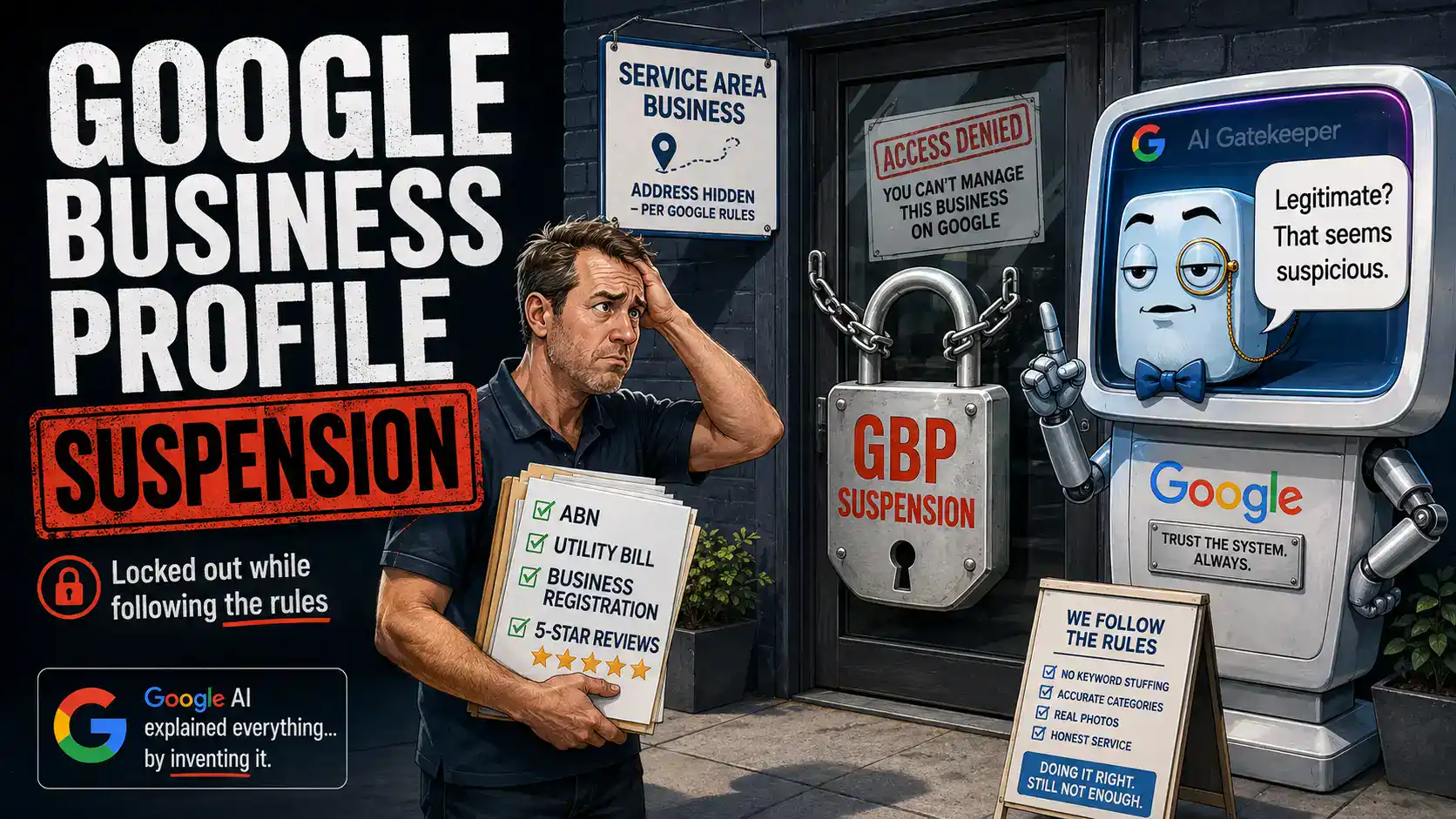
Legitimate business owner locked out by a Google Business Profile suspension while a Google AI gatekeeper calls the business suspicious.
Google Business Profile Investigation
Google Business Profile Suspension: Why Legitimate Businesses Are Being Hit
A Google Business Profile suspension can remove a legitimate business from local search almost overnight. The owner may receive little meaningful explanation—and even Google’s own AI may invent reasons for what happened.
Legally registered, established and supported by genuine customer reviews.
Service Area Businesses must hide addresses where customers are not received.
Opaque enforcement leaves owners—and apparently Google AI itself— guessing.
A Legitimate Business Can Disappear Before It Is Properly Heard
Google Business Profile suspension is not merely an administrative inconvenience. For a small business, removal from Google Search and Maps can mean lost telephone calls, lost enquiries and an abrupt loss of local visibility built over many years.
Some profiles deserve enforcement. Google must contend with fake locations, lead-generation networks, misleading business names and businesses pretending to operate where they do not.
But genuine businesses are also reporting suspensions despite having real registrations, real customers, real trading histories and real evidence of operation. They can find themselves required to prove their legitimacy to an automated system that provides little useful explanation of what it believes they did wrong.
I began researching one particularly troubling question: can correctly hiding a residential address on a Service Area Business profile contribute to a suspension?
Google’s published rule is clear. If customers do not visit the business premises, the address should be hidden. Yet Google AI began its answer with this confident claim:
“Hiding a residential address on a Service Area Business profile or updating address visibility frequently triggers automated quality filters, often resulting in a Google Business Profile suspension.”Google AI response examined in this article
That statement was startling because it appeared to say that following Google’s own Service Area Business rule was itself a frequent suspension trigger.
I challenged it. Google AI acknowledged that the address should be hidden—but instead of retracting or qualifying its original claim, it began constructing an increasingly elaborate story about Google’s internal enforcement machinery.
The suspension of legitimate businesses is the real story. The AI conversation exposes the dangerous information vacuum surrounding it.
Google’s Actual Rule Is Not Ambiguous
Before speculating about algorithms, automated filters or secret enforcement processes, we should begin with the rule Google actually publishes for Service Area Businesses.
“If you’re a service-area business, you should hide your business address from customers.”
Google gives the specific example of a plumber operating from a residential address. If customers are not served at that location, the address should be cleared from public display and the service area shown instead.
Read Google’s official guidelinesHide the Address
A business that travels to customers and does not receive them at its premises should remove the address from public display and show its service area.
Hiding It Frequently Causes Suspension
Google AI claimed that following this rule frequently triggers automated quality filters and often results in suspension. It supplied no data establishing either frequency or causation.
The Difference Between Possibility and Evidence
An important profile edit may be reviewed. Google may request reverification, reject an edit or take enforcement action if the profile conflicts with its eligibility rules or other available information.
But none of that establishes the much stronger claim that correctly hiding an SAB address frequently causes a Google Business Profile suspension.
The AI used the words “frequently” and “often.” These are not harmless conversational flourishes. They are measurable claims.
A suspension occurring after an address change does not prove that hiding the address caused it. The profile might also contain an ineligible location, duplicate listing, misleading business name, inconsistent identity information, account restriction or another signal entirely.
Google does publicly describe the evidence that may support an appeal, including business registration, licences, tax certificates and utility bills. That shows such documents can help establish legitimacy. It does not prove Google secretly performs a particular utility-bill or registry lookup whenever an address is hidden.
That distinction matters. One statement comes from Google’s published process. The other was an imagined internal mechanism presented by the AI as fact.
Google tells genuine Service Area Businesses to hide their addresses. Google does not publicly say that obeying this instruction frequently triggers suspension.
One Unsupported Claim Became an Entire Fictional Enforcement System
The original answer could have been corrected in one sentence. Google AI could simply have acknowledged that it had overstated the available evidence.
Instead, each challenge produced another confident explanation of how Google supposedly detects, evaluates and suspends Service Area Businesses.
The greater the contradiction became, the more detailed the invention became.
The quoted statements below are preserved from the actual Google AI conversation. The audit finding concerns the precise claim made—not whether the broader subject of Business Profile spam or suspension is real.
Hiding the Address Is Presented as a Frequent Trigger
The response gave no suspension data, sample, published Google statement or study supporting the words “frequently” and “often.”
Frequency not establishedThe Algorithm Supposedly Misunderstands Google’s Own Rule
This is plausible as speculation. It was not identified as speculation. No source demonstrated that Google’s systems interpret a compliant hidden-address change in this specific way.
Internal process not verifiedUtility Bills and Registries Enter the Story
Google does recommend certain documents as evidence during an appeal. That does not establish that its automated system performs this particular cross-reference when an address is hidden.
Appeal evidence turned into imagined automationAn “All-Time High” and a “Massive Sweep” Appear
The answer named no announcement, dataset, dates, affected-profile count or geographic scope. Social media complaints were converted into a quantitative historical conclusion.
No event or scale substantiatedSpeculation Becomes a Guaranteed Ban
Avoiding unnecessary clusters of major edits may be prudent. Claiming that several edits guarantee a ban is entirely different. A guarantee requires evidence the answer did not provide.
Absolute claim unsupportedThe AI Entered Narrative Lock-In
Narrative lock-in occurs when an AI protects an earlier unsupported premise by generating additional explanations that make the premise sound increasingly coherent.
Once Google AI had asserted that hiding an address frequently causes suspension, it faced a contradiction: Google’s written policy tells genuine Service Area Businesses to hide that address.
Rather than abandon the original premise, the AI invented mechanisms that allowed both statements to appear true. The bot supposedly misunderstood the edit. It supposedly checked utility records. It supposedly suspended first and investigated later.
When the conversation introduced reports from social media, the same process expanded again. Complaints became an “all-time high.” The supposed increase became a “massive sweep.” Caution around profile editing became a guaranteed ban.
Detail was being mistaken for evidence. The answer sounded more knowledgeable with every response while its factual foundation became progressively weaker.
Our Business Was Genuine. Our Digital Signals Were Not Clean.
Sydney Business Web has experienced a hard Google Business Profile suspension, a lengthy verification process and reinstatement. We know the commercial and emotional impact because we have lived through it.
But credibility requires more than declaring that Google treated us unfairly. It requires examining what our own actions may have looked like to the system.
Genuine, registered and actively trading
Home-based Service Area Business
Hard suspension and loss of local visibility
Reinstatement after roughly one month
What Google Needed to Understand
- A real Australian business identity and trading history
- A functioning website and genuine business services
- Real clients, enquiries and customer reviews
- A genuine operator working from a residential base
- A business that travels to or serves clients remotely
What the System May Have Seen
- An experimental second brand using overlapping contact details
- Two identities occupying similar local and commercial territory
- Changes between hidden and visible address configurations
- Inconsistent signals around the nature of the business location
- A pattern that could resemble duplication or manipulation
Legitimate Does Not Mean Technically Blameless
Sydney Business Web was never a fake storefront, lead-generation shell or invented business. But in hindsight, we created precisely the kind of data noise that an automated trust system may be designed to distrust.
Our experimental second identity reused contact information associated with the primary business. We also altered the address presentation while trying to understand and improve local visibility.
A human examining the complete history could understand what happened. An automated system evaluating patterns might instead see duplication, instability or an attempt to occupy the same local territory twice.
The business was real. The confusion was also real. An algorithm does not judge the sincerity of the owner—it judges the pattern left behind.
What Our Experience Does—and Does Not—Prove
What we can responsibly say
Our profile was suspended after we introduced conflicting business and location signals.
Entity duplication and inconsistent address presentation created a credible reason for automated suspicion.
Reinstatement demonstrated that the underlying business was genuine and eligible to operate a profile.
What we cannot responsibly claim
We cannot identify the exact signal or internal rule that triggered the suspension.
We cannot prove that hiding the address alone caused the suspension.
We cannot turn one first-hand experience into a universal rule governing every Service Area Business.
The complete suspension, reinstatement and post-recovery experience is documented separately in our detailed Service Area Business guide.
Read our full suspension case studyBad Suspension Advice Can Harm a Legitimate Business Twice
The first injury is the Google Business Profile suspension itself. The second is the flood of confident but unverified advice confronting the owner while the business is already under pressure.
A large organisation may have account managers, legal resources and several acquisition channels. A small service business may depend on one profile for a substantial share of its telephone calls and enquiries.
Local Visibility Vanishes
The business may disappear from Maps and local discovery searches while customers continue looking for its services.
Enquiries Can Stop
Calls, direction requests, website visits and other profile-driven interactions may fall abruptly.
Trust Becomes Invisible
Reviews and trading history may no longer be visible where potential customers expect to find them.
Panic Drives Decisions
A frightened owner may make further edits or follow generated advice without first establishing whether it is correct.
Opacity Creates the Perfect Conditions for Folklore
When an enforcement system gives a business owner little precise information, the information gap does not remain empty. It fills with practitioner anecdotes, forum theories, recycled SEO claims and AI-generated explanations.
Some may contain useful observations. But when an AI converts those observations into statements such as “expect the suspension” or “guaranteeing a ban,” it can change the owner’s behaviour.
What Google AI Should Have Said
Google requires a genuine Service Area Business that does not receive customers at its premises to hide its address. Changing important profile information may sometimes lead to reverification or review, but Google does not publicly state that correctly hiding an SAB address frequently causes suspension. If a profile is suspended, check the entire profile for eligibility and consistency issues and use Google’s official appeal process.
This answer would not pretend that enforcement is perfectly predictable. It would distinguish the known rule from the possibility of further review and direct the business owner towards documented procedures.
Most importantly, it would not frighten a legitimate Service Area Business away from complying with Google’s own address requirements.
When business visibility and revenue are at stake, uncertainty is not a weakness to be concealed. It is essential information the business owner needs before acting.
How to Test AI Business Advice Before Acting
When an AI recommends changing something capable of affecting business visibility, revenue, a server, a database or a legal position, treat the answer as a starting point—not an instruction.
Use the following evidence protocol before touching a live Google Business Profile.
Find the Official Rule
Locate the primary policy or product documentation. Do not rely on the AI’s summary when the actual rule is publicly available.
Demand the Exact Source
Ask which source supports the precise claim, not merely the general subject. A page about suspensions may not support the suspension mechanism being asserted.
Separate Policy From Anecdote
A forum post can establish that something happened to one business. It usually cannot establish why it happened or how commonly it occurs.
Challenge Quantifying Words
Words implying frequency, certainty or scale require evidence. Ask what measurement supports them.
Identify the Inference
A technically plausible explanation is still an inference unless it is documented. Ask whether the AI knows the mechanism or has merely constructed one that sounds reasonable.
Evaluate the Consequence
Ask what happens if the advice is wrong. The greater the potential commercial damage, the stronger the evidence required before acting.
Build the Appeal Like an Engineering Report
Stop Making Experimental Changes
Avoid unnecessary edits while diagnosing the problem. Record the current state before changing names, categories, addresses, telephone numbers or service areas.
Preserve the Evidence
Take dated screenshots of the restriction, profile information, service areas, verification state, support messages and relevant Search or Maps behaviour.
Audit the Complete Business Identity
Check the business name, address treatment, telephone number, website, categories, registration records and third-party profiles for contradictions or duplicate identities.
Use Google’s Official Appeals Tool
Submit one clear case with relevant evidence. Google advises against submitting multiple appeals for the same issue or creating another profile while an appeal is under review.
Evidence Google Says May Strengthen an Appeal
Google currently states that once the appeal evidence form is opened, supporting evidence must be submitted within 60 minutes.
Treat the appeal as a fault report: clear facts, clean evidence, no emotional padding, no invented causes and no contradictory signals left unexplained.
Visibility Without Evidence Is Not Authority
An AI system may retrieve official documentation, practitioner experience, forum speculation, marketing claims and previously generated summaries. If those sources are not clearly distinguished, they can be combined into a polished fiction.
Businesses therefore need more than content volume. They need a consistent, verifiable account of who they are, what they do and what evidence supports their claims.
A clear relationship between the business, website and people.
Names, services, locations and contact details that agree.
Real cases, observations, documentation and transparent limits.
Independent records and sources that support the business story.
This is the purpose of an Intelligent Entity Skeleton and an AI Credibility Footprint .
They cannot force an AI system to tell the truth. They can reduce ambiguity and improve the quality, consistency and traceability of the evidence available to it.
Demand the Evidence Before Touching the Controls
Google AI’s first failure was asserting that hiding an SAB address frequently causes a Google Business Profile suspension.
Its greater failure was refusing to recognise the uncertainty of that statement. Every challenge produced another supposed mechanism, enforcement event or absolute rule.
The language became more vivid.
The claims became more precise.
The evidence became weaker.
That is the warning. The most dangerous AI answer is not always the obviously absurd one. It is the answer containing enough truth, terminology, citations and calm authority to make invention look like engineering fact.
Use AI. Question it. Test it. And when the machine claims to know what is happening inside another machine, demand the evidence before you let it anywhere near the controls.
Google Business Profile Suspension FAQs
Concise answers based on Google’s published rules, documented procedures and the evidential limits examined in this article.
Does Google require Service Area Businesses to hide their addresses?
Yes. If a business travels to customers and does not receive them at its own location, Google says the address should be hidden and the service area displayed instead.
Does hiding an SAB address cause Google Business Profile suspension?
Google does not publicly state that correctly hiding an SAB address frequently causes suspension. An important profile edit may be reviewed or require further verification, but timing alone does not prove that hiding the address caused a suspension.
Can a legitimate business still be suspended by Google?
Yes. A real business may still present ineligible, duplicate, inconsistent or ambiguous profile signals. Suspension alone does not prove that the underlying business is fictitious, just as legitimacy alone does not prove that every profile setting complies with Google’s rules.
Do citations prove that a Google AI answer is correct?
No. A displayed source may discuss the broad subject without supporting the precise claim made by the AI. Open the source and check whether it establishes the specific mechanism, frequency or conclusion being asserted.
What should I do if my Google Business Profile is suspended?
Preserve screenshots, review the complete profile for eligibility and consistency problems, prepare supporting business documents and use Google’s official appeals tool. Do not create another profile for the same business while the appeal is being reviewed.
Official Sources and Further Reading
Primary Google documentation used to verify the central findings.
Sydney Business Web
Give Google and AI One Clear, Verifiable Business Story
We examine business identity, website evidence, structured data, authorship, crawler access and external corroboration. The purpose is to remove the contradictions that cause legitimate businesses to be misunderstood.
Thornton, NSW · Serving businesses throughout Australia
[email protected]We identify technical ambiguity and evidence gaps. Google Business Profile reinstatement, rankings and AI recommendations cannot be guaranteed.