By Keith Rowley, Founder and Lead Engineer, Sydney Business Web
🚨 Google Business Profile Suspension: Quick-Start
If you are in a crisis, and don't want to read the whole post yet,- Use these shortcuts to jump to the most critical data. But don't miss out - there's no junk or space-fillers in here so read it all when you feel a little more able to breathe - I've been there where you are now and I understand what you are going through:
- 👉 The Address Visibility Matrix (Exactly what to hide vs. show to stay compliant)
- 👉 The Escalation Matrix (How to actually get a human at Google to help)
- 👉 Suspension FAQs (Are reviews gone? Should I start a new profile?)
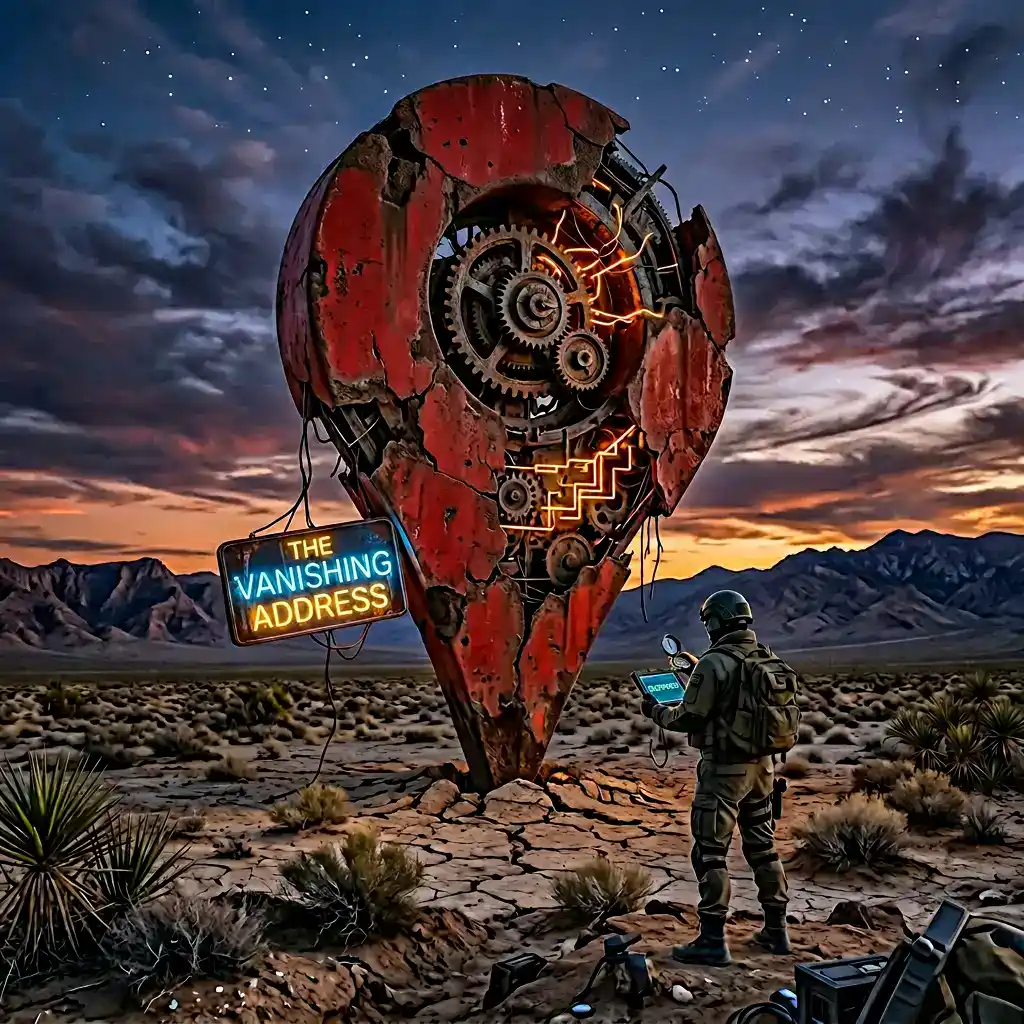
The "Vanishing Pin" and the 2026 Google Ghost Map
I’ve operated in some of the world’s most high-pressure environments — from the engine rooms of merchant ships in heavy seas to the complex trade routes of international business management as an MBA and even a short time as a reserve paratrooper, jumping out of C130 transport aircraft at 800 feet. I thought I knew how to manage risk. I was wrong.
None of that fully prepares you for the particular dread of a Google Business Profile (GBP) suspension. Have you ever woken up to find your business has simply vanished from the map? One day you are visible, trusted, and taking enquiries. The next, you are a ghost.
If you are a home-based Service Area Business (SAB) in our part of the world — whether you are a gardener in Maitland, a consultant in the Hunter Valley, or a web designer like us here in Thornton — your digital existence can feel as though it is balanced on a razor’s edge.
This article is based on our own suspension, reinstatement, support interactions, and ongoing local-search recovery work. Some of the terms I use here — including "ghost entity", "geographic anchor", and "vanishing pin" — are practical descriptions of what we observed. They are not official Google terminology.
In 2026, we discovered something most generic SEO advice barely touches: a business can appear compliant and verified in one part of Google’s system while still behaving as if it has lost its local geographic anchor. You can become a "horse with no name" — visible enough to support, but strangely hard for customers in Newcastle, the Lower Hunter, and nearby areas to find in the places where local visibility matters most.
"In 2026, compliance is no longer just about following the rules; it is also about surviving the data gaps between Google’s disconnected local-search systems."
1. Our Experience: The "Nuclear" Suspension
As an engineer and former merchant navy officer, (but fortunately not as a paratrooper!), I have seen what happens when systems collide. Fifteen months ago, our own business hit a digital iceberg. Sydney Business Web was hit with a hard Google Business Profile suspension that removed us from local visibility for roughly a month.
In hindsight, we gave Google’s systems exactly the sort of data noise they are designed to distrust.
First, we created a "digital double" — an experiment with the NewcastleBusinessWeb site that used the same contact details as our primary brand. To us, it was an experiment. To the algorithm, it could easily look like a duplicate business entity trying to occupy the same local search space twice.
Second, we made the mistake that many home-based businesses are tempted to make: we changed address visibility between a Service Area Business (SAB) setup and a visible physical address. We were trying to be transparent, but the result was inconsistency. For a home-office-based business, that kind of inconsistency can look like a policy problem, a verification problem, or a trust problem — and Google does not always distinguish gently between the three.
Have you been tempted to "tweak" your address to see if it improves your ranking in Newcastle, Maitland, or the Lower Hunter? Be very careful. For us, that kind of dashboard activity became part of the chain of events that led to a brutal suspension, a long re-verification process, and a painful lesson in local-search fragility.
We had to prove we were not a lead-generation ghost or a duplicate local entity, but a real, MBA-led technical consultancy operating from Thornton. The lesson was simple: if your digital identity becomes noisy, inconsistent, or ambiguous, Google may not ask politely for clarification. It may simply remove you from the map.
"Our suspension was a self-inflicted wound caused by data noise. If you run a business from home, your biggest threat may not be the competition — it may be your own dashboard edits."
2. Post-Suspension Reality: The Geocoding Desert
Clawing your way back from a Google Business Profile suspension feels like a victory — until you realise reinstatement does not always mean full recovery.
After our profile came back online, the dashboard looked clean. We were live. We were verified. On paper, the immediate crisis was over. But in practice, something still felt wrong. Local visibility did not return the way it should have, and the business appeared to be operating in what I now call a "Geocoding Desert".
This was the ultimate "Horse with No Name" problem. Google seemed to know who we were, but not clearly enough where to place us in local search.
Eventually, during a live Google Business Profile support chat, I asked the question directly: if Google needed to verify the business location, what address did it currently have on file internally? The answer was startling. Support stated that they had checked the hidden address and that Google had not registered any address for our specific business profile.
Just as importantly, support also told us this could be normal for a pure Service Area Business. In other words, according to that support interaction, a compliant hidden-address SAB may have no address registered on the profile at all. That was the point where much of the AI advice I had received began to fall apart.
The textbook AI assumption was that a hidden internal base address must exist somewhere and that this hidden address was required to geocode the business correctly. Google Support told us otherwise. For a pure SAB, the service areas may be handled as polygons, and the profile may not have a physical address or pin-marker coordinates in the usual sense.
That does not automatically prove that the missing address caused our local visibility problem. It does, however, expose the uncomfortable reality: a business can be verified, compliant, and live while still feeling geographically unanchored in local search. For a home-based business in Thornton trying to regain visibility across Newcastle, Maitland, and the Lower Hunter, that distinction matters.
If your Google Business Profile has been reinstated but your enquiries have not returned, do not assume the problem is only rankings, reviews, or content. You may be dealing with the strange modern reality of a compliant Service Area Business: visible enough to exist, but not necessarily anchored enough to perform.
"The shock was not merely that our address was hidden. It was that Google Support confirmed no address was registered at all — and then told us that, for a pure SAB, this could be completely normal."
3. Google’s Rules Today: The "Signage" Trap
Google’s rules for business addresses are not written for wishful thinking. If a business shows its address publicly on Google, Google expects that location to be a real, customer-facing business location. One of the clearest danger points is signage: businesses showing an address on Google should generally have permanent, fixed signage showing the business name at that location.
For storefronts, that makes sense. For the army of gardeners, consultants, developers, bookkeepers, trainers, and other home-based professionals working across the Lower Hunter, it creates a brutal practical problem.
If you operate as a Service Area Business (SAB) and do not serve customers at your home address, the compliant route is to hide the address on Google and show service areas instead. But if your local visibility has collapsed after a suspension, the temptation is obvious: show the address, force the location back into the system, and hope the map starts behaving again.
That temptation is dangerous.
If you show a residential address publicly on Google without a proper customer-facing location and permanent business signage, you may be inviting the very suspension you are trying to recover from. A Street View check, a competitor report, or an automated quality review could treat the profile as non-compliant. For a home-based business in Thornton, Maitland, or Newcastle, that one visibility toggle can become a digital landmine.
We have spent months trying to get this nuance understood: a legitimate home-based business can have real ABN details, real clients, real reviews, real credentials, and still be unable to show a public address on Google without creating a new compliance risk. That is the trap. Google’s rules are designed to stop fake storefronts, but the same machinery can make honest Service Area Businesses feel invisible.
So the first rule is simple: do not expose your address on Google just because you are trying to recover local visibility. If you are a genuine SAB, preserve compliance first. A visible address may feel like the shortcut back to the map, but it can also be the lever that drops you through the trapdoor.
"The signage rule is meant to stop fake storefronts, but it can also terrify legitimate home-based businesses into a corner. Visibility is useless if the act of chasing it gets you suspended again."
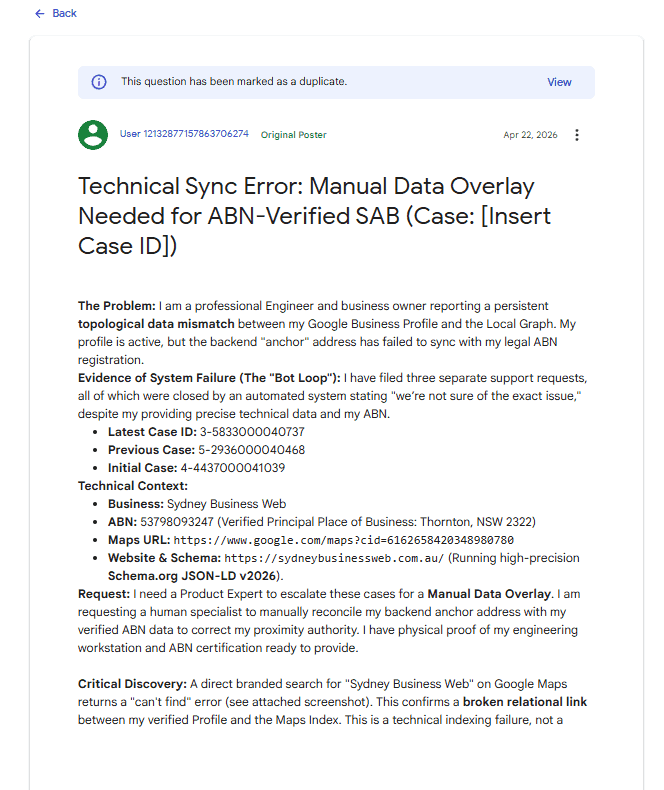
This ticket was closed and referred to 'Verify Business'
Example of the support/community loop we encountered while trying to explain a Service Area Business location-sync issue. The profile was live, the business was real, but the case was still marked as a duplicate rather than treated as a distinct technical problem.
4. Beyond E-E-A-T: Disinfecting Your Digital Presence
How do you stay visible without getting hit by the next compliance sweep? You start by cleaning up the evidence trail around your business.
Google talks about Experience, Expertise, Authoritativeness, and Trust. For a Service Area Business, those signals are not abstract theory. They are practical survival tools. Your website, business registration, service areas, credentials, contact details, and third-party profiles all need to tell the same story.
I call this process digital disinfection. It means removing ambiguity, reducing conflicting signals, and building a single, consistent source of truth around who you are, what you do, where you operate, and why you are legitimate.
This is not about trying to trick Google. It is the opposite. It is about making your business so clear, consistent, and well documented that both humans and machines have less room to misunderstand it.
For home-office-based businesses in Maitland, Thornton, Newcastle, and the Hunter Valley, the clean-up process usually includes three major parts:
- The Website Anchor: Your official website should clearly identify the real business behind the profile. That may include your business name, ABN, service areas, contact details, credentials, and, where appropriate for your own transparency strategy, your business address. The point is to make the website the strongest public proof that the business is real.
- Consistent Structured Data: JSON-LD schema is not a magic map-pin repair tool, but it can help reinforce your business entity, service area, website ownership, founder information, and local context. Used properly, schema gives search systems cleaner evidence to interpret.
- Entity Linking: Connect your business to credible third-party evidence. ABN registration, professional credentials, awards, trusted directory profiles, Google Business Profile links, and consistent business mentions all help reduce doubt. The goal is not noise. The goal is corroboration.
The important point is consistency. If your Google Business Profile says one thing, your website says another, your directories say a third thing, and your social profiles say something else again, you are creating the very confusion that automated systems are designed to distrust.
"Digital disinfection is not about hiding the truth. It is about removing the contradictions that cause machines to misread a legitimate business as a risky one."
5. The Address Visibility Matrix: Where to Show and Where to Hide
This is the part that can save your profile — or bury it.
For a home-based Service Area Business, address visibility is not a casual setting. It is not a cosmetic preference. It is a compliance trigger. Treat it like a live electrical panel: touch the wrong switch and you may not enjoy the result.
The practical rule is simple: Google may need to understand who you are and where your business is based, but that does not mean you should advertise your home address as a public shopfront on Google. If customers do not visit you at that address, and you do not have a genuine customer-facing location with appropriate business signage, showing the address on Google can become a suspension risk.
For businesses in Thornton, Newcastle, Maitland, and the Lower Hunter, this is the address visibility matrix I would use:
Google Business Profile
HIDE
If you are a genuine SAB and customers do not visit your home address, keep the address hidden. Do not expose it just to chase a pin. That button may look harmless, but for a home-based business it can behave like a detonator.
Official Website
SHOW WHERE APPROPRIATE
Your website should be the strongest proof that the business is real. For our own strategy, that means clear business identity, ABN, service areas, credentials, contact details, and business-location transparency. The website is where legitimacy should be made plain.
Website JSON-LD Schema
USE CAREFULLY
Schema should reinforce the real entity: business name, website, service areas, founder details, credentials, and location context. It is not a magic map-pin repair tool, but it gives search systems a cleaner machine-readable version of the truth.
Public Directories
BE VERY CAREFUL
Directories can create powerful corroboration, but they can also create dangerous storefront signals if they publicly display a home address. If your Google profile is a hidden-address SAB, your directory footprint should not make you look like a walk-in shop.
Social Media Profiles
AVOID ADDRESS NOISE
Use service areas, region, and business identity. Do not scatter your home address across social platforms unless you have a clear reason to do so. Random address exposure creates noise, and noise is exactly what you are trying to remove.
The mistake is thinking consistency means showing the same address everywhere. For a Service Area Business, consistency means something more subtle: the public-facing footprint must support the same business truth without accidentally presenting your home as a shopfront.
"The address is not the business. The business is the entity, the evidence, the service area, and the trust trail. Get that distinction wrong, and Google may treat your home office like a fake storefront."
6. The Clean-Up Protocol: What to Fix Before You Appeal Again
Before you fire off another appeal, stop. Do not thrash around inside the dashboard like a man trapped in a lift pressing every button at once. That is how you turn a recoverable problem into a bigger one.
If your Google Business Profile has been suspended, reinstated, or left in that strange half-life where it is "live" but locally invisible, your first job is not to panic. Your first job is to clean the battlefield.
This is the protocol I would follow before touching the profile again:
1. Stop Dashboard Twitching
Do not keep changing the address, phone number, categories, service areas, or business name to see what happens. Google does not read frantic edits as "experimentation." It may read them as instability, hijacking, or evasion.
2. Screenshot Everything
Take dated screenshots of your profile status, service areas, business information, verification state, support replies, and any Maps/Search behaviour that looks wrong. If the machine later denies what happened, your evidence trail matters.
3. Remove Entity Confusion
Kill or clearly separate duplicate brands, old experiments, conflicting landing pages, reused phone numbers, and anything that makes one business look like three. Google hates ghosts, doubles, and masks.
4. Check Your Legal Proof
Make sure your ABN, business name, website, email domain, service areas, and public business identity all tell the same story. If you need to escalate, you want clean evidence, not a pile of contradictions.
5. Clean Public Citations
Audit directories, social profiles, old listings, and third-party mentions. If you are a hidden-address SAB, do not let half the internet describe you as a walk-in storefront while your Google profile says you serve customers off-site.
6. Prepare One Clear Case
When you contact support or the GBP Help Community, do not ramble. Give the business name, profile URL, ABN evidence, website, case IDs, screenshots, and the exact fault. Make it easy for a competent human to see the problem.
The aim is to remove every avoidable excuse for the system to distrust you. If your profile is already under suspicion, do not hand the bot a loaded pistol and then complain when it shoots your listing.
Appeals should be built like engineering reports: clear facts, clean evidence, no emotional froth, no unnecessary edits, and no contradictory signals left lying around the web like unexploded ordnance.
"Before you appeal, disinfect. A messy digital footprint turns a legitimate business into a suspicious pattern. Clean the evidence trail before asking Google to trust you again."
7. Verification & Official Sources
I do not expect you to take my word for it just because I have more degrees than a thermometer and more patter than a centipede wearing flip-flops.
In the maritime world, you check the charts. In the Parachute Regiment, your mate checks your parachute ties from behind and verifies your static line before you jump. In local SEO, you check the documentation — because if you are wrong, Google will not care how sincere you were.
The advice in this article is based on three things: our own Google Business Profile suspension and reinstatement experience, a live support conversation with Google Business Profile support, and the public documentation Google provides for business profiles and structured data.
The key point is simple: do not build your recovery plan on guesswork, forum mythology, or cheery AI summaries. Check the rules yourself. Then act with discipline.
Service Area Business Address Rules
Google’s guidance on service-area businesses, including when a business should clear or hide its address and use service areas instead.
View Official SAB Guidelines →Business Address & Signage Requirements
Google’s public guidance on eligible business profiles, including the requirement that publicly shown business locations should represent real, staffed, customer-facing locations.
Verify Business Profile Rules →Review Schema & Self-Serving Ratings
Google’s structured data rules for review snippets, including why service businesses should be cautious about self-serving review markup.
Review Structured Data Rules →Those documents are not bedtime reading. They are survival charts. If the chart says there is a reef at those coordinates, do not sail there just because your competitor seems to have made it through once.
"The documentation is the map. Your experience is the weather. Ignore either one, and sooner or later you hit rocks."
I'm still sorting through our social media presence for address leakage and it's slow going I'm afraid - but I WILL stay ahead of that damn AI that's carrying the 'suspension scissors'!
8. The AI Mirage: When the Machine Misleads the Engineer
I’m going to make a confession that might seem strange coming from a man who builds high-tech digital galaxies for a living: stop taking AI advice as gospel.
During this 15-month Google Business Profile battle, I consulted some of the most advanced AI systems available. Some of the advice was useful. Some was half-true. Some was confidently wrong. That is the danger. AI often sounds most convincing at the exact moment it is wandering off the road with a map printed in invisible ink.
The biggest mistake was the assumption that a hidden-address Service Area Business must still have a hidden internal address registered somewhere inside Google, and that this address was required to anchor the business properly in Maps. That sounded logical. It even sounded technically elegant. Then Google Business Profile support told us directly that our profile had no address registered at all — and that, for a pure SAB, this could be normal.
That was the moment the AI mirage evaporated.
AI models are pattern-recognition machines. They are not looking at the ground truth of your Thornton home office, your ABN record, your support ticket, your reinstatement history, or the strange behaviour of your local visibility after suspension. They produce plausible answers from patterns. In ordinary situations, that can be helpful. In edge cases, it can be bloody dangerous.
I have worked in the Parachute Regiment, the mining industry, and the Merchant Navy. In those worlds, you do not trust a piece of equipment merely because the manual says it should work. You inspect it. You test it. Then your mate — the man in the stick behind you at action stations — checks it again before you jump. Trust is earned by verification, not by confident wording.
Treat AI the same way. Use it for drafting, brainstorming, code structure, schema review, and research prompts. But do not let it make the final call on a live Google Business Profile when your livelihood is on the line. If an AI tells you to "just update your address to fix the pin," it may be leading you straight back to the suspension pit.
Use the machine. Test the machine. But never let the machine take the wheel when a wrong turn can nuke your business.
"AI understands the map, but it does not always understand the terrain. In local search, the terrain is policy, support history, edge cases, and consequences. Trust your evidence before you trust the algorithm."
9. Diagnosis: Are You Suspended, Reinstated, or Geographically Unanchored?
Before you escalate anything, diagnose the wound properly. A business that is suspended, a business that is reinstated, and a business that is live but locally invisible are not the same animal. Treating them as the same problem is how you waste weeks shouting into the machinery.
This is where many Service Area Businesses get trapped. The dashboard says "live." Support says "verified." Your reviews may still exist. Your website may still rank organically. But the local visibility that used to bring enquiries from Thornton, Newcastle, Maitland, or the Lower Hunter simply does not return.
That is when you need to ask a sharper question: are you dealing with a ranking problem, a compliance problem, or a geographic anchoring problem?
Suspended
The profile is not live.
Your Google Business Profile has been removed, disabled, or restricted. This is a compliance and reinstatement problem first. Do not obsess over rankings until the profile itself is restored.
Reinstated
The profile is live, but fragile.
Your profile has returned, but the trust signals may still be recovering. This is the stage where reckless edits, duplicate listings, or public address changes can throw you straight back into the pit.
Geographically Unanchored
The profile is live, but local visibility is dead.
This is the ghost state. Google may recognise the business exists, but local discovery searches behave as if the business has lost proximity authority or has not fully reconnected to the local graph.
Here are the warning signs that you may be in the third category:
- Your profile is live and verified, but local enquiries have not returned.
- Support tells you everything looks fine, but the real-world search results say otherwise.
- Your business can be found by name, but struggles badly for local discovery searches.
- Your organic website rankings may improve while the Local Pack remains stubbornly weak.
- Your service areas are set, but your business behaves as if it has little or no proximity authority.
- Repeated tickets are closed, merged, or marked as duplicates without the actual local visibility problem being addressed.
That last point matters. If support keeps treating the issue as a simple verification or policy question, but your actual problem is a broken or weakened local relationship, you are speaking the wrong language to the wrong layer of the system.
This is why I use the phrase "geographic anchor". It is not official Google terminology. It is a practical way to describe the invisible relationship between a real business, its verified identity, its service area, and its ability to appear where local customers are searching.
If that relationship is damaged, more blog posts, more citations, and more cheerful dashboard edits may not solve it. You may need escalation — not because you are trying to game the system, but because the system may have put you into a category its own front-line support process does not understand.
"If the profile is dead, appeal it. If the profile is live but fragile, stabilise it. If the profile is live but geographically unanchored, stop shouting about rankings and start documenting the data failure."
10. The Escalation Matrix: Reclaiming Your Geographic Anchor
When you operate as a Service Area Business, the public "map pin" is not the prize. In many cases, there should not be a public pin at all. What you are really fighting for is something less visible but far more important: local geographic confidence.
I call this the Geographic Anchor. It is not official Google terminology. It is my practical description of the relationship between your verified business identity, your service areas, your website, your business evidence, and the way Google decides where you belong in local search.
When that relationship breaks, you become what I call a Ghost Entity. The dashboard may say "verified." Support may say the profile is live. But your proximity authority behaves as if someone cut the rope. Google knows who you are, but local search no longer seems confident about where to place you.
That is the problem ordinary support often struggles to understand. Front-line support tends to work in simple categories: suspended, reinstated, verified, live, not live. But there is a miserable grey zone between "profile restored" and "local visibility restored" — and many Service Area Businesses get trapped there.
If that happens, do not keep opening emotional tickets saying "my ranking is bad." That is too vague. You need to describe the fault as a local data integrity problem.
Standard Appeals Tool
Level 0: Automated Gate
Use this for the initial reinstatement process, especially if the profile is suspended and you need to submit business evidence, identity material, ABN details, or compliance corrections.
Reality check: useful for clear suspensions, but poor at understanding subtle post-reinstatement local visibility faults.
GBP Help Desk
Level 1: Front-Line Support
Use this for basic profile status checks, confirmation of whether the profile is live, and clarification of what Google’s system currently shows.
Reality check: if they see a live, verified profile, they may assume the problem is solved even when local visibility has not recovered.
GBP Help Community
Experienced Product Experts
The Google Business Profile Help Community is often the better place for unusual cases, especially where standard support keeps closing, merging, or misunderstanding the issue.
Reality check: Product Experts are not magic, but the experienced ones may recognise patterns that ordinary support misses.
Expert Escalation
Manual Review Possibility
If the case is well documented, a senior Product Expert may be able to guide the issue toward further review. This is where your screenshots, profile URL, case IDs, ABN evidence, website evidence, and clean explanation matter.
Reality check: nobody should promise a fix. But a precise, evidence-based case has a far better chance than a frustrated complaint.
How to Speak So a Human Can Help You
If you have multiple ignored, closed, or duplicated case IDs, do not arrive in the community breathing fire and shouting "Google has destroyed my business." I understand the temptation. I have felt it. But it does not help.
Go in like an engineer preparing a fault report. Give the business name, profile URL, website, ABN evidence, service area, previous case IDs, screenshots, and the exact observed behaviour.
The wording matters. Try something like this:
"My profile is live and verified, but after reinstatement it appears to be geographically unanchored. Branded recognition and general profile status are not the issue. The problem is that local discovery visibility and proximity confidence have not recovered. I am trying to determine whether there is a post-reinstatement local data sync problem affecting the profile."
That is a very different message from "my rankings are bad." It tells the reader you understand the difference between a marketing complaint and a structural local-search fault.
Will this guarantee a repair? No. Nothing in the Google Business Profile world deserves that much confidence. But it gives a competent human the best chance of recognising that you are not asking for preferential treatment. You are asking for a broken relationship between a real business and Google’s local systems to be examined properly.
"In local search, proximity is power. If the geographic anchor is broken, you do not merely have a ranking problem. You have a data integrity problem — and data integrity problems need evidence, not panic."
Final Word: Do Not Fight the Map Blind
If there is one lesson I would carve into the dashboard of every home-based Service Area Business, it is this: do not fight Google’s local system blind.
A suspension is not just an inconvenience. It can sever the trust, visibility, and local confidence your business has spent years building. And once you are reinstated, the work may not be over. You may still need to repair the evidence trail, clean up conflicting signals, document the fault, and make your business easier for both humans and machines to understand.
For businesses in Thornton, Newcastle, Maitland, and the wider Hunter Region, this is not academic SEO theory. It is the difference between being found and being functionally invisible.
At Sydney Business Web, we cannot promise to override Google, force a local-pack recovery, or magically restore a broken profile. Anyone who promises that is selling comfort, not engineering. What we can do is help you build a cleaner, stronger, better-documented digital footprint — website, schema, service-area signals, business identity, citations, and technical evidence — so that your business presents itself as one clear, legitimate entity.
That is the sane path through the mess. Not panic. Not dashboard twitching. Not duplicate profiles. Not blindly trusting AI. Evidence, consistency, compliance, and persistence.
"You cannot always control Google’s machinery, but you can control the evidence you give it. Make the business real, make the signals clean, and never hand the algorithm a reason to doubt you."
The "Panic Room" FAQ: Survival Questions for Suspended and Unanchored Service Area Businesses
If your Google Business Profile has been suspended, reinstated, or left in that miserable ghost state where it is live but not really performing, you probably do not want a lecture. You want clear answers. Here they are.
"When your business is suspended or unanchored, panic is the enemy. Do not delete, duplicate, twitch, or blindly trust the machine. Stabilise the profile, clean the evidence, and move like an engineer."
Internal Sydney Business Web References
The following Sydney Business Web pages provide useful background for the issues discussed in this article: Service Area Business visibility, AI search, local-pack fragility, schema, technical SEO, and our regional hub-and-spoke structure across Thornton, Maitland, Newcastle, the Lower Hunter, and the Hunter Valley.
Related Sydney Business Web Articles
Ask Google About Website Developers in Thornton
A directly related article showing how Google AI interpreted Sydney Business Web, local reputation, technical capability, and regional relevance around Thornton.
Read Thornton AI Visibility Article →Organic Ranking vs the Local Pack
Explains why organic visibility and Local Pack visibility are related but not identical — a key distinction for businesses recovering from GBP problems.
Read Organic vs Local SEO →Make Your Business Website Visible to AI
Supports the AI-search side of this post by explaining why clear content, structured information, entity signals, and machine-readable evidence matter.
Read AI Visibility Guide →A Chat with Grok on Schema and AI Visibility
A related discussion about schema, entity clarity, AI interpretation, and why structured business information can help search systems understand a company more accurately.
Read Schema and AI Visibility Discussion →Automated Account Suspension
Useful companion reading on the wider problem of automated systems shutting down real people and real businesses with limited human understanding.
Read Automated Suspension Article →Business Websites, eCommerce and SEO
The broader Sydney Business Web article archive for business website design, eCommerce, SEO, technical problem-solving, AI visibility, and local search strategy.
View Main Article Archive →Regional Hub-and-Spoke Pages
Business Websites Hunter Valley
Our regional hub page for Hunter Valley business website design, technical SEO, performance, and service-area visibility.
Visit Hunter Valley Hub →Website Designer Maitland
Our Maitland regional service page for business website design, local SEO, speed, technical support, and practical online growth.
View Maitland Page →Website Designer Newcastle
Our Newcastle regional page for engineered WordPress websites, WooCommerce, schema, speed, security, and online visibility.
View Newcastle Page →Website Designer Lower Hunter
Our Lower Hunter page, supporting regional relevance for nearby businesses that need serious website development and technical SEO.
View Lower Hunter Page →Website Design Thornton 2322
Our Thornton page, directly relevant because Sydney Business Web operates from Thornton and serves businesses across the surrounding region.
View Thornton Page →"The regional pages show where we work. The related articles show how we think. Together, they give Google, AI systems, and human readers a clearer picture of the real business behind the profile."
External References
The following external references are the most relevant official sources for the Service Area Business, Google Business Profile, structured data, suspension, and business-identity issues discussed in this article.
Google Business Profile Guidelines
The core Google rules for representing a business on Google, including business identity, address accuracy, service areas, and profile eligibility.
Read Google Business Profile Guidelines →Service Area Business Rules
Google’s guidance on setting service areas and removing the address when a business does not serve customers at its business address.
Read Service Area Guidance →Business Eligibility & Ownership
Google’s eligibility rules for Business Profiles, including the requirement that eligible businesses make in-person contact with customers.
Check Business Eligibility Rules →Fix Suspended or Disabled Profiles
Google’s official suspension and reinstatement guidance, including appeal evidence, review steps, and the warning not to create a new profile for the same business while appealing.
Read Suspension Appeal Guidance →GBP Suspension Handling Guide
A recent Google Business Profile Help Community guide on handling suspensions methodically, using clear evidence, and avoiding vague or emotional escalation.
Read GBP Suspension Guide →Local Business Structured Data
Google Search Central’s LocalBusiness structured-data guidance, relevant to business identity, business details, and how structured data can help Google understand a business page.
Read LocalBusiness Schema Guidance →Structured Data Introduction
Google’s general explanation of structured data and how it helps Search understand page content, entities, organisations, and other information on the web.
Read Structured Data Introduction →Review Snippet Structured Data
Google’s review-snippet rules, including the important warning around review markup and self-serving ratings for businesses and organisations.
Read Review Schema Rules →FAQ Structured Data
Google’s FAQPage structured-data guidance, useful when adding visible FAQ content and matching FAQ schema to the questions and answers shown on the page.
Read FAQ Schema Guidance →Helpful, Reliable, People-First Content
Google Search Central’s guidance on useful, trustworthy content and E-E-A-T, relevant to the article’s focus on experience, evidence, trust, and clarity.
Read Google’s Helpful Content Guidance →ABN Lookup
The official public view of the Australian Business Register, useful for checking publicly available ABN information and supporting business identity evidence.
Open ABN Lookup →ASIC Business Names Register
ASIC’s official business names register, useful for checking registered business-name ownership and supporting business identity evidence in Australia.
Search ASIC Business Names →"When a Google Business Profile problem becomes serious, do not build your recovery plan from hearsay. Use official rules, official evidence, and clean documentation."
CONTACT SYDNEY BUSINESS WEB NOW!


NOTE: We provide this analysis to help the community to stay compliant and informed. Sydney Business Web does not offer GBP reinstatement or suspension recovery services. Our focus remains on building high-performance, compliant digital entities for our clients.
If you need FREE ADVICE with zero guarantees you can contact us on Facebook