Introduction
Search is moving towards AI, whether business owners are used to it or not. The old world of ten blue links has not vanished, but it is increasingly being joined—and sometimes displaced—by a more conversational, synthetic and decisive form of search.
People now ask broad questions, layered questions and follow-up questions. Google and other answer systems increasingly respond with generated summaries and recommendations before a user ever clicks through to a website.
That changes the game. This is no longer merely a scrap over rankings and keyword placement. It is a fight to be understood.
If you want your business website visible to AI, it cannot be vague, thin, contradictory or written like a committee memo from a bad episode of Dilbert. AI-driven search looks for evidence about who you are, what you do, where you operate, whether your business can be verified, and whether the wider web supports the story your own site is telling.
Your website still matters enormously, but it is no longer the whole battlefield. AI does not simply inspect a homepage and salute smartly. It can draw upon your service pages, location signals, business profile, content depth, reviews, authorship, structured data and the consistency of your wider digital presence.
That is one reason we have strengthened our own regional signals through dedicated pages for website design in Thornton, Maitland, Newcastle, the Lower Hunter and the Hunter Valley.
The encouraging part is that none of this is mystical, and it is not reserved for giant brands with marketing departments full of people in matching sneakers. Businesses become easier for AI systems to recognise when they are easier to identify, verify, trust and summarise.
In practical terms, that means clear service pages, consistent business information, sensible site structure, proper internal linking, useful content, visible proof and structured data that accurately supports what appears on the page. There is no magical “AI schema” or secret switch that guarantees inclusion.
Google itself provides guidance on AI features and your website and on succeeding in AI-powered search experiences. The fundamentals remain recognisable: make your business accessible, useful, coherent and supported by evidence.
In this article, we examine that shift from a practical business-owner viewpoint. We use anonymous Google queries, real AI answers and plain-English analysis to explore a simple question: what makes one business website visible to AI while another remains nearly invisible?
No breathless “future of everything” waffle. No claims of endorsement from Google. Just a sober look at how search is changing, what signals appear to matter, and what business owners can do before their carefully built website becomes the online equivalent of a polished shop hidden behind a warehouse.
The question is no longer only whether your website ranks. It is whether your business is clear, credible and consistent enough for AI to recognise, trust and talk about.
Why AI Search Now Matters to Business Owners
Being online is no longer the same thing as being visible. A business can have a respectable website, several service pages and even some decent rankings, yet remain largely absent from the AI-generated answers customers see before they click anything.
That is the commercial problem. When a search system can identify, verify and summarise a competitor more confidently than it can summarise your business, you may lose the customer before that person ever reaches your website.
For small and medium-sized businesses, the standard is rising. A thin brochure site, vague service descriptions, confused location signals, stale content or an inconsistent wider presence can all make a business harder for AI-driven search to interpret. In the past, some businesses survived with a homepage, a contact page and a prayer. That is beginning to look like taking a Lee-Enfield to a drone fight.
The old visibility model
- Target a handful of keywords
- Build pages intended mainly to rank
- Measure success largely through positions and clicks
- Treat the website as an isolated marketing asset
The AI Visibility model
- Make the business entity easy to identify
- Explain services, expertise and locations clearly
- Support claims with visible and external evidence
- Keep information consistent across the wider web
What matters increasingly is the complete picture presented by the business—not merely the wording of an individual page. Search and answer systems need to connect your company, services, people, locations, experience, content and external reputation into a coherent whole.
Can a search system confidently determine:
- What your business actually does?
- Where you are genuinely based?
- Which regions or markets you serve?
- Which services you are qualified to provide?
- Who is responsible for the work and content?
- Whether independent evidence supports your claims?
These are not abstract technical questions. They influence whether your business is described accurately, included in a recommendation, cited as a useful source—or ignored in favour of a competitor whose online presence is easier to understand.
That is why businesses need more than isolated keywords. They need specific service pages, clear authorship, sensible internal linking, credible location signals, useful content, accurate structured data and a wider digital presence that supports rather than contradicts the website.
This is the basis of what Sydney Business Web calls AI Visibility: engineering a clearer, more credible and more verifiable representation of a real business—not simply inserting fashionable phrases into existing SEO copy.
That is the real shift: search is moving beyond simply listing pages and towards interpreting businesses. Owners who understand that early can strengthen their position while others are still muttering buzzwords into the wind and wondering why the phone is not ringing.
If AI-driven search cannot quickly establish who you are, what you do, where you operate and why you are credible, it is far less likely to place your business in front of a potential customer.
How We Tested Google AI Anonymously
We did not ask Google to praise us. We asked the kinds of questions a genuine prospective customer might ask.
That distinction matters. There is little value in feeding an AI system leading questions and then admiring the response like a manager applauding his own PowerPoint. The purpose of this exercise was to see how Google AI appeared to understand a real business when approached from the outside using ordinary language and ordinary commercial curiosity.
The queries were not written to force flattering answers. Some were basic identity questions. Others were deliberately sceptical and commercially useful.
Examples of the questions we asked
- Who are Sydney Business Web?
- What do they specialise in?
- Where are they based?
- Are they reliable?
- Are they expensive?
- Are they suitable for small businesses?
- What makes them different?
- Are they more technical than a typical agency?
Ask normal questions
We used plain-English queries that a real business owner could reasonably type or speak during early supplier research.
Capture the answer
We recorded the response as it appeared at the time rather than repeatedly rewriting the question until we received a preferred result.
Examine the evidence
We considered what the answer suggested Google could identify, connect and explain about the business—and where uncertainty remained.
AI search does not necessarily evaluate one webpage in isolation. Its answers may reflect information gathered from service pages, location signals, business profiles, topical content, external references and the overall consistency of the business across the web.
When those signals reinforce one another, the resulting description may be detailed and confident. When they are sparse, vague or contradictory, an AI system may produce a generic answer, misunderstand the business, or omit it altogether.
We have therefore treated each query in this article as a small field test. We are not claiming endorsement from Google, privileged access, guaranteed repeatability or special treatment. The value lies precisely in the ordinariness of the exercise: it resembles the impression a potential customer may receive before visiting the website.
An important limitation
AI-generated search responses can change with time, wording, location, available sources, product updates and personalisation. These screenshots record what appeared during particular tests; they are evidence of observed visibility, not a permanent ranking certificate.
That is why the screenshots below are useful. They are not trophies. They show how the business was being interpreted from outside its own website—and what other business owners can learn from that interpretation.
The useful question is not “Can I make AI say nice things?” It is: “What does AI appear to understand about my business when a real prospect asks a normal question?”
Who are Sydney Business Web
Who Are Sydney Business Web?
This is the most basic question a prospective customer can ask—and one of the most revealing. Before an AI system can recommend a business, it must first be able to identify and describe it.
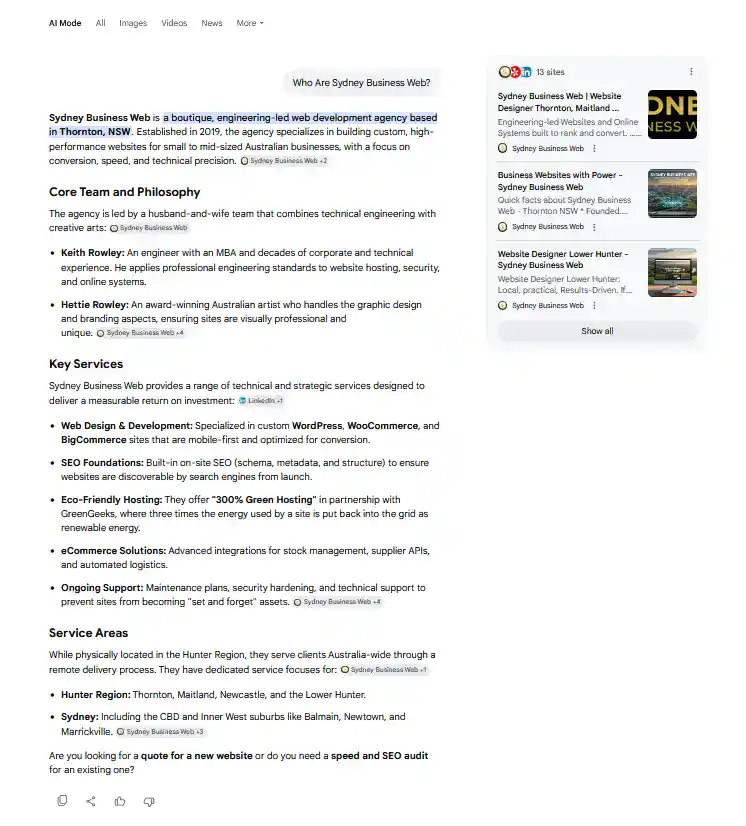
The result was substantially more detailed than a generic directory description. Google AI identified Sydney Business Web as a boutique, engineering-led web development agency based in Thornton, NSW, established in 2019 and focused on custom, high-performance websites for small and mid-sized Australian businesses.
It also connected the business to named people, a husband-and-wife structure, technical engineering and creative design roles, eCommerce, SEO foundations, hosting, ongoing support and a service footprint extending beyond the immediate Hunter region.
What the answer successfully connected
That is the important evidence. The system did not merely repeat a homepage slogan. It assembled multiple attributes into a reasonably coherent representation of the business: identity, people, expertise, services, location and operating reach.
The screenshot also shows citations to several Sydney Business Web pages and an external LinkedIn source. That does not amount to endorsement by Google, but it does demonstrate that the answer was being supported by discoverable information rather than appearing as an unsupported compliment.
In practical AI Visibility terms, this is an example of successful entity resolution. The business has supplied enough connected information for an answer system to distinguish it from thousands of generic web designers and describe it with useful specificity.
The lesson for another business
Ask the simplest possible question: “Who is my business?” If the resulting answer is missing, vague, inaccurate or confused with another company, the problem is deeper than one weak ranking. Your website and wider digital presence may not yet provide a sufficiently clear and consistent business identity.
AI visibility begins with being identifiable. Clear company information, named people, specific services, credible location signals, consistent external profiles and accurate structured data all help create the connected business representation that Sydney Business Web describes as an Intelligent Entity Skeleton.
If Google AI can answer “Who are you?” with confidence, detail and supporting sources, your business is already sending stronger identity signals than most small-business websites manage.
What Does Sydney Business Web Specialise In?
This is where AI moves beyond identifying a business and begins defining its actual market position. A useful answer must be specific enough to distinguish the business from thousands of agencies that simply claim to offer “web design and SEO”.
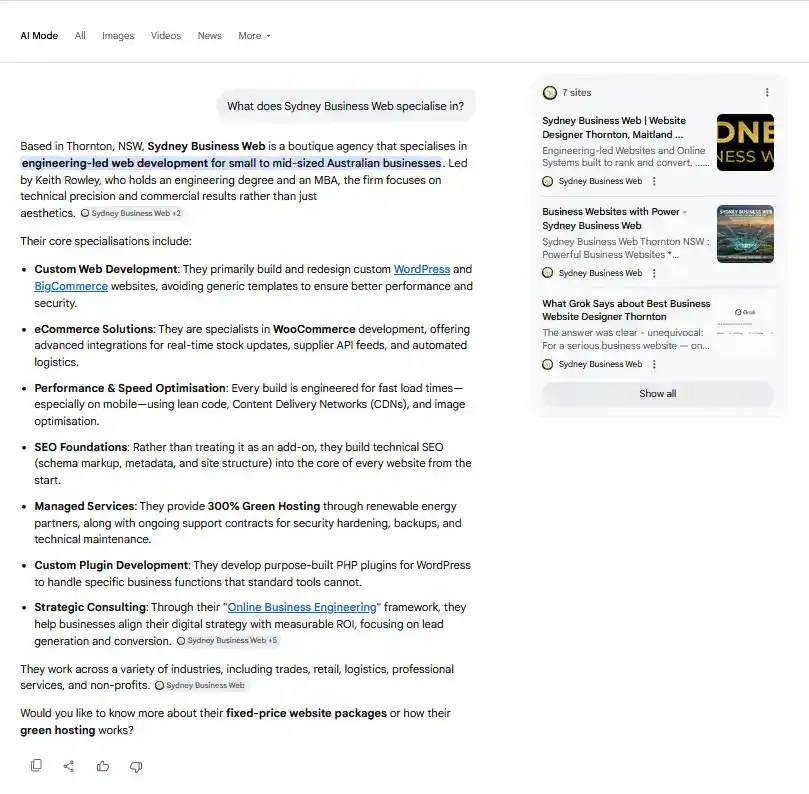
The answer did not reduce Sydney Business Web to the generic label of “web designer”. It described the business as a boutique agency specialising in engineering-led web development for small to mid-sized Australian businesses, led by Keith Rowley and focused on technical precision and commercial results.
More importantly, it assembled a detailed specialisation profile from information spread across the website.
What Google AI identified as our specialisations
The answer also recognised the industries served, including trades, retail, logistics, professional services and not-for-profit organisations. This matters because a commercially useful AI description should connect technical capability with the kinds of businesses that capability is intended to help.
This is a stronger result than merely appearing for the phrase “web designer”. It indicates that Google could identify a repeated technical pattern across the site and synthesise it into a reasonably accurate explanation of what differentiates the business.
What this screenshot does—and does not—prove
The visible citations in this answer point primarily to Sydney Business Web’s own pages. This is therefore not independent endorsement by Google. What it does demonstrate is that the website contains enough connected, consistent and specific information for Google AI to construct a detailed specialisation profile rather than a vague generic summary.
That distinction is important. A business website visible to AI does not merely repeat a list of services. It establishes a recognisable pattern through detailed service content, examples of technical work, named expertise, supporting articles, internal links and consistent descriptions across the site.
For another business owner, this is an excellent diagnostic test: ask an AI search system what your company specialises in and read the answer without generosity. Does it describe the work you genuinely want to win, or does it produce bland language that could apply to almost any competitor?
If the answer is generic, the solution is not clever prompting. The solution is to make your actual specialisation more visible, more specific and more consistently supported throughout your digital presence.
If AI can accurately explain what makes your business technically and commercially distinctive, you are no longer merely online. You are becoming intelligible.
Where Is Sydney Business Web Based?
This is a deceptively simple question, and for local visibility it matters a great deal. If Google AI cannot determine where a business is actually based, its understanding of service areas, local relevance and trust can become fuzzy very quickly.
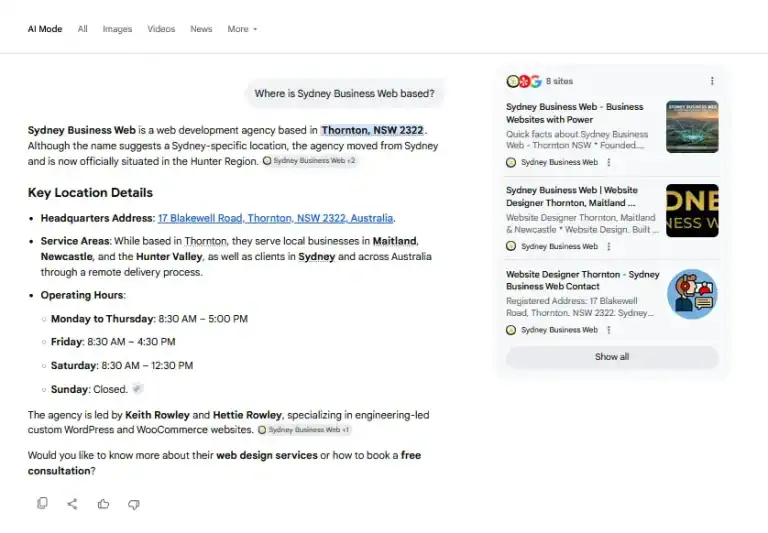
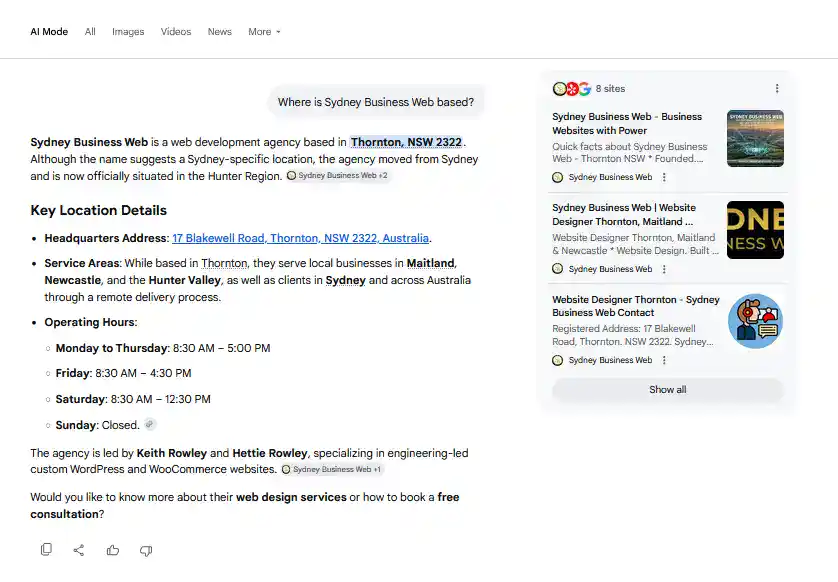
When asked “Where is Sydney Business Web based?”, Google AI gave a clear and commercially useful answer. It identified the business as being based in Thornton, NSW 2322 and, importantly, addressed the potential mismatch between the business name and the physical location by explaining that although the name suggests Sydney, the business is officially based in the Hunter Region.
That is valuable because it shows more than simple extraction of an address. The answer appears to reconcile name, base location and service footprint into a coherent explanation—the sort of clarification a real prospective customer may genuinely need.
What the answer successfully established
This is exactly where clear location architecture helps. A strong home-base page such as the Thornton website design page anchors the business geographically, while related pages for Maitland, Newcastle, the Lower Hunter and the Hunter Valley help build a believable map of where the business operates.
That is much stronger than a vague claim to serve “everywhere”. Generic service-area language often tells search systems very little. Clear, corroborated and internally linked geography tells them much more.
The wider lesson for business owners
If your business name, website wording, Google Business Profile, schema, contact information and service pages point in slightly different directions, AI may form a blurred picture of where you are and whom you serve. When those signals line up properly, even a potentially awkward location question can be answered with confidence.
For local and regional businesses, this is a particularly useful diagnostic test. Ask an AI search system where your business is based and read the answer critically. Is it specific? Is it correct? Does it distinguish between your headquarters and your wider service area? If not, the issue is usually broader than one weak page.
In AI Visibility terms, location is not a decorative detail. It is part of the business entity itself. A clear home base, a believable service area and consistent supporting evidence make it much easier for search systems to trust the geography they present to potential customers.
AI visibility improves when your business has a clear home base, a believable service area and a digital presence that tells the same location story everywhere.
Do Sydney Business Web Only Work in Thornton?
This is exactly the sort of question a sensible prospect may ask after seeing a strong local presence. A business needs a clear home base without accidentally appearing unable—or unwilling—to work beyond its immediate suburb.
When asked “Do Sydney Business Web only work in Thornton?”, Google AI answered clearly: no. It distinguished between the company’s physical base in Thornton and its broader ability to serve clients throughout the Hunter Region, Sydney and other parts of Australia.
The response also recognised how that broader delivery works in practice: through video calls, screen sharing, staging websites and other remote collaboration methods. That is commercially useful because it presents the business accurately—grounded in one location, but not restricted by geography.
What the answer understood about our operating reach
This is the distinction a strong service business needs AI systems to understand. The business is genuinely based somewhere, has meaningful relevance to nearby markets, and can also work effectively with suitable clients farther away.
That operating footprint is supported by dedicated pages for Thornton, Maitland, Newcastle, the Lower Hunter and the Hunter Valley. Together, those pages create a more credible geographic structure than one unsupported homepage sentence claiming national reach.
The answer also connected geography with the way Sydney Business Web operates and the kinds of clients it serves. That is significant. A useful AI representation should not only understand where a business works, but also how it can deliver the work and which clients are likely to be suitable.
The test for another local business
Ask whether your company works only in its home suburb. A good answer should distinguish clearly between your physical base, your genuine regional relevance and any wider delivery capability. If the response is narrow, confused or exaggerated, your website may not yet be presenting a believable service-area structure.
This is not an argument for creating dozens of thin location pages or claiming every town in Australia. The geography must be real, commercially sensible and supported by visible information. Strong location signals establish relevance; unsupported sprawl merely creates noise.
For AI Visibility, the goal is a coherent operating story: where the business is based, where it has genuine relevance, how it delivers its services and how far that delivery can credibly extend.
The strongest local businesses look clearly based, clearly relevant and clearly capable of serving suitable clients beyond their immediate suburb.
Are Sydney Business Web Any Good?
This is the blunt question many prospective customers eventually ask, even when they do not say it aloud. Identity and specialisation matter, but commercial trust ultimately depends on whether an AI system can find credible evidence that the business delivers competent work.
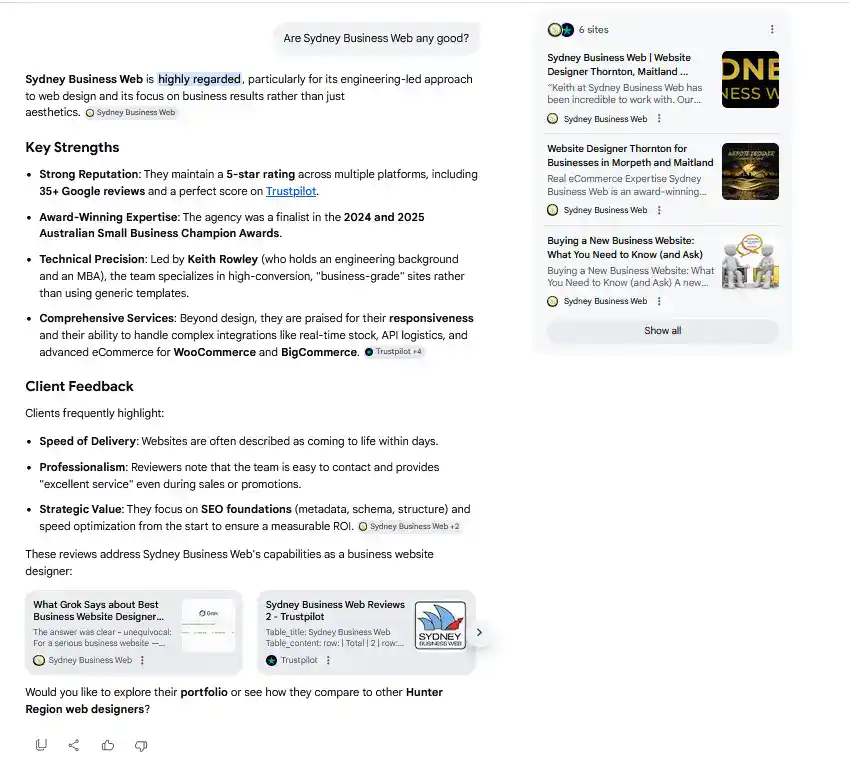
Google AI gave a strongly positive answer, describing Sydney Business Web as highly regarded, particularly for its engineering-led approach and its focus on business outcomes rather than appearance alone.
Crucially, the answer did not rely only on cheerful adjectives. It presented several specific reasons for that assessment, drawing upon review information, award recognition, named technical expertise and descriptions of the work delivered.
Evidence identified in the answer
This is a more commercially meaningful result than an AI system merely saying that the website looks professional. The answer connected reputation with identifiable evidence and then related that evidence to the technical and strategic character of the business.
It also avoided reducing Sydney Business Web to a visual-design agency. Instead, it described a business capable of handling technically involved projects, complex integrations, eCommerce systems and measurable commercial requirements.
What this result actually demonstrates
This is not Google formally endorsing Sydney Business Web or independently certifying the quality of its work. It is an AI-generated synthesis based on information it found across Sydney Business Web pages, Trustpilot and other visible sources. Its value lies in showing that sufficiently specific reputation and capability evidence was discoverable and could be assembled into a coherent answer.
That distinction matters. AI systems cannot personally inspect the quality of a website build, interview a client or audit every technical claim. They can, however, locate and connect reviews, awards, named expertise, case evidence, service detail and consistent descriptions from multiple sources.
This connected body of support forms part of what Sydney Business Web calls an AI Credibility Footprint: the evidence surrounding a business that helps search and answer systems assess whether its own claims appear credible.
For another business owner, this is a valuable test. Ask whether your company is any good and examine the reasons supplied. Are there identifiable reviews, achievements, people, projects and capabilities behind the answer—or merely generic praise copied from your own marketing language?
A business website visible to AI is not merely polished. It is surrounded by enough specific, consistent and discoverable evidence for AI to explain why the business may be credible.
Why Does Sydney Business Web Rank So Well in Thornton?
This is where Google AI stops merely describing a business and starts offering a theory of its visibility. That makes the question especially useful, because it is not just about identity or reputation. It is about cause: why does one business appear strongly in a local market while others remain buried beneath a small avalanche of generic “we build beautiful websites” waffle?
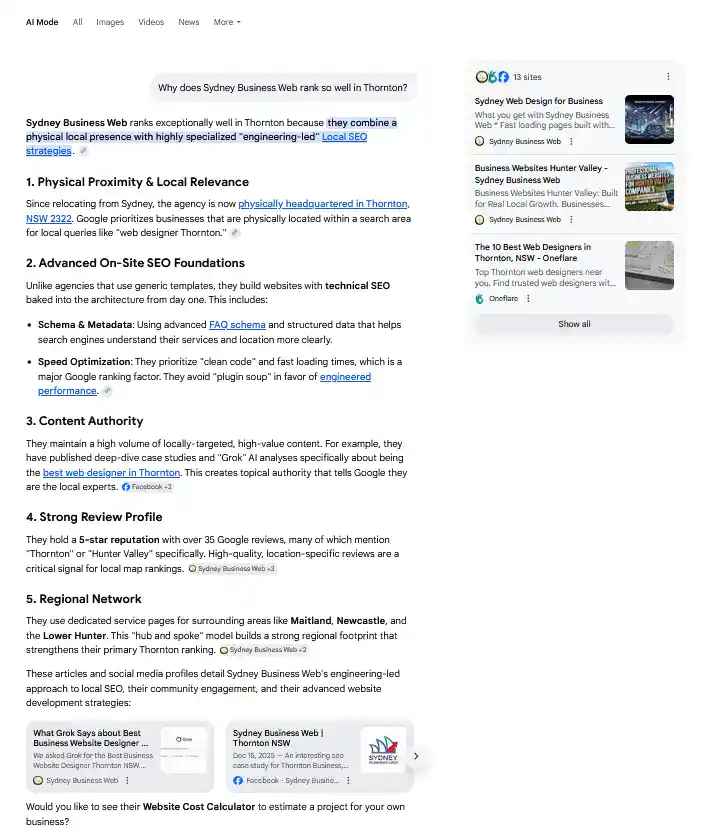
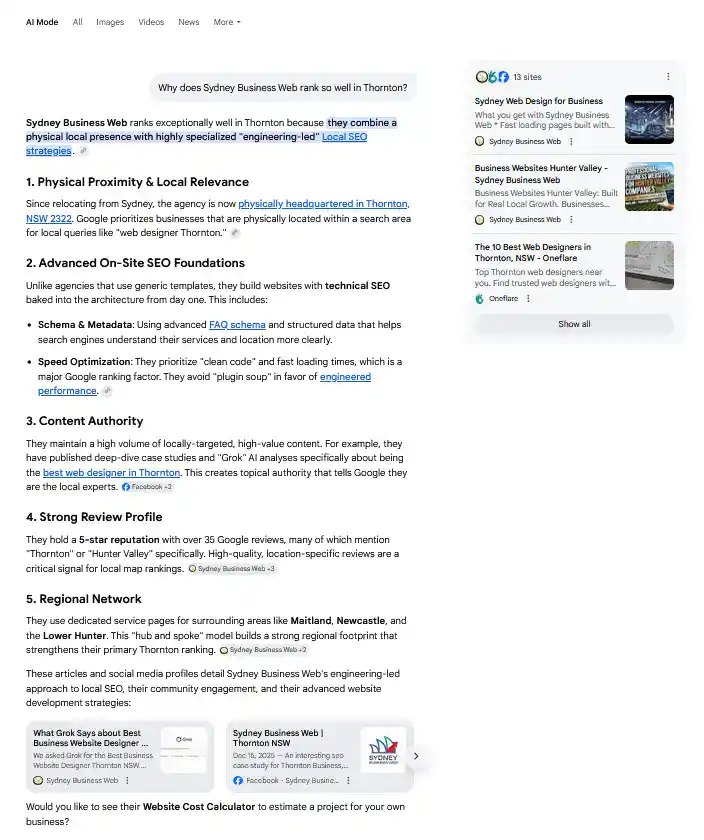
When asked “Why does Sydney Business Web rank so well in Thornton?”, Google AI produced a detailed explanation built around several practical factors: physical proximity and local relevance, technical SEO foundations, content authority, review strength and a broader regional network.
That is revealing because the answer does not treat local visibility as magic or luck. It treats it as the combined effect of location signals, technical clarity, useful content and trust evidence working together.
What Google AI appeared to identify as the main reasons
The first point matters greatly. A business can talk about serving the world, but if Google can clearly see where it is actually based, that gives it a far firmer anchor for suburb and regional relevance. In this case, the Thornton page appears to establish that home base clearly.
That signal is then reinforced by related regional pages for Maitland, Newcastle, the Lower Hunter and the Hunter Valley. Together, they form a much more believable geography than a vague claim to “service everywhere”.
The technical layer is equally important. Google AI specifically referred to technical SEO, including schema, structure, metadata and speed. In other words, it appears to recognise that the site is built with search visibility in mind from the start rather than having SEO scattered on afterwards like parsley on a bad pub meal.
Then there is the authority layer. Google AI highlighted content depth and review strength, which suggests it is connecting local relevance with visible proof. A business does not usually become a strong local result merely by repeating a suburb name twenty times and praying for miracles. It needs useful pages, reviews, evidence of competence and enough topical substance to look active, informed and commercially real.
The caution here matters
This screenshot should not be treated as Google revealing its ranking algorithm. It is Google AI’s explanatory synthesis of why the business seems strong in Thornton. Even so, that synthesis is valuable, because it highlights the kinds of visible signals an AI system could connect when trying to explain local prominence.
For other business owners, this is one of the most useful questions in the whole exercise. Ask Google why your business ranks well in an area where you are strong—or why a competitor ranks well where you are not. The answer may expose the real ingredients of visibility: location clarity, technical foundations, content strength, reviews and regional relevance.
So what does this result tell us? It suggests that Sydney Business Web’s Thornton strength is not being read as one isolated trick. Google AI appears to see it as the product of multiple aligned signals working together. That is the real lesson: strong local visibility usually comes from coherence, not gimmicks.
When a business is visible to AI at a local level, it is usually because location, structure, content, reviews and authority are all pulling in the same direction.
Are Sydney Business Web Reliable?
Reliability is where attractive marketing claims go to be tested. A business may have a polished homepage and enough buzzwords to stun a council meeting, but a prospective customer ultimately wants to know something much simpler: can these people be relied upon to do the work properly and remain available afterwards?
When asked “Are Sydney Business Web reliable?”, Google AI answered directly and described the business as a highly reliable web design agency. More importantly, it gave reasons for that assessment rather than presenting unsupported praise.
The response brought together several different trust signals: public reviews, industry recognition, named technical expertise, a transparent Australian operating identity and continuing support after a website has been launched.
Evidence Google AI connected with reliability
The review evidence is particularly important because it exists beyond the wording of the website itself. A company can describe itself as dependable as often as it likes, but public customer experiences provide a separate layer of evidence that search and answer systems can discover and compare.
The answer also recognised that reliability does not end when a website goes live. For many businesses, the more revealing test comes afterwards: whether the developer remains accessible, maintains the system, responds when something breaks and continues improving what was built.
That matters because plenty of small businesses have encountered agencies that deliver a website, collect payment and then evaporate into a fine mist of excuses. Making support, maintenance, security and continuity visible helps distinguish an ongoing technical relationship from a one-off transaction.
What this answer does—and does not—establish
Google AI has not personally audited every Sydney Business Web project or guaranteed future performance. This is an AI-generated assessment based on the evidence it could locate and connect. Its significance lies in the range and specificity of that evidence: reviews, recognition, named expertise, operating transparency and continuing support.
This forms another part of the business’s AI Credibility Footprint. Reliability becomes easier for an AI system to describe when the same trust story is supported by multiple visible sources rather than asserted only by the business itself.
For another business owner, this is an excellent diagnostic question. Ask whether your company appears reliable and examine the reasons supplied. Does the answer point to real customers, identifiable people, continuing support and corroborating evidence—or does it merely recycle reassuring language from your homepage?
A business becomes more persuasive to AI when reliability is supported by reviews, recognition, technical credibility, operating transparency and visible evidence of continuing support.
How Long Have Sydney Business Web Been Around?
Longevity matters because a polished homepage can be built quickly, but a credible history, reputation and body of work take rather longer. A useful AI description should be able to place a business in time as well as explain what it does today.
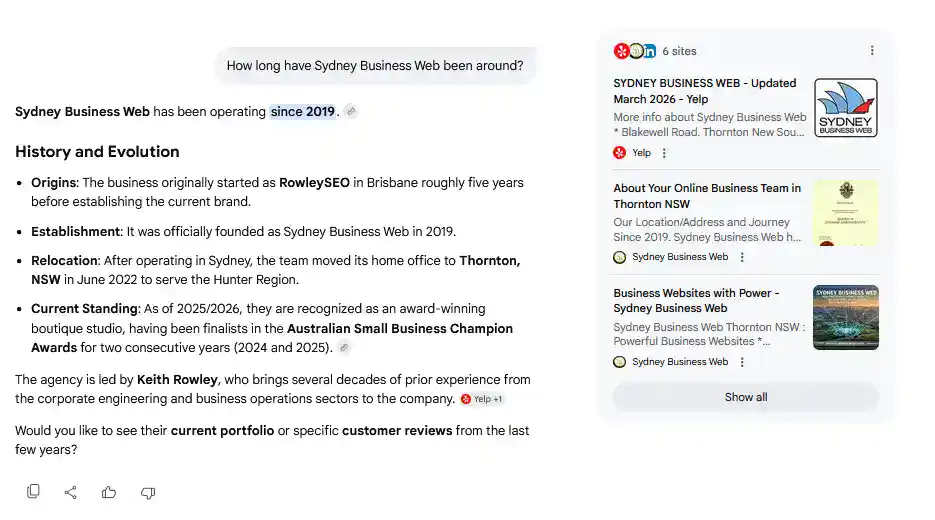
When asked “How long have Sydney Business Web been around?”, Google AI gave a clear answer: the current Sydney Business Web business and brand were established in 2019.
The answer did more than extract a single date. It added context about the earlier origins of the business, the development of the present brand and the later move to Thornton, NSW. In effect, it assembled a short business timeline rather than treating Sydney Business Web as a static website that had appeared from nowhere.
What the answer understood about the business history
That is commercially useful. Prospective customers often want to know whether they are dealing with an established operator or the digital equivalent of a market stall that could be folded up and wheeled away by teatime.
A recognisable history does not prove that every project will be successful, but it does provide evidence of continuity. A business that has operated for years, developed its services, accumulated reviews and remained publicly identifiable is easier to regard as stable than one whose digital presence offers no clear timeline at all.
The lesson for other businesses
Your website should give a truthful and coherent account of when the business began, how it developed and where it operates today. That does not require an invented heroic origin story. It requires dates, people, milestones and business descriptions that agree across your website and wider digital presence.
This is another form of entity clarity. Search systems should be able to distinguish the founding of the present business, any earlier professional history and later changes in location or direction without encountering contradictory dates or incompatible stories.
Ask an AI search system how long your own business has existed and examine the answer carefully. Is the date correct? Does it distinguish between the current company and earlier experience? Does it describe a sensible progression—or expose conflicting information scattered across the web?
A clear timeline helps establish that the business is not merely selling services today. It has roots, continuity and a history that can be discovered and understood.
A business looks stronger to AI when it can be placed clearly and consistently in time, not merely described by what it happens to sell today.
Are Sydney Business Web Expensive?
This is where curiosity meets money—and money usually clears the air rather quickly. A prospective customer may admire the work and trust the reputation, but eventually the practical question arrives with its boots on: are they expensive?
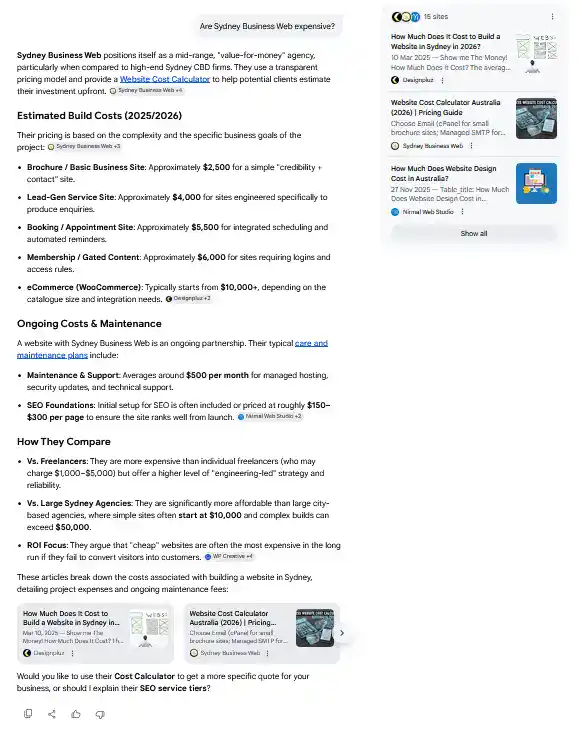
Google AI gave a reasonably nuanced answer rather than forcing Sydney Business Web into a simplistic “cheap” or “expensive” category. It placed the business broadly in the mid-range, while suggesting that its pricing was generally below that of many larger Sydney CBD agencies.
That is a commercially sensible description of the position Sydney Business Web aims to occupy: not bargain-basement website production, but engineering-led work priced without the overheads and theatre of a large city agency.
What the answer understood about pricing and value
The important point is that Google AI attached its judgement to visible pricing structure. It referred to indicative price bands and Sydney Business Web’s pricing calculator rather than producing a market position from thin air.
That level of transparency helps search systems—and prospective customers—understand that different website types involve very different amounts of design, engineering, content, integration and testing. A brochure site cannot sensibly be priced in the same way as a substantial WooCommerce build with supplier feeds, stock synchronisation and custom workflows.
“Expensive” is also relative. Sydney Business Web may cost more than a freelancer assembling an off-the-shelf template, while representing strong value beside a larger agency charging city rates for a thinner technical result.
That distinction reflects the wider argument made in our article on business websites, eCommerce and SEO: a serious website is a business asset rather than a decorative purchase.
What this answer should not be mistaken for
This is not a binding quotation or an independent pricing audit by Google. It is an AI-generated interpretation of the pricing information and market signals it found. Its evidentiary value lies in showing that Sydney Business Web’s intended position—technically capable, transparent and sensibly priced—was sufficiently clear to be summarised.
For another business owner, this is an excellent diagnostic question. Ask whether your company is expensive and examine whether the answer reflects your intended market position. Does it understand what affects the price, whom you compete with and why a customer might reasonably pay more—or less—for your particular offering?
When the answer is wildly inaccurate, the problem may lie in thin pricing information, inconsistent service descriptions or a failure to explain what customers actually receive for their money.
A business visible to AI should help prospects understand roughly where it sits on the value spectrum, what affects the price and why that position may be justified.
“That Seems Expensive?”
This is the point at which price turns into value. A prospective customer may accept that a business is not cheap and still feel a jolt when confronted with real numbers. The commercially useful question then becomes: expensive compared with what?
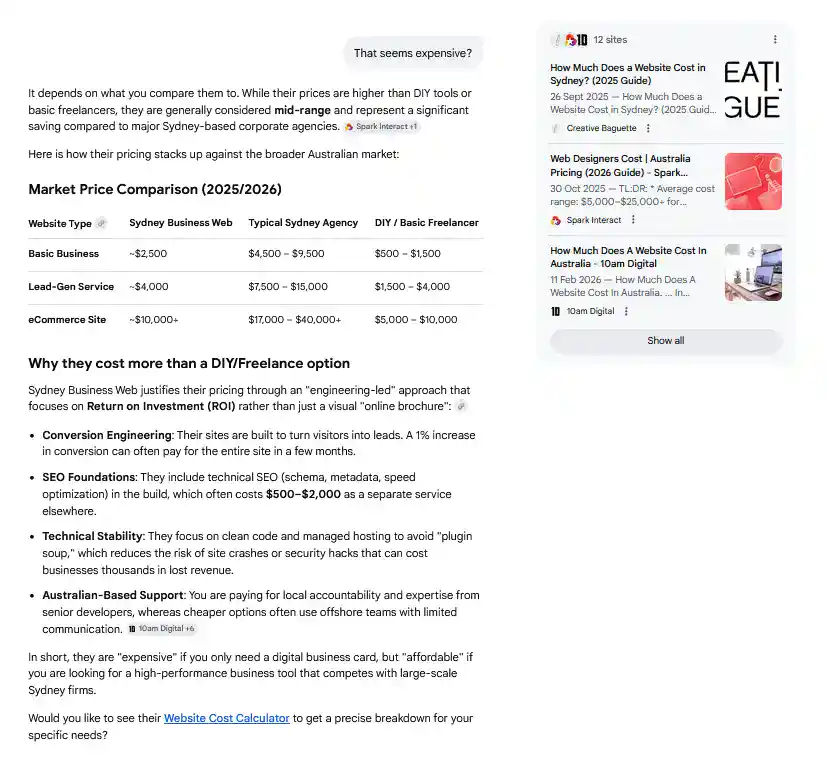
Google AI did not respond with a defensive sales pitch or merely repeat the earlier pricing figures. It placed Sydney Business Web in context by comparing its offering with DIY website tools, basic freelance builds and larger Sydney agencies.
Its conclusion was that the pricing appeared mid-range and value-driven: more substantial than a low-cost template build, but generally below the fees associated with larger city agencies.
How the answer explained the difference in value
This is an important distinction because many businesses compare an engineered commercial asset with a commodity. They compare a website designed to support leads, sales, search visibility and future development with a cheap online brochure, and then wonder why the prices do not match.
It is rather like comparing a field radio designed for combat with something found in the middle aisle at Aldi. Both may technically produce sound, but only one was designed to remain useful when the conditions become unpleasant.
A website becomes easier to assess when the business explains not merely the number on the quotation, but what affects that number, what is included, which risks are reduced and which commercial outcomes the work is intended to support.
Why this follow-up is particularly revealing
The first pricing question tested whether Google AI could identify Sydney Business Web’s market position. This follow-up tested whether it could defend that position through comparison and reasoning. It shows that conversational search may move rapidly from finding a supplier to evaluating whether the supplier represents sensible value.
This does not mean Google has audited Sydney Business Web’s pricing or certified that every project represents good value. It means the publicly available information gave the system enough context to explain why the pricing might be justified for the right customer.
For another business, this is a valuable exercise. Ask whether your prices seem expensive and examine the explanation. Does AI understand the difference between your service and its cheaper alternatives—or has your website failed to communicate why that difference exists?
A business visible to AI should not merely look cheaper or dearer. It should look understandable, defensible and worth the money to the right kind of customer.
Are Sydney Business Web a Good Fit for Small Businesses?
This is one of the most commercially useful questions in the entire exercise because it moves beyond admiration and gets down to fit. A business may look capable, reliable and technically strong, but a prospective customer still needs to know: are they right for a business like mine?
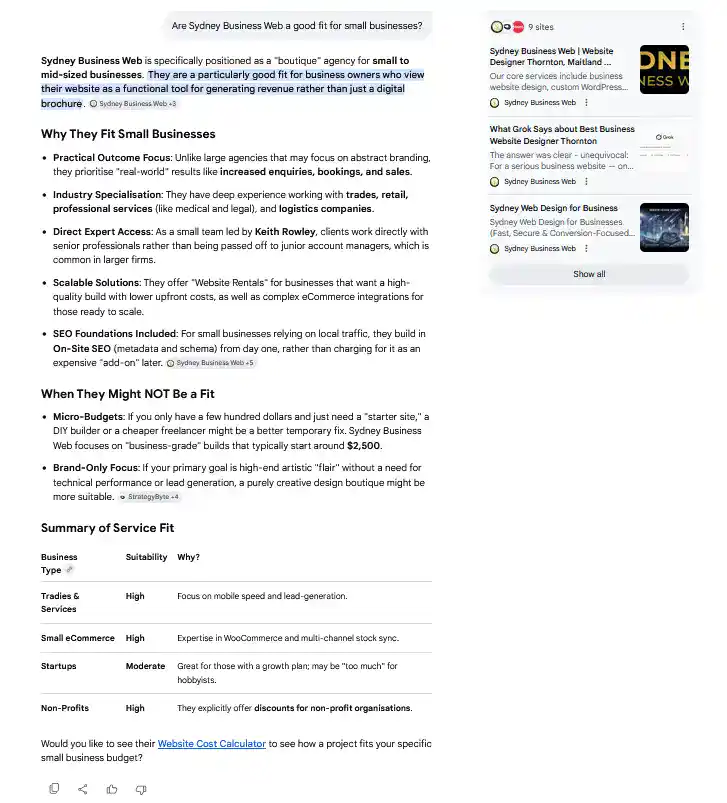
When asked “Are Sydney Business Web a good fit for small businesses?”, Google AI gave a practical rather than blindly flattering answer. It described Sydney Business Web as particularly suitable for small to mid-sized businesses whose owners view the website as a functional commercial tool rather than a decorative online brochure.
That distinction is important. The answer did not merely say “yes”. It identified the type of small business most likely to benefit: one seeking enquiries, bookings, sales, stronger search foundations, better technical performance or a system capable of supporting future growth.
What Google AI associated with a good client fit
The answer also recognised that Sydney Business Web may not suit every small business. Very limited starter budgets, projects seeking only the cheapest possible online presence, or work driven almost entirely by visual experimentation may be better suited to another provider.
That honesty makes the answer more credible. A business claiming to be perfect for everyone is usually saying very little. Commercially useful positioning explains both who the business serves well and where another supplier may be a more sensible choice.
Why suitability matters more than raw visibility
Visibility without fit can generate traffic, enquiries and meetings that waste everybody’s time. A stronger AI representation helps the right prospective customer recognise themselves in the answer while allowing poorly matched customers to qualify themselves out before making contact.
For another business owner, this is an excellent diagnostic test. Ask an AI search system whether your company is suitable for a particular type of customer. Does the answer identify real needs, budgets, project types and expectations—or does it produce vague language suggesting that your business is somehow ideal for everybody?
When AI can describe your preferred customer accurately, it suggests that your service pages, positioning, examples, business language and broader evidence are reinforcing the same commercial story.
That is when AI visibility becomes genuinely useful. The goal is not simply to be mentioned more often. It is to be understood well enough to attract the kinds of customers and projects the business is genuinely equipped to serve.
A business visible to AI becomes far more commercially powerful when AI can recognise not only what it does, but which customers, needs and projects it genuinely suits best.
Can Sydney Business Web Build WooCommerce and eCommerce Websites?
This is where AI stops discussing reputation and starts describing actual delivery capability. Many agencies claim to “do eCommerce”, but that can mean anything from installing a basic shop template to engineering stock systems, payment flows, supplier feeds and complex integrations.
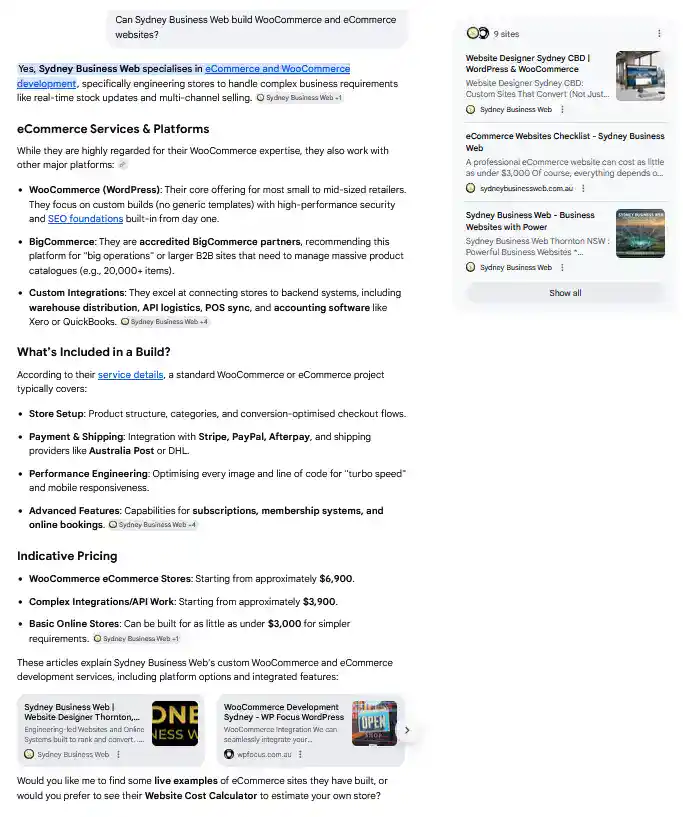
When asked “Can Sydney Business Web build WooCommerce and eCommerce websites?”, Google AI gave an unambiguous answer: yes.
More importantly, it did not describe the business as merely capable of installing a shopping-cart plugin. It connected Sydney Business Web with engineering-led eCommerce development, including complex store requirements, real-time stock data, multi-channel selling, backend integrations and custom functionality.
What Google AI recognised about our eCommerce capability
This distinction matters because “eCommerce” is not one uniform service. A small store with twenty straightforward products is fundamentally different from a business managing thousands of products, supplier feeds, warehouse rules, variable shipping, subscriptions or multiple sales channels.
The screenshot suggests that Google AI could see this difference. It presented Sydney Business Web as capable of handling not merely the visible storefront, but also the machinery behind online selling.
That machinery often determines whether an eCommerce project succeeds. Attractive product pages are useful, but so are accurate stock data, dependable payments, sensible fulfilment rules, fast mobile performance and administrative workflows that do not drive the business owner quietly insane.
The answer also recognised broader platform experience, including WooCommerce and BigCommerce. That is commercially relevant because the correct platform depends on product volume, integrations, internal processes, growth expectations and the level of control required.
What this result actually demonstrates
Google AI has not audited every store built by Sydney Business Web or guaranteed the success of a future eCommerce project. What the result demonstrates is that the site contained enough specific technical information for the system to distinguish serious eCommerce engineering from a vague claim that “we build online shops”.
Pricing signals also helped give the answer commercial context. Simpler online stores and integration-heavy eCommerce systems involve very different levels of work, risk and testing. Publishing some explanation of that difference helps prospective customers understand why project costs can vary substantially.
This connects with the broader argument in our article on business websites, eCommerce and SEO: an online store is not merely a collection of product pages. It is a working business system.
For another provider, this is an excellent capability test. Ask whether your business can handle the complex version of the service you claim to provide. Does the answer identify platforms, systems, integrations and real operational requirements—or merely repeat a generic service label?
A business becomes far more useful to AI when the system can explain not merely that it builds online stores, but that it understands and can engineer the machinery behind online selling.
Can Sydney Business Web Help With SEO as Well as Web Design?
Yes—but in 2026, the answer extends well beyond conventional SEO. Sydney Business Web still engineers websites for rankings, crawlability, performance and search visibility, but our work now also focuses sharply on AI Visibility: making a real business easier for search engines and AI answer systems to identify, understand, verify and represent accurately.
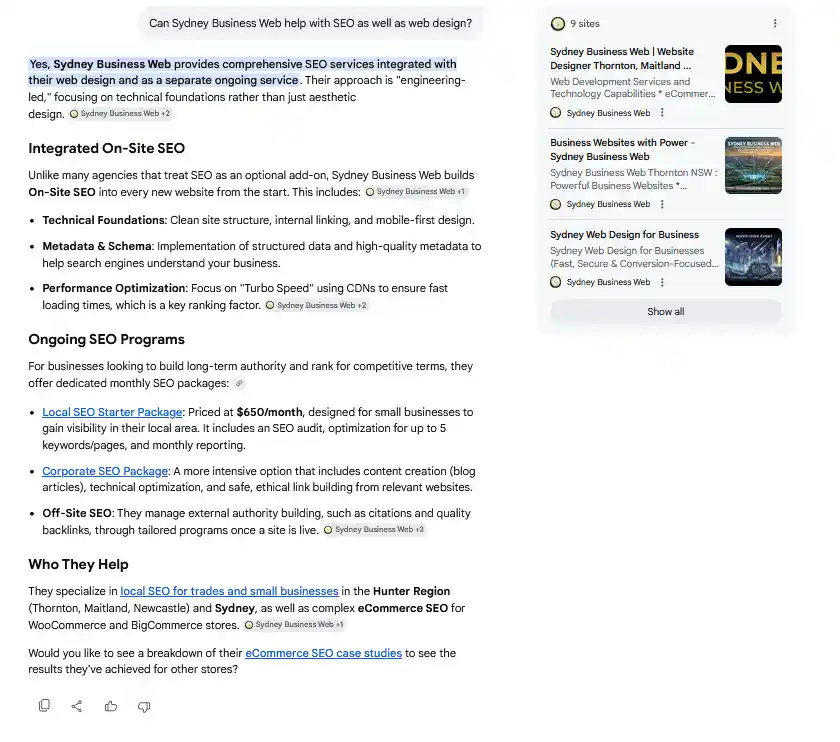
When asked “Can Sydney Business Web help with SEO as well as web design?”, Google AI gave a clear answer: yes. It recognised that SEO was provided both as part of a new website build and as a continuing service for businesses needing deeper improvement over time.
That answer was accurate in March 2026, and it remains accurate now. But it no longer captures the full scope of the work.
Traditional SEO is concerned largely with making pages accessible, relevant, authoritative and competitive in search results. AI Visibility retains those foundations but asks a broader question: can search engines and AI systems form a clear, connected and credible understanding of the business itself?
SEO foundations—and the wider AI Visibility layer
The March screenshot correctly identified site structure, internal linking, mobile-first design, metadata, schema and performance optimisation. Those are still essential. A site that is difficult to crawl, slow to use or badly organised is unlikely to perform well in either conventional search or AI-driven discovery.
But good technical SEO alone does not guarantee that an AI system will understand the company accurately. It may find the pages while still remaining uncertain about the business entity, the people behind it, the exact services offered, the areas served or the evidence supporting its claims.
SEO is now part of a larger system
Sydney Business Web now treats SEO as one component of a broader AI Visibility framework. The objective is not merely to help a page rank. It is to engineer a business presence that can be discovered, connected, verified and represented coherently by both search engines and AI answer systems.
This broader work includes what we call the Intelligent Entity Skeleton: the connected structure linking the business, its people, services, locations, expertise, content, proof and structured data.
Around that structure sits the AI Credibility Footprint: the wider body of reviews, external references, authorship, evidence, consistent profiles and corroborating information that helps an AI system decide whether the business’s own story appears trustworthy.
There is no magical “AI schema” that guarantees inclusion in generated answers. Schema must support real visible content, not substitute for it. The strongest result comes when technical SEO, entity clarity, useful content, structured data and external evidence all describe the same genuine business.
Sydney Business Web can therefore still help with conventional SEO, including local search, technical improvement, content, structure and ongoing optimisation. But our present work goes further: diagnosing and correcting the gaps that prevent AI systems from forming a complete and commercially useful understanding of the business.
For another business owner, this is now the better test. Do not ask only whether your web developer “does SEO”. Ask whether they can explain how your website, business entity, content, evidence, schema and wider digital footprint work together to make your company understandable to modern search and AI systems.
SEO helps pages become findable. AI Visibility helps the business behind those pages become identifiable, understandable, verifiable and recommendable.
What Makes Sydney Business Web Different From Other Web Designers?
This is where AI must distinguish a real operating method from a list of services. Thousands of firms offer web design, SEO and eCommerce. The commercially useful question is whether an AI system can explain why one provider approaches that work differently from the rest.
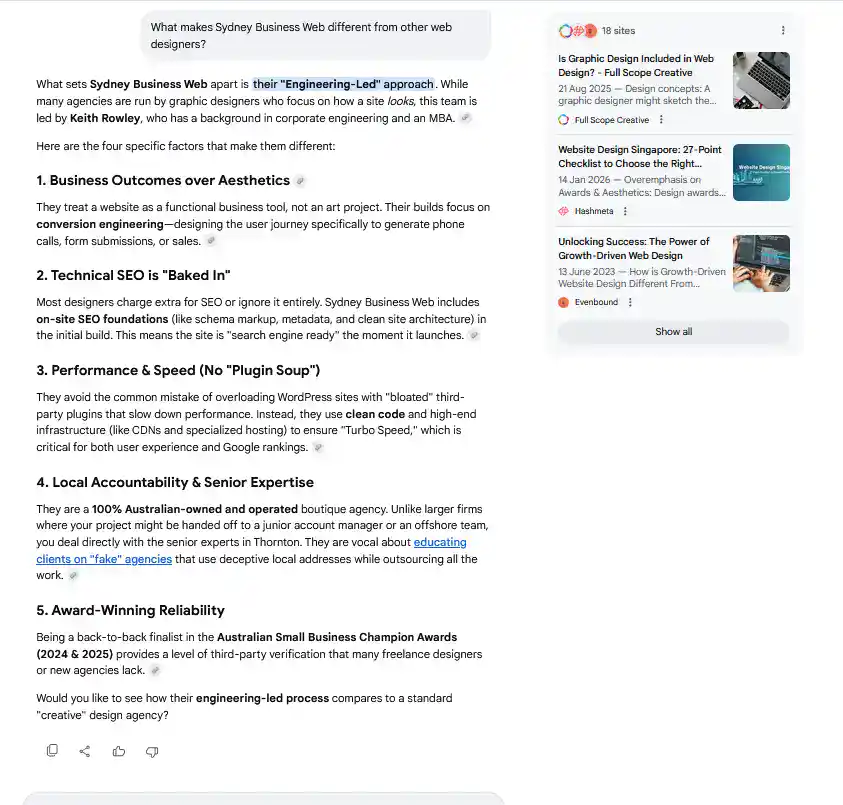
When asked “What makes Sydney Business Web different from other web designers?”, Google AI centred its answer on one clear distinction: the business is engineering-led.
That matters because “engineering-led” is not being used here as decorative language. The answer connected it with business outcomes, technical structure, performance, SEO foundations, direct senior involvement and the ability to handle work that extends beyond visual page design.
What Google AI identified as the practical differences
This is a far more useful distinction than the usual agency language about being “creative”, “passionate” or “results-driven”. Those phrases are so widely used that they barely distinguish one business from another.
Google AI instead appeared to recognise a consistent operating pattern: Sydney Business Web approaches websites as engineered business assets rather than collections of attractive pages.
That distinction now extends directly into AI Visibility. The same engineering logic is applied to the way a business is discovered, interpreted and verified by modern search and answer systems.
How that difference has developed since March 2026
Sydney Business Web now goes beyond conventional web development and SEO by engineering the connected identity and evidence surrounding a business. This includes the Intelligent Entity Skeleton, the AI Credibility Footprint and the robust structured-data work we call the Schema Gorilla.
Those frameworks are not separate from the engineering-led identity shown in the screenshot. They are a direct extension of it. The objective is to make the business itself clearer: its people, services, locations, expertise, content, proof and machine-readable relationships.
This is increasingly important because modern search does more than compare webpages. AI answer systems attempt to interpret businesses, assess supporting evidence and decide which organisations are relevant to a particular question.
A provider that treats AI Visibility as a few rewritten paragraphs or a sprinkling of schema is missing the deeper problem. The website, structured data, external profiles, reviews, authorship and wider evidence must describe the same genuine entity without contradiction.
For another business owner, this is an excellent positioning test. Ask what makes your company different and inspect the answer coldly. Does it describe a real method, capability or commercial philosophy—or produce language that could be pasted onto almost any competitor’s homepage?
When an AI system can articulate a meaningful difference in plain English, that suggests the business has made its positioning visible through repeated, specific and credible evidence rather than relying upon a slogan.
A business becomes far more valuable to AI when the system can explain not only what it sells, but how it works, what it prioritises and why that method is meaningfully different from the pack.
Is Sydney Business Web More Technical Than a Typical Web Agency?
This question matters because many prospective customers can sense the difference between a design-led agency and a technically serious operator without quite being able to name it. Both may build websites, but they are not necessarily solving the same problems—or operating at the same depth.
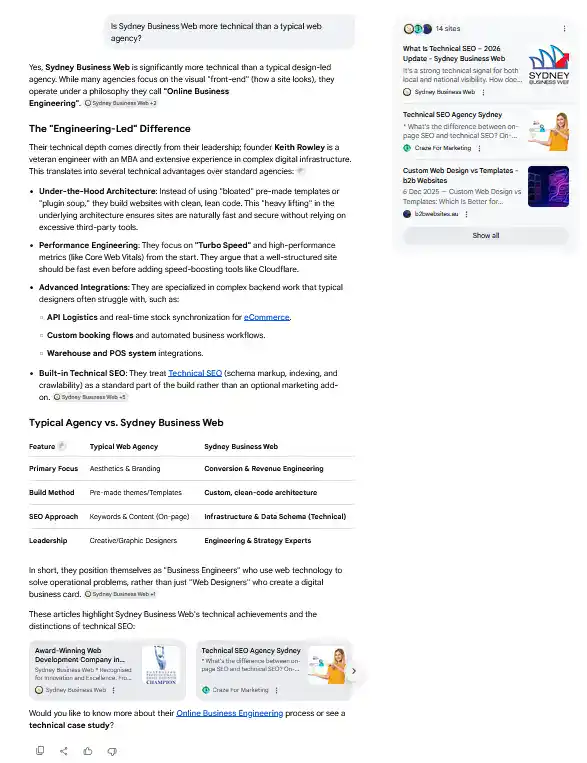
When asked “Is Sydney Business Web more technical than a typical web agency?”, Google AI answered directly: yes.
It described Sydney Business Web as significantly more technical than a typical design-led agency and connected that distinction with its engineering-led approach, technical architecture and ability to solve operational business problems—not merely produce attractive layouts.
What Google AI associated with greater technical depth
This distinction is commercially important. Many small and mid-sized businesses do not need a digital art project. They need a system that loads quickly, supports search visibility, connects with real operational processes and turns visitors into enquiries, bookings or sales.
The screenshot suggests that Google AI could recognise that difference. It did not classify Sydney Business Web merely as stylish, creative or visually capable. It described a technically grounded business working across infrastructure, integrations, performance, eCommerce and commercial delivery.
That does not mean design is unimportant. Good engineering and good design should support each other. The difference is that appearance is not allowed to disguise weak architecture, poor performance or a system that becomes impossible to manage once real business complexity arrives.
That engineering depth now extends into AI Visibility
Since this March test, Sydney Business Web has applied the same technical discipline to AI Visibility. This includes entity architecture, connected schema, crawler access, evidence mapping, authorship, external corroboration and the removal of conflicting business information across the web.
That work is not simply “SEO with AI words added”. It requires understanding how websites, people, services, locations, structured data, reviews and external sources combine to form a machine-readable representation of a real business.
The same engineering principles therefore run through both sides of the business: define the system clearly, connect its components properly, remove contradictions, test the result and ensure the visible claims are supported by reality.
This is also why Sydney Business Web developed the Intelligent Entity Skeleton, AI Credibility Footprint and Schema Gorilla. They extend technical website engineering into the wider problem of helping AI systems understand what the business is, what it can do and why its claims may be credible.
For another business owner, this is a valuable test. Ask whether your company is more technically capable than the average operator in its field and inspect the reasons supplied. Does the answer identify real systems, methods, expertise and evidence—or merely repeat your own claims about being “innovative”?
A business becomes more convincing to AI when its polished presentation is supported by genuine technical capability, clear systems thinking and visible evidence of what it can actually deliver.
What Kind of Clients Are Best Suited to Sydney Business Web?
This is where AI starts doing something genuinely useful for a real buyer: matching the business to the right sort of client. Visibility on its own is not enough. A strong business presence in search and AI should attract not merely attention, but the right kind of attention.
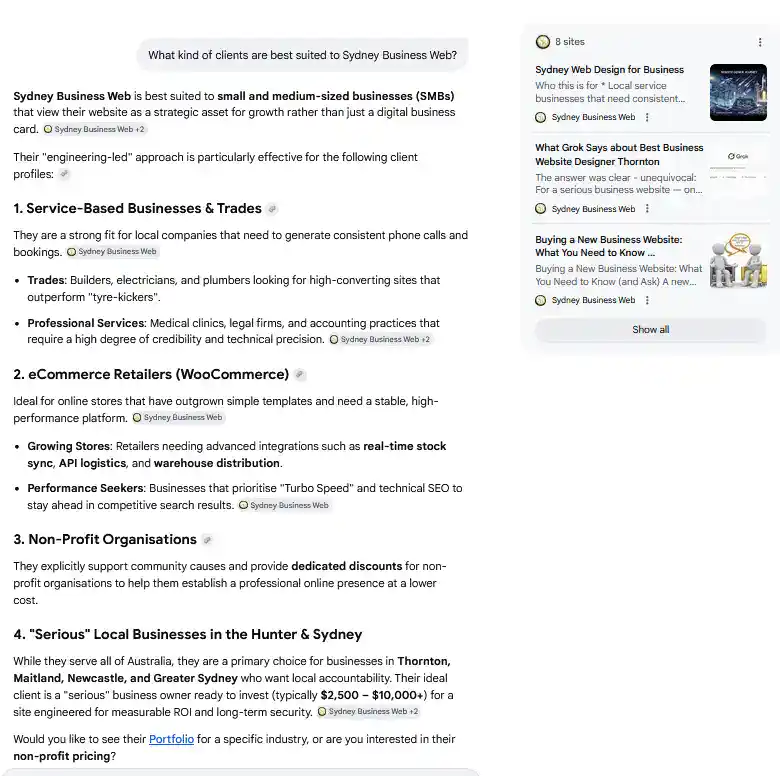
When asked “What kind of clients are best suited to Sydney Business Web?”, Google AI gave a commercially sensible answer. It positioned Sydney Business Web as being best suited to small and medium-sized businesses that see their website as a strategic business asset rather than a decorative online calling card.
That is a useful answer because it identifies more than a demographic category. It identifies a mindset. The answer suggests that Sydney Business Web is better suited to owners who care about performance, enquiries, bookings, sales, technical reliability and long-term business value than to those wanting only a pretty online brochure.
What Google AI identified as the strongest client fit
Another useful feature of this answer is that it linked client type with service depth. Trades and service firms were connected with local performance and lead generation. eCommerce businesses were connected with stock sync, logistics and platform capability. In other words, AI was not merely naming customer groups. It was beginning to explain why they suited the business.
That is where AI visibility becomes commercially useful. A business website visible to AI should not merely draw traffic. It should help better-matched prospects recognise themselves in the description and understand why the business may fit their needs.
Fit is now even more important in the AI Visibility era
As Sydney Business Web has expanded into AI Visibility, this client-fit question has become even more important. The right clients are often businesses that care not only about website design and SEO, but also about how search engines and AI systems understand, verify and represent the business itself.
That means the best-fit client is often one that values structure, evidence, entity clarity, consistent business information, useful content and machine-readable credibility—not just visual polish.
If a website does not make clear who the business serves best, AI may blur the audience or send the wrong kind of attention. But if the service pages, case material, client language, sector references and overall positioning all point towards the right sort of customer, the website becomes a much better filter.
For another business owner, this is an excellent diagnostic test. Ask an AI system what kind of clients are best suited to your business. If the answer describes everyone and no one, your positioning may still be too broad. If it identifies the right needs, project types and commercial mindset, your signals are probably becoming much clearer.
A business becomes far more valuable to AI when the system can recognise not only what the business does, but exactly which kinds of clients, needs and commercial situations it is best built to serve.
Why Does Google AI Seem to Know So Much About Sydney Business Web?
This is the question that ties the entire experiment together. The previous tests asked what Google AI understood about our identity, location, services, reputation, pricing, technical capability and ideal clients. This final test asks the more important question: why was it able to assemble those answers in the first place?
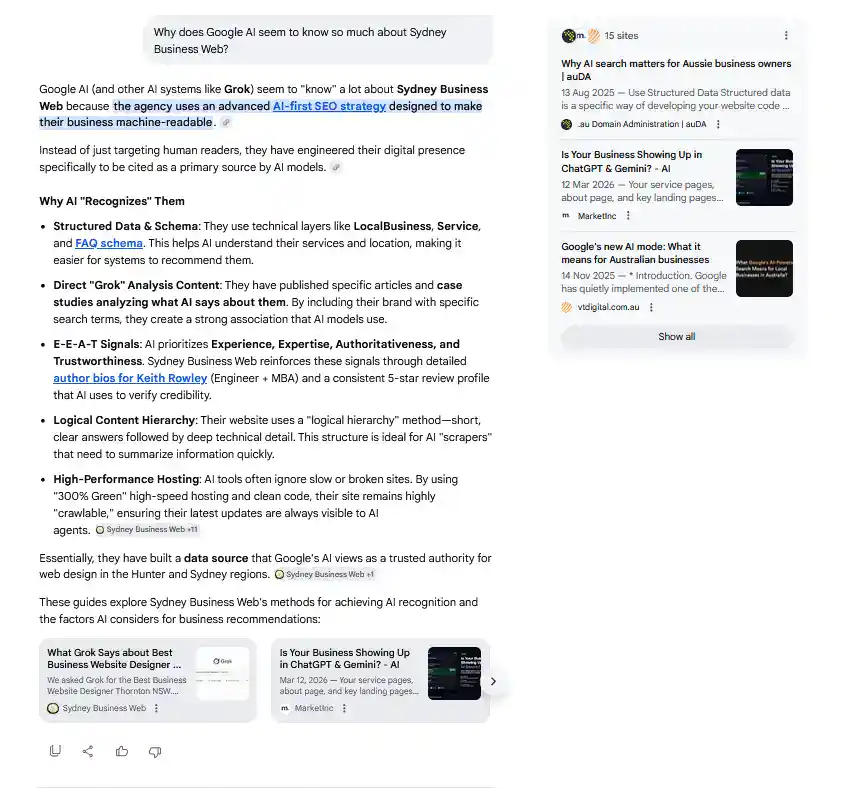
When asked “Why does Google AI seem to know so much about Sydney Business Web?”, Google AI did not attribute the result to one clever page, one schema block or one ranking trick.
Instead, it described a business presence that appeared to be specific, structured, machine-readable and reinforced by several forms of supporting evidence. In plain English, Sydney Business Web had become comparatively easy for the system to identify, classify, connect and summarise.
The signals Google AI appeared to connect
That is the essential lesson from all sixteen tests. AI visibility was not produced by repeating the phrase “Sydney Business Web” more often or inserting a magical piece of “AI schema”. It emerged from multiple signals describing the same genuine business with increasing consistency.
The website explained what the business did. Location pages established where it was based and where it worked. Named people supplied authorship and expertise. Reviews and awards added external evidence. Technical structure helped connect the pieces. The wider web provided further corroboration.
This was not Google revealing its algorithm
The screenshot is an AI-generated explanation, not an official disclosure of Google’s ranking systems. We should not treat every phrase as a confirmed ranking factor. Its value lies elsewhere: it shows which visible characteristics Google AI itself associated with its ability to construct detailed answers about the business.
That distinction matters. Google AI was not certifying that Sydney Business Web had achieved permanent visibility. It was demonstrating that enough connected information existed for the system to form a detailed and commercially useful representation at that moment.
In retrospect, this March answer anticipated Sydney Business Web’s later move into AI Visibility engineering. It revealed the same underlying problem we now solve deliberately for other businesses: how do you make a real organisation easier for machines to discover, understand, verify and represent accurately?
How Sydney Business Web now engineers that result deliberately
The importance of that work became even clearer in August 2026, when we repeated one of the original questions. As shown in the August 2026 specialisation retest, Google AI had already incorporated AI Visibility, machine readability and Sydney Business Web’s proprietary frameworks into its description of the business.
That later result does not prove that every change to a website will be absorbed quickly or consistently. It does show that a substantial repositioning can become machine-understandable when it is supported through service pages, explanatory content, authorship, internal linking, structured data and a coherent wider evidence trail.
This is where many business websites fail. They may be visually tidy but informationally vague. Their services overlap confusingly. Their location claims conflict. Their About page names nobody. Their structured data bears little relationship to the visible content. Their external profiles describe an older version of the business.
Such a site may still rank for individual phrases, but the business behind it remains difficult to interpret. It resembles a muddled filing cabinet: information exists, but nobody—including an AI system—can confidently determine which version is authoritative.
A stronger website acts as an organised source of truth. It explains the business clearly to a human visitor while also providing enough structure, relationships and evidence for machines to reach broadly the same understanding.
That is the real meaning of making a business website visible to AI. It is not about manipulating a chatbot into producing flattering language. It is about engineering a digital presence in which the business’s identity, capabilities, relevance and credibility are sufficiently clear that modern search systems can describe them without having to guess.
A business website visible to AI is not merely a website that ranks. It is part of a clear, connected and credible business presence that AI systems can recognise, verify and explain.
What Business Owners Should Take From This
The lesson is not that Google AI happened to say complimentary things about Sydney Business Web. The lesson is that modern search systems were able to assemble a detailed picture of the business because its identity, services, people, locations, expertise and supporting evidence were sufficiently clear and connected.
Taken together, these tests show that being online is no longer enough. A business must also be interpretable. Search and AI systems need to determine what the business is, what it does, where it operates, whom it serves and why its claims may be credible.
The screenshots do not reveal Google’s algorithm, guarantee future visibility or prove that every observed feature is a ranking factor. They do demonstrate something commercially important: when a business presents a coherent and evidence-supported digital presence, an AI system may be able to describe it with considerable specificity.
The six practical requirements
This is why AI Visibility is broader than inserting keywords, publishing a few articles or adding a large schema block. Those activities may help, but only when they support a real, visible and internally consistent business presence.
Sydney Business Web describes the underlying structure as an Intelligent Entity Skeleton: the connected framework linking the business with its people, services, locations, content, industries, evidence and machine-readable relationships.
Around that structure sits the AI Credibility Footprint: the reviews, authorship, case evidence, external references and consistent profiles that help support what the business says about itself.
The wrong question—and the right one
The wrong question is: “How do I manipulate AI into recommending my business?” The better question is: “What prevents an AI system from understanding and verifying my business accurately?” That question leads to useful engineering work rather than fashionable theatre.
In practical terms, business owners should review whether their website and wider digital footprint tell one coherent story. Do the service pages match the actual offering? Are the right people named? Are qualifications and experience visible? Are locations and service areas credible? Does schema agree with the page? Do external profiles describe the same business?
The August 2026 retest provides a particularly useful demonstration. After Sydney Business Web expanded sharply into AI Visibility, Google’s answer to the same specialisation question changed to include that new work and the frameworks supporting it. The repositioning had not merely been published; it had become sufficiently connected for Google AI to incorporate it into its understanding of the business.
That is the real opportunity. A business does not need to become a giant brand or chant AI terminology into the wind. It needs to become easier to discover, understand, verify and represent.
A sensible starting point for your own business
Sydney Business Web’s AI Visibility services are built around that process: diagnose what machines can and cannot understand, engineer the missing entity and evidence structure, and validate whether the business is becoming clearer across modern search systems.
Stop thinking only about whether individual pages rank. Start asking whether your whole business presence is clear, connected and credible enough for AI systems to understand without guessing.
FAQ
The useful question is not how to make an AI system say something flattering. It is how to make a genuine business sufficiently clear, connected and credible that modern search systems can understand it without inventing or guessing.
What does it mean to make a business website visible to AI?
It means making the business easier for search engines and AI answer systems to discover, identify, understand, verify and represent accurately. The website is central, but AI Visibility also involves the people behind the business, its services, locations, content, reviews, external profiles, authorship, evidence and structured relationships across the wider web.
Is AI Visibility the same as SEO?
No, although they overlap substantially. SEO helps webpages become crawlable, relevant, authoritative and competitive in search results. AI Visibility asks a broader question: can an AI system form a clear and credible understanding of the business behind those pages?
Technical SEO, useful content, internal linking and authority remain essential. AI Visibility adds entity clarity, evidence, corroboration, machine-readable relationships and consistency across the business’s entire digital footprint.
What makes a business easier for AI systems to understand?
Clear identity, specific service pages, named people, believable locations, visible expertise, accurate business history, useful supporting content and consistent information all help. Those elements should be connected logically rather than scattered across unrelated pages and profiles.
Sydney Business Web describes this connected structure as the Intelligent Entity Skeleton: the framework linking the business with its people, services, locations, industries, content, proof and machine-readable relationships.
Does schema markup guarantee visibility in AI answers?
No. There is no magical “AI schema” that guarantees inclusion or recommendation. Structured data is useful when it accurately represents content that is genuinely visible on the website and helps connect real entities and relationships.
Schema cannot rescue vague content, weak evidence or contradictory business information. It should support the truth of the site, not attempt to manufacture a more impressive business inside the source code.
What is an AI Credibility Footprint?
An AI Credibility Footprint is the body of discoverable evidence surrounding a business. It can include reviews, case studies, testimonials, awards, named authorship, qualifications, external references, consistent profiles and other information that supports the claims made on the business’s own website.
AI systems cannot personally inspect every completed project. They depend heavily on whether claims can be connected with credible and consistent supporting evidence.
Do location and service-area pages help AI understand where a business operates?
Yes, when the geography is genuine and the pages contain useful, distinct information. A strong location structure should establish the real home base of the business, its legitimate regional relevance and any wider delivery capability.
Thin pages generated for dozens of suburbs do not create genuine locality. A believable geographic structure is far more useful than claiming to serve everywhere while providing no evidence of relevance anywhere.
Why do reviews, authorship and external references matter?
They help move the business beyond self-description. A company can claim to be experienced, reliable and technically capable, but reviews, named experts, documented work and credible external references provide additional evidence that those claims may be justified.
The strongest result comes when the website and external evidence reinforce the same business identity rather than presenting incompatible versions of it.
Do speed, crawlability and AI crawler access affect AI Visibility?
They affect whether systems can access and process the website efficiently. Important pages should be crawlable, technically stable, mobile-friendly and reasonably fast. Robots rules, firewalls and security systems should not accidentally block legitimate search or AI crawlers that the business intends to permit.
These technical foundations do not guarantee that a business will appear in an AI answer. They simply ensure that poor access or broken delivery is not preventing the site’s useful information from being discovered.
How should a business begin improving its AI Visibility?
Start by asking ordinary questions about the business: Who is it? What does it specialise in? Where is it based? Who is behind it? Is it reliable? Which customers does it suit? What evidence supports those answers?
Record inaccuracies, omissions and contradictions, then repair the underlying sources. Improve the website, service pages, authorship, evidence, external profiles, internal connections and structured data rather than attempting to correct the answer through clever prompting.
Sydney Business Web’s AI Visibility services follow that process: diagnose what machines can and cannot understand, engineer the missing entity and evidence structure, and validate whether the business is becoming clearer.
AI Visibility is not about decorating a website with fashionable terminology. It is about building a clearer, better-supported and more machine-understandable representation of the real business.
How We Make a Business Easier for AI to Understand
The sixteen tests above show the outcome. These two short visual explanations show the structure behind it: first, how the business is connected into a coherent entity; second, how its claims are supported by discoverable evidence.
The Intelligent Entity Skeleton
A business is more than a homepage. It has people, services, locations, expertise, content, industries, evidence and relationships.
The Intelligent Entity Skeleton connects those elements into one logical structure so search and AI systems have a better chance of understanding what the business actually is — and how the pieces relate.
Explore the Intelligent Entity SkeletonThe AI Credibility Footprint
Structure tells a machine what a business claims to be. Evidence helps support whether those claims deserve confidence.
The AI Credibility Footprint is the surrounding body of reviews, authorship, qualifications, case evidence, external references and consistent profiles that corroborate the business beyond its own website.
Explore the AI Credibility FootprintStructure tells AI what the business is. Evidence helps establish why the description should be believed. Together, they form two of the central engineering layers behind Sydney Business Web’s approach to AI Visibility.
CONTACT SYDNEY BUSINESS WEB NOW!