SPECIAL INDUSTRY BRIEFING: The Mid-2026 AI Search Turmoil & the Engineering-Led Response
Prepared by: Sydney Business Web
Context: Algorithmic recalibration of Large Language Models (LLMs) and Generative Engine Optimisation (GEO)
Audience: Business Partners, Operational Directors, and Serious Business Owners
Executive Summary
The digital landscape in mid-2026 is experiencing an unprecedented structural shift. Businesses with impeccable real-world reputations and clean web infrastructure are experiencing temporary drops in AI visibility. Concurrently, surface-level creative agencies relying on bloated “brochure” websites are temporarily surfacing for high-intent search queries.
This briefing outlines the underlying mechanics of this algorithmic anomaly, provides a three-month outlook, and explains why an engineering-led approach to data architecture is the only sustainable path forward for commercial survival.
1. The Anatomy of the Mid-2026 Search Disruption
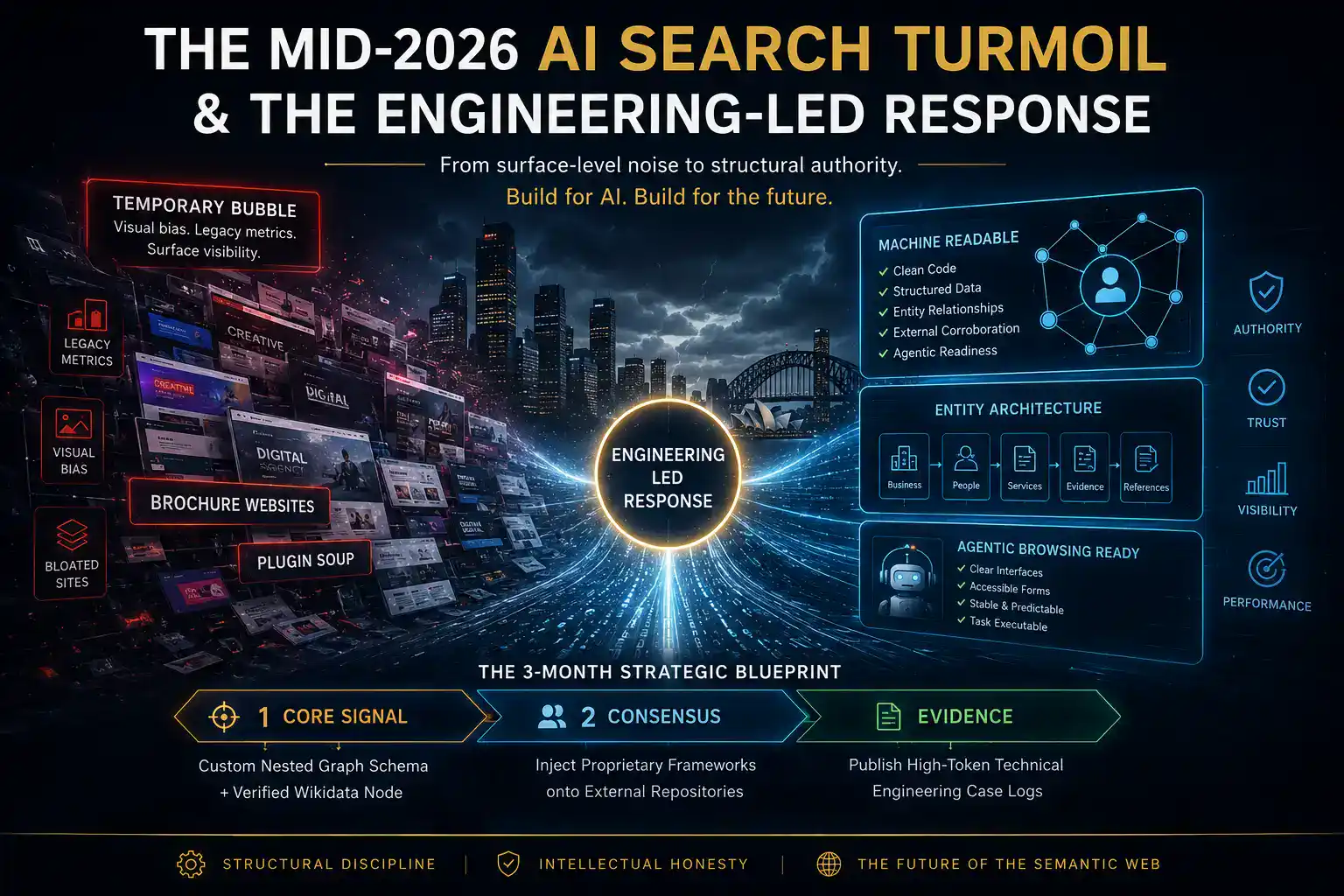
Three distinct technical factors have converged to create a temporary “bubble” where visual design is being rewarded over structural integrity:
The “Spam Correction” Core Updates
Following a massive influx of low-quality, AI-generated content flooding the web in early 2026, search engines deployed emergency spam-filtering updates. To minimise algorithmic risk, retrieval models temporarily dialled up the weight of legacy domain metrics—such as historic domain age and raw backlink volume.
This has given large, legacy creative agencies a temporary pass based on historical noise rather than current technical competence.
Multi-Modal Interface Bias
Modern AI engines are heavily prioritising “multi-modal” search results—forcing user interfaces to display visually rich layout cards, images, and video blocks.
Currently, search crawlers are misinterpreting heavy visual user-engagement signals as business authority, temporarily favouring flashy front-end design over the bloated, inefficient code sitting underneath.
Keyword and Buzzword Dilution
Core technical terms such as AI Visibility, Semantic Search, and Schema Graphs have entered the mainstream corporate lexicon.
Conventional agencies are aggressively inserting these phrases into their marketing copy without modifying their underlying technology. Because they rely on flat, auto-generated SEO plugin defaults, their data layer remains fragmented, yet their sheer domain size allows them to temporarily crowd out technical specialists.
2. Why the “Pretty Picture” Model Is a Financial Liability
A website built purely for human eyes using heavy visual page-builders and “plugin soup” creates deep structural blind spots for machine-reading systems.
When a Large Language Model (LLM) or autonomous AI agent attempts to parse a conventional brochure website, it encounters severe code bloat and isolated metadata.
As AI Search Overviews absorb a higher share of commercial search traffic over the coming months, these visually dense but structurally weak websites face a severe degradation in organic traffic. Because automated crawlers cannot cleanly verify their real-world credentials, the AI simply drops their confidence score to protect its own output accuracy.
3. The Three-Month Outlook: The Clean-Code Crackdown
The current algorithmic landscape is an unsustainable bubble due to one primary constraint: computational cost.
Ingesting and rendering bloated codebases burns an astronomical number of server tokens. Over the next 90 days, search engines and AI engines will be forced to aggressively tune their retrieval layers to reward computational efficiency.
Websites engineered as database-driven systems—featuring streamlined DOM trees, server-level optimisation, and custom-nested JSON-LD schema graphs—will experience a significant surge in visibility. They cost the AI fractions of a cent to read and verify compared with heavy, template-built agency sites.
Furthermore, search is rapidly transitioning from passive information retrieval to Agentic Workflows, where autonomous AI bots browse the web to execute tasks, parse forms, and verify service parameters.
An engineering-led asset is natively prepared for this machine-to-machine economy; a standard brochure site is completely unreadable to it.
4. The Sydney Business Web Strategic Blueprint
To capitalise on this technical realignment and solidify market positioning over the next three months, Sydney Business Web is executing a rigorous, three-tiered Entity Validation push:
[ Phase 1: Core Signal ] ──> Custom Nested Graph Schema + Verified Wikidata Node
            │
[ Phase 2: Consensus ]   ──> Inject Proprietary Frameworks onto External Repositories
            │
[ Phase 3: Evidence ]    ──> Publish High-Token Technical Engineering Case Logs
Month 1: Core Signal Anchoring
Standardising root-level machine instructions via localised llms.txt and llms-full.txt files to eliminate processing noise for scrapers.
This is reinforced by deeply nesting homepage graph schema—explicitly binding the business service catalogue to verified real-world entity registries such as the Australian Business Number and Wikidata ID Q134008807.
Month 2: External Consensus Building
Moving proprietary technical frameworks—such as the Intelligent Entity Skeleton—out of isolated site environments and planting them across highly crawled, authoritative developer channels and open-source repositories.
This forces the AI’s retrieval layer to recognise these frameworks as validated industry truths rather than self-published marketing claims.
Month 3: Execution Log Deployment
Re-architecting traditional marketing case studies into data-dense engineering logs.
By swapping generic customer testimonials for hard structural metrics—such as database-cleanup parameters, API-integration logic, and server-level response diagnostics—the website feeds AI scrapers the exact token combinations required to prove absolute domain competence.
Conclusion
Human visitors judge a website by its visual layout, but AI search systems judge a website by its database logic and structural evidence.
While the algorithms are currently distracted by surface-level design noise, the underlying technical transition towards machine legibility is absolute.
By maintaining strict structural discipline and holding the line on intellectual honesty, Sydney Business Web and its clients are perfectly positioned to inherit the future of the semantic web.
External Technical References
Current first-party documentation covering generative AI search, structured data, autonomous browsing agents and AI crawler access.
Optimising for Generative AI Features
Google’s current technical guidance for website visibility within AI Overviews, AI Mode and other generative search experiences.
Read the official guidance → Google Search CentralGeneral Structured Data Guidelines
Official requirements for accurate, visible and non-misleading structured data implemented through JSON-LD and other supported formats.
Review the structured data rules → OpenAI DocumentationChatGPT Agent and Autonomous Browsing
OpenAI’s description of agents that browse websites, interact with interfaces and complete multi-stage online tasks.
Explore ChatGPT agent → Cloudflare DocumentationAI Crawler and Bot Reference
Technical reference covering recognised AI crawlers, crawler identities and the infrastructure controls governing machine access.
View the crawler reference →Related Sydney Business Web Reading
Further technical analysis of agentic browsing, entity architecture, online credibility and the engineering foundations of AI visibility.
Agentic Browsing Readiness for Business Websites
How website interfaces, forms, access controls and technical architecture must adapt for autonomous AI agents.
Read the technical briefing → AI Visibility FrameworkThe Intelligent Entity Skeleton
How connected business entities, services, people, evidence and schema nodes form a coherent machine-readable structure.
Explore the entity framework → AI CredibilityThe AI Credibility Footprint
Why independently corroborated signals across the web carry more evidentiary weight than unsupported claims published by a business itself.
Read the credibility analysis → AI Search ArchitectureEngineering a Verifiable Digital Footprint
The technical and evidentiary architecture required to make a business understandable, traceable and verifiable by AI search systems.
Read the architecture briefing →Frequently Asked Questions
Practical questions arising from the current disruption in AI search visibility and machine-readable website architecture.
Why can a technically strong website lose AI visibility?
AI visibility is not determined by technical quality alone. Retrieval systems continually rebalance factors such as domain history, external references, content patterns, user behaviour and spam risk. A temporary decline does not necessarily indicate that the website has become technically weaker.
Does attractive visual design improve AI search rankings?
Not directly. Strong imagery, video and layout may improve human engagement, but they do not replace clear content, entity relationships, crawler access, structured data and independently verifiable business evidence.
What is an Intelligent Entity Skeleton?
An Intelligent Entity Skeleton is a connected framework linking the business, its legal identity, people, services, service pages, evidence, external references and structured-data nodes. Its purpose is to make the business easier for search engines and AI systems to understand and verify.
Can an SEO plugin create a complete entity architecture?
Usually not by itself. Plugins can generate useful basic schema, but they rarely understand the full commercial relationship between a business, its founders, services, evidence, industries, case studies and external corroboration. That structure normally requires deliberate design.
What makes a website ready for agentic browsing?
An agent-ready website has clear navigation, predictable interfaces, accessible forms, explicit service information, stable URLs, sensible security controls and content that autonomous systems can parse without relying entirely on visual interpretation.
Will clean code automatically produce higher AI visibility?
No. Clean code reduces technical friction, but it cannot manufacture authority or credibility. AI visibility also depends on factual consistency, useful content, real-world evidence, external corroboration and whether crawlers are permitted to access the relevant material.
What is the purpose of llms.txt and llms-full.txt?
These files can provide machine-readable guidance about important website content and preferred source material. They may assist some AI-oriented crawlers, but they are not universal standards and should support—not replace—proper site architecture, internal linking and structured data.
What should businesses do during an AI visibility decline?
First verify crawler access, indexing, technical health and recent changes. Then strengthen entity consistency, internal relationships, service evidence and external corroboration. Reactive keyword stuffing or publishing large volumes of generic AI content is more likely to increase noise than restore confidence.
CONTACT SYDNEY BUSINESS WEB NOW!