
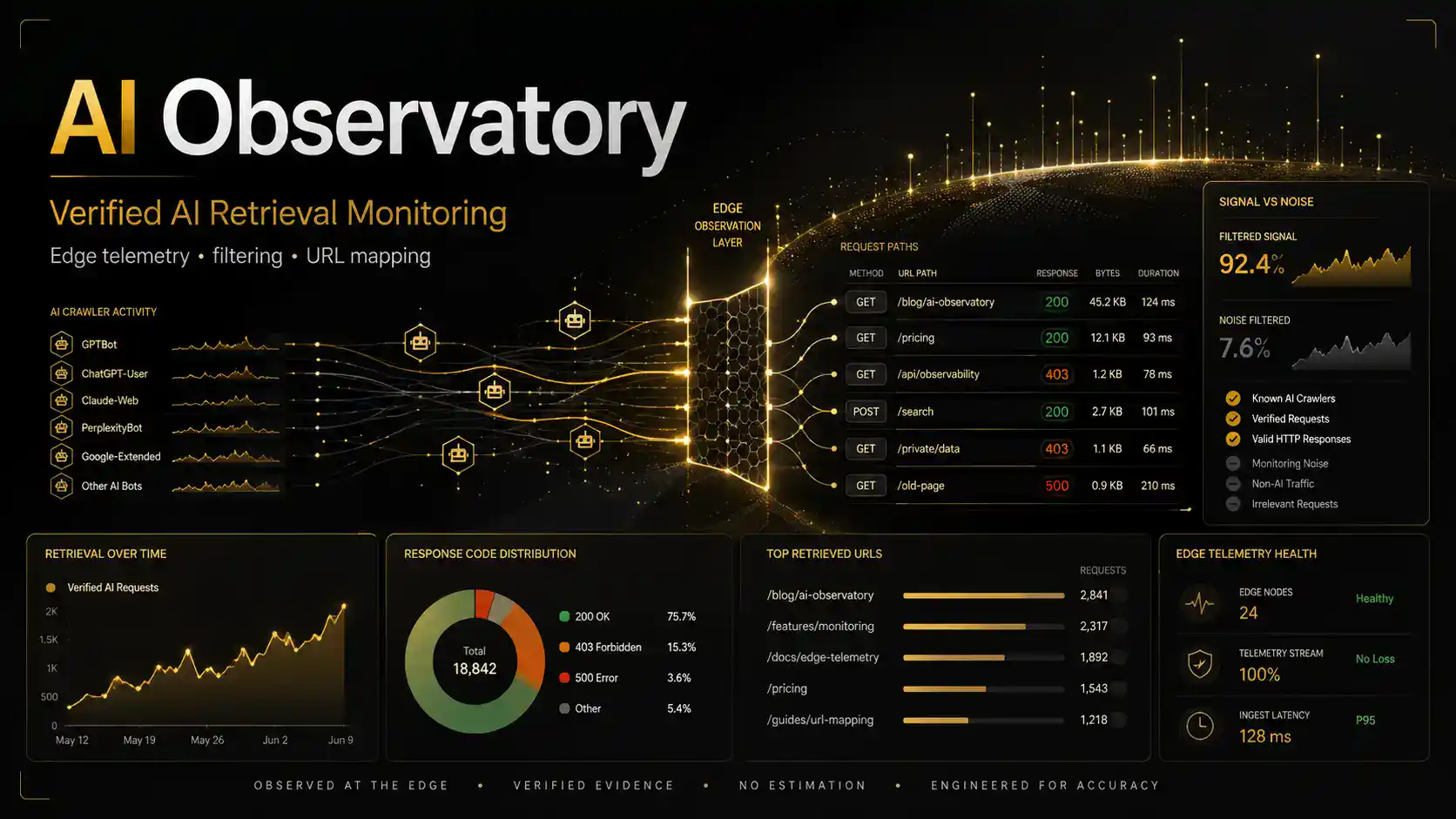
Your dashboard says 500 AI visits.
But how many actually mattered?
You may think ChatGPT, Google or another AI system visited your website 500 times. But 500 crawler requests does not mean 500 AI systems successfully read useful information about your business.
Bot hits, discovery requests, failed responses, irrelevant URLs, probes, supporting resources and other machine traffic can all inflate the headline number.
Perhaps only a handful were identifiable machines successfully retrieving substantive information about the business. Five is illustrative — the whole point is that you need to measure the real number.
A machine requesting robots.txt, checking a sitemap, probing an old URL, fetching an image, receiving a 403 response or merely presenting a recognised user-agent is not the same thing as an AI system successfully retrieving your services, products, expertise, pricing, evidence or other meaningful business content.
Yet when all of those requests are bundled together into a headline “AI crawler” number, the result can look far more impressive than the underlying evidence deserves.
That is the weakness in raw bot counts. They answer “How much machine traffic did we see?” when the more important business question is “How much useful AI retrieval actually occurred?”
Your business needs to know the real retrieval number. Until you know how often AI systems are genuinely retrieving useful information from your website, you do not have a reliable baseline from which to begin measuring AI visibility.
Without that baseline, improvement is difficult to measure honestly. Did machine retrieval increase? Did crawler access improve? Are more important pages being reached? Are changes to website architecture, structured data or entity information producing a measurable effect?
And further downstream, what relationship exists between retrieval, the way an AI system describes the business, whether it recommends the business and whether it ultimately cites the website?
If the first number in that measurement chain is polluted by noise, everything built on top of it becomes harder to interpret.
Remove noise and irrelevant machine requests.
Determine which machine or crawler produced the observation.
Identify the exact URL and the type of information requested.
Record whether the website actually returned the requested content successfully.
That is what the Sydney Business Web AI Observatory was designed to do. It does not try to make the AI crawler number as large as possible. It attempts to separate useful retrieval evidence from the surrounding machine noise.
The result is a much more defensible starting point for AI visibility measurement: not simply evidence that a bot touched the website, but evidence that identifiable machine systems successfully retrieved information that actually matters to the business.
This is why we call it the gold standard for verified AI retrieval monitoring. Before you measure AI mentions, recommendations, citations or visibility, you first need to know what the machines are genuinely retrieving.
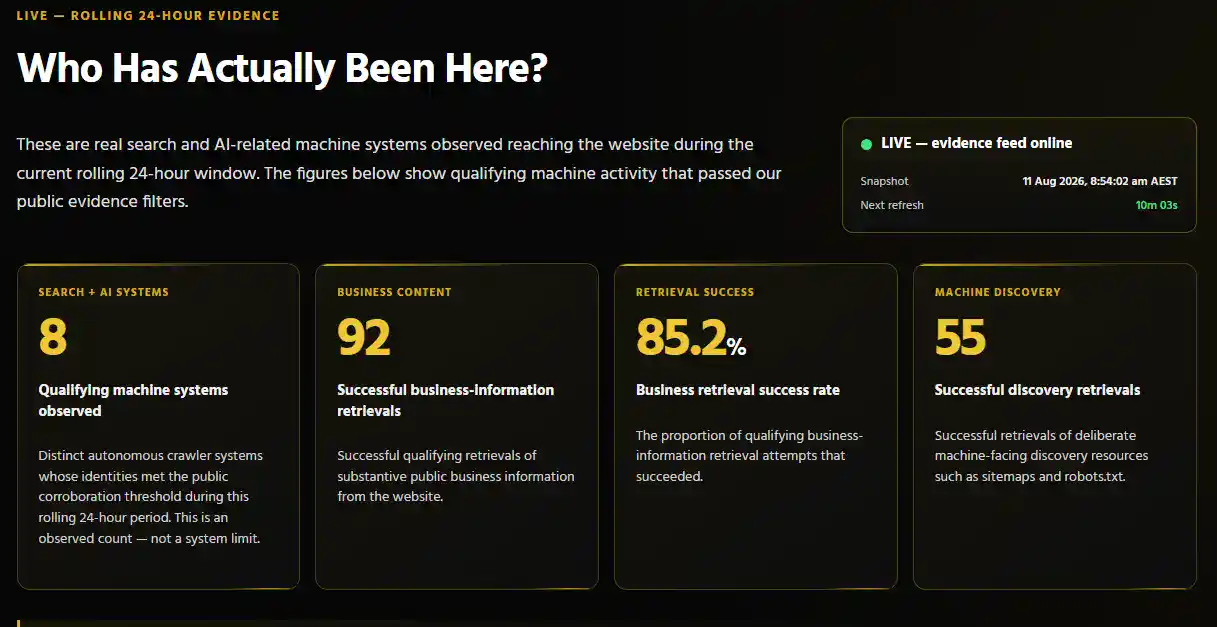
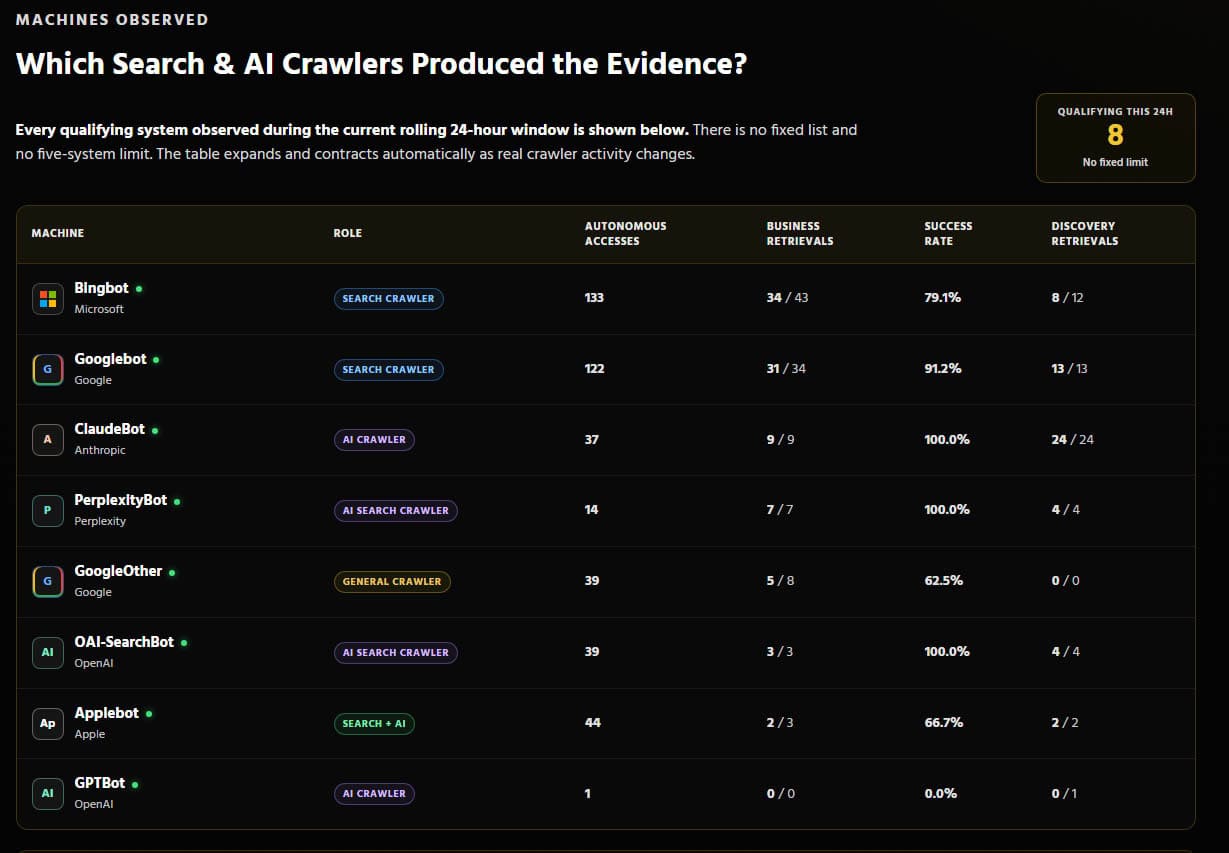
This is the key point: the Observatory is not trying to win a contest for the biggest AI crawler number. It is trying to produce a more defensible retrieval baseline from which AI visibility can actually be measured.
What other AI monitoring methods often get wrong
The problem is not that other tools are useless. The problem is that many of them measure a different layer of reality — or they bundle too many unlike things into one impressive-looking number.
| Method | What it usually measures | What it often misses | Why that can mislead a business |
|---|---|---|---|
| Raw server logs | All machine requests hitting the server | Whether the requests were useful, relevant or meaningful as business retrieval evidence | A very large number can create the illusion of strong AI activity when much of the traffic may be low-value noise |
| Cloudflare / infrastructure views alone | Bot and crawler traffic at the network edge | Business-level qualification, filtering, content relevance and practical interpretation | Excellent raw telemetry, but still too blunt on its own for measuring AI visibility sensibly |
| Prompt / rank trackers | What AI systems say when prompted | Whether the system actually retrieved your website content in the first place | These tools measure outputs. They do not prove the upstream retrieval chain that produced them |
| Mention / citation dashboards | Where your business appears in AI answers or citations | The retrieval mechanics beneath those downstream appearances | Useful later in the chain, but not strong evidence of what the machines actually read from your site |
| AI Observatory | Filtered, qualified and verified machine retrieval evidence | It does not pretend to prove downstream understanding, recommendation or citation on its own | It provides a cleaner first number in the chain: what identifiable systems are genuinely retrieving from the website |
A serious measurement system needs more than a counter.
If AI retrieval is going to become a meaningful business metric, the measurement needs to be repeatable, interpretable and sufficiently clean that changes in the number actually mean something.
Otherwise, you are not really measuring AI visibility. You are watching machine traffic move around.
A gold-standard retrieval measurement should tell you not merely that a machine appeared, but which useful information was requested, whether it was delivered successfully and whether the observation belongs in your AI visibility baseline at all.
| Measurement requirement | Why it matters | AI Observatory approach |
|---|---|---|
| Observe at the edge | Client-side analytics can miss crawler activity entirely. Measurement needs to occur where the machine request actually reaches the website infrastructure. | ✓ Observes machine requests through the instrumented Cloudflare edge layer. |
| Separate signal from noise | Raw request totals mix valuable retrieval activity with technical, irrelevant and unsuccessful traffic. | ✓ Applies filtering so that the dashboard focuses on observations useful for business-retrieval measurement. |
| Know what was requested | A visit to a service page is not equivalent to a request for robots.txt, an image, an obsolete URL or another supporting resource. | ✓ Maps retrieval observations to the actual URLs and content classes involved. |
| Know whether it succeeded | An attempted retrieval is not the same thing as successfully receiving the requested resource. | ✓ Records HTTP outcomes so successful retrieval can be distinguished from blocked, failed or otherwise unsuccessful requests. |
| Preserve system-level evidence | Aggregate numbers become much more useful when you can see the underlying machine systems contributing to them. | ✓ Provides system-level observations beneath the rolling summary metrics. |
| Create a repeatable baseline | You cannot determine whether AI visibility work is improving retrieval if the starting number itself is unstable or polluted. | ✓ Produces a filtered retrieval baseline that can be compared across monitoring windows. |
The Observatory does not pretend that retrieval proves every step that follows. A successful HTTP response does not prove that an AI system understood the content, stored it, recommended the business or later cited the website.
That would be an unjustified claim.
What it does provide is something more useful: a defensible measurement of the first observable stage.
Get the first measurement wrong and the rest of the chain becomes difficult to interpret. Get the retrieval baseline right, and you finally have somewhere credible to start.
You do not need to build any of this yourself.
The AI Observatory is not sold as a piece of software that leaves the business owner staring at Cloudflare settings, server logs and Worker code. Sydney Business Web handles the technical implementation.
We assess whether the website is suitable, configure the monitoring layer, establish the filtering logic and deploy the Observatory around the site's real production traffic.
Check the website, DNS, hosting and Cloudflare suitability.
Build and configure the edge monitoring implementation.
Separate useful retrieval evidence from ordinary machine noise.
Give the business a defensible retrieval baseline to work from.
In other words, the technical sophistication of edge-level measurement does not become a technical burden for the client. You get the measurement system; we do the engineering.
AI Observatory FAQ
The important distinction throughout this article is between raw machine activity and useful, defensible retrieval evidence.
What counts as a useful AI retrieval?
A useful retrieval is more than a bot merely touching the website. The Observatory is designed to focus on observations where an identifiable machine requests information meaningful to understanding or discovering the business and the website successfully returns that resource.
The purpose is to distinguish substantive business retrieval from surrounding machine noise such as irrelevant requests, failed requests, technical probes and supporting traffic.
Does a 200 OK response prove that an AI system understood or used the information?
No. A successful HTTP response proves that the requested resource was successfully delivered. It does not prove that the AI system understood it, stored it, incorporated it into a model, recommended the business or later cited the website.
Those are downstream stages and need to be measured separately. The Observatory deliberately avoids claiming visibility into processes occurring inside Google, OpenAI, Anthropic or other AI systems.
How is the AI Observatory different from ordinary Cloudflare bot reporting?
Cloudflare provides extremely valuable edge-level traffic information. The Observatory uses that infrastructure as part of a more focused measurement layer built specifically around useful business retrieval.
The difference is the qualification, filtering, URL mapping, retrieval classification and business interpretation applied to the observations rather than simply presenting raw automated traffic.
Why is counting AI crawler visits not enough?
Because a raw crawler count can combine very different kinds of machine activity into one impressive-looking headline number.
Five hundred requests might include discovery traffic, technical files, irrelevant URLs, unsuccessful responses and other activity that tells you very little about whether AI systems are actually retrieving useful information about the business.
Your business needs the real retrieval number if it wants a meaningful baseline from which to measure AI visibility.
Does the AI Observatory measure AI mentions, recommendations and citations?
Not by itself. The Observatory measures the retrieval layer — the first directly observable stage in the AI visibility measurement chain.
Downstream monitoring then looks at how the business is interpreted, whether it appears in relevant AI answers, whether it is recommended and whether the website is cited.
The real value comes from correlating those downstream outcomes with a much cleaner retrieval baseline.
Do I need to understand Cloudflare Workers or server infrastructure?
No. Sydney Business Web handles the technical implementation.
We assess the website's suitability, configure the monitoring architecture, implement the filtering and establish the Observatory around the production website. The technical complexity remains our responsibility rather than the client's.
Measure the right thing first.
AI visibility is becoming measurable, but only if we stop treating every crawler request as equivalent.
Raw bot counts tell you that machines are present. Prompt trackers tell you what AI systems say. Citation tools tell you whether your website appears downstream.
All of those measurements have value.
But before any of them can be interpreted properly, your business needs a defensible answer to a simpler question: what useful information are AI systems actually retrieving from our website?
Supporting the measurement model
The AI Observatory sits within a wider Sydney Business Web AI Visibility measurement framework. These articles explain the engineering, retrieval-evidence and downstream visibility layers in more detail, followed by relevant primary technical documentation.
Sydney Business Web — supporting work
Independent technical references
Find out what AI systems are really retrieving.
If AI visibility matters to your business, you need more than an impressive crawler count. You need a defensible baseline showing which machines are successfully retrieving useful information from your website. That is what the AI Observatory was built to measure.