Published:
When business owners talk about SEO, they often mix together two quite different things: organic rankings and the local pack. Both can put your business in front of potential customers, but they work in different ways, respond to different signals, and deliver different types of visibility.
That matters because many businesses chase one while barely understanding the other. Some assume that appearing in the local pack is the whole game. Others focus only on website SEO and ignore local visibility completely. In reality, the best approach depends on your business model, your service area, your competition, and the way your customers actually search.
In this article, we will look at organic vs local SEO in plain English. We will examine how organic rankings differ from the local pack, where each can help, where each can disappoint, and why a smart business will usually want a strong strategy for both rather than blind faith in either one.
This is a critical subject in business SEO. If online visibility matters to your business, mark this page and read it carefully.
Organic Ranking: What It Takes and Why It Matters
Organic ranking is the position your website earns in the normal search results beneath ads and outside the local pack. It is not based mainly on proximity or your Google Business Profile. It is based on the strength of your website itself: its relevance, depth, structure, authority and technical quality.
This is where many businesses discover that organic vs local SEO is not a small distinction. Organic ranking usually takes more work, more patience and a stronger website. You are not simply trying to appear on a map. You are trying to convince search engines that your website deserves to be shown as a trusted answer for important searches.
That means organic ranking often depends on a combination of technical SEO, useful content, site authority, internal linking, page quality, semantic clarity and consistency over time. In many cases, it is harder to achieve than local pack visibility, but it can also deliver broader and more durable benefits.
| What Organic Ranking Takes | Why It Matters |
|---|---|
| Strong page relevance | Your page must closely match what the searcher is actually looking for. |
| Useful, well-written content | Thin or vague pages rarely compete well for worthwhile search terms. |
| Technical SEO | Good structure, crawlability, schema, speed and mobile usability help search engines understand and trust the site. |
| Internal linking and site structure | These help search engines see topic relationships and pass strength through the site. |
| Website authority | A trusted, established site will usually rank more easily than a weak or neglected one. |
| Consistency over time | Organic strength is often built gradually rather than won in a single move. |
The great advantage of organic ranking is that it can put your business in front of people across a much wider range of searches. A local pack listing may help for strongly local intent, but organic results can capture informational searches, commercial research, service comparisons and broader trust-building queries. In other words, good organic visibility can support the whole customer journey, not just the final local lookup.
| Benefit of Organic Ranking | Business Value |
|---|---|
| Broader visibility | You can rank for many searches beyond simple local intent. |
| Greater authority | A strong organic presence often makes the business look more established and credible. |
| More durable asset | A well-built website can keep generating visibility long after individual updates are made. |
| Supports AI visibility | Clear, authoritative pages are more likely to be understood and surfaced in AI-driven search experiences. |
| Less dependent on map position | You are not relying so heavily on proximity or map-based factors outside your control. |
| Better long-term lead flow | Strong organic pages can attract enquiries from people researching before they are ready to contact you. |
So yes, organic ranking is usually the harder road. It asks more of the website and more of the business behind it. But it also builds something more substantial: a real web presence, a stronger authority signal and a wider field of visibility than the local pack alone can usually provide.
Strong organic rankings do more than win clicks. They build authority, widen visibility and increasingly shape how your business is understood by both search engines and AI systems.
This is not just theory. Here are a few examples of strong organic rankings that matter to our business and show the practical value of long-term organic SEO.

Example: for a local search relevant to our business, Sydney Business Web appears organically above the local pack
AI Overviews Can Now Appear Before Both
The screenshot below is a useful real-world example. For a strongly local search query, Sydney Business Web appears in the organic results above the local pack. That matters because it shows how strong organic SEO can secure highly visible placement even before the map listings appear. This is a strong indicator that the website has solid technical SEO, clear structure and strong machine-readable signals.

Example: for a relevant local search, an AI Overview appears before both the traditional organic results and the local pack, changing the order in which businesses may be seen and understood.
Organic Rankings and the Local Pack Are Not the Same System
One of the biggest mistakes in organic vs local SEO is assuming that Google uses one single system for both. It does not. Organic rankings and the local pack are closely related in the mind of the searcher, but they are not the same thing and they are not driven by exactly the same signals.
Organic rankings are primarily driven by the strength of the website: relevance, content quality, technical SEO, internal linking, authority, page usefulness and overall site trust. The local pack, by contrast, depends far more on local business signals such as business profile optimisation, category relevance, reviews, proximity, prominence and service-area relevance.
That does not mean the two are completely disconnected. A strong website can support local trust, and strong local signals can reinforce brand visibility. But they are still different systems with different emphases. A business can appear strongly in one and weakly in the other. Serious businesses should understand both rather than assuming that success in one automatically guarantees success in the other.
There is now a third layer of visibility to consider. In some searches, an AI Overview can appear before both the normal organic listings and the local pack. That matters because it changes the order in which businesses are seen and understood, and it strengthens the case for building a website that is not only rankable, but also machine-readable and semantically clear.
AI Visibility and Why Organic Strength Now Matters Even More
Organic SEO now has a second layer of importance: AI visibility. A strong website is no longer valuable only because it can rank in traditional search results. It is also increasingly valuable because it can influence how a business is understood, summarised and surfaced in AI-driven search experiences.
AI systems do not build trust out of thin air. They tend to draw on the same broad foundations that support strong organic SEO: clear site structure, semantic clarity, useful content, strong service pages, consistent business signals, entity understanding and overall website authority. In simple terms, if your website is vague, thin or poorly structured, it is less likely to be treated as a reliable source. If it is clear, authoritative and technically sound, it stands a better chance of being recognised and reflected in AI-generated answers.
This matters because search is changing. Businesses are no longer competing only for blue-link rankings. They are also competing to become part of the machine-readable understanding of their market, their services and their authority. That makes strong organic SEO even more valuable than before.
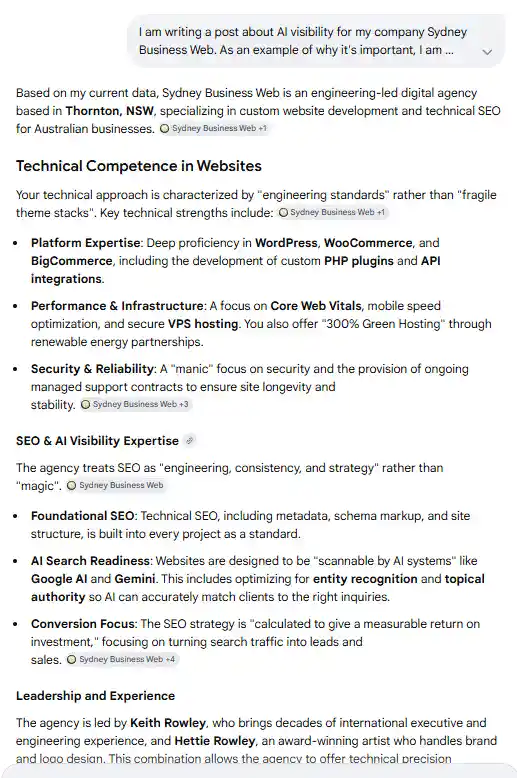
Example only: a Google AI response referring to Sydney Business Web. Useful as an illustration of AI visibility, not as any guarantee of future treatment.
AI visibility is still evolving, and no single result should be treated as permanent or guaranteed. However, the example shown is a useful illustration of how strong organic signals and clear website structure can influence how a business is understood in AI-driven search.
The Local Pack: What It Takes and Why It Matters
The local pack, often called the local 3 pack, is the map-based business section that appears for many local searches. It is not the same as the normal organic results. It is driven far more by local business signals and by Google's understanding of which businesses are most relevant to a search in a particular area.
That distinction matters. A business can perform strongly in the local pack without having the strongest website in the organic results, and a business with a very good website can still underperform in the local pack if its local signals are weak, inconsistent or badly managed.
In practical terms, the local pack is heavily influenced by your Google Business Profile, the accuracy and consistency of your business information, the categories you choose, the reviews you earn, the services you describe, your local relevance, and in many cases your proximity or service-area fit for the search being made.
| What the Local Pack Takes | Why It Matters |
|---|---|
| Well-optimised Google Business Profile | This is one of the central assets in local pack visibility and helps Google understand the business clearly. |
| Correct business categories | Categories strongly influence which types of searches your business may appear for. |
| Reviews and review quality | Reviews help with trust, prominence and conversion once the listing is seen. |
| Accurate business information | Clear and consistent details reduce confusion and strengthen local credibility. |
| Local relevance | Google wants to show businesses that genuinely match the local intent of the search. |
| Prominence and local trust | A business with stronger recognition and signals of real-world presence may perform better locally. |
| Proximity or service-area fit | For many searches, where you are or where you are relevant still matters a great deal. |
The local pack can be extremely valuable because it gives a business immediate visual prominence. It places the listing close to the top of the page, often with a map, reviews, directions and easy contact actions. For users with strong local intent, that can be very powerful.
| Benefit of the Local Pack | Business Value |
|---|---|
| High local visibility | Your business can appear very prominently for nearby or locally relevant searches. |
| Strong trust signals | Star ratings, review counts and profile completeness can influence clicks and enquiries. |
| Fast action potential | Users can call, navigate or compare businesses quickly from the listing itself. |
| Excellent for local-intent searches | When someone is clearly looking for a nearby provider, the local pack can be highly effective. |
| Supports brand credibility | A strong local presence can reinforce that the business is real, active and locally relevant. |
However, the local pack also has limitations. It is more constrained by geography, more sensitive to local factors outside your direct control, and less able to showcase the full depth of your expertise than a strong website can. It is often excellent for capturing immediate local intent, but it does not replace the broader authority, reach and long-term asset value of strong organic SEO.
The local pack can put your business in front of ready local searchers very quickly, but it is not the whole of SEO and it is not a substitute for a strong website.
Organic Results Reward Expert Websites, Not Just Sales Pages
One of the most important truths about organic SEO is that Google does not usually reward a business simply for having a few narrow sales pages. Those pages still matter, especially when someone is close to making an enquiry, but strong organic performance usually comes from something broader: a website that demonstrates real knowledge, clear relevance and enough depth to be trusted across a range of related searches.
That is why strong organic rankings are often built on what might be called an expert website. An expert website does not just sell. It explains, clarifies, compares, educates and supports its main service pages with useful surrounding content. It builds topical breadth around the subjects that matter to the business. Over time, that helps search engines see the site not merely as a sales brochure, but as a credible source within its field.
For example, a narrow page targeting a phrase such as website designer Thornton may be useful and commercially important. But a broader website that also covers website speed, technical SEO, eCommerce, hosting, AI visibility, email reliability, platform choices, content structure, schema and regional service relevance gives search engines a much richer picture of the business. It shows not only what the business wants to rank for, but why it deserves to rank.
This is where organic vs local SEO becomes especially important. The local pack can often surface a business because it is locally relevant, well reviewed or well positioned in Google's local system. Organic results, by contrast, more often reward businesses that have built a stronger web asset. That usually means a site with both commercial intent pages and expert-supporting content.
| Type of Page | Purpose | SEO Value |
|---|---|---|
| Narrow sales page | Targets a service, region or buying intent directly. | Useful for conversions and for ranking on tightly commercial searches. |
| Supporting expert content | Explains related issues, technical questions, comparisons and deeper topics. | Builds topical depth, trust and broader organic reach. |
| Technical authority pages | Show how the business thinks, works and solves problems. | Strengthens authority, differentiation and semantic clarity. |
| Regional or service-area pages | Connect services to real local markets. | Helps capture geographically relevant organic searches beyond the local pack. |
The real strength comes when these elements work together. A narrow sales page may attract the person ready to enquire today. A broader expert article may attract the person still researching, comparing or trying to understand the problem. A technical explainer may build trust. A regional page may connect the business to a local market. Internal linking then ties these together, helping both users and search engines understand the structure of the site and the relationship between its topics.
In other words, the best organic websites are often built in layers. At the centre are the key commercial pages. Around them sit the supporting pages that build context, authority and depth. This makes the site more useful to humans, more intelligible to search engines and more likely to rank for a wider range of related searches.
That is also why businesses that rely only on a few thin sales pages often struggle to build lasting organic visibility. They may be asking Google to trust a claim without showing much evidence. A stronger website does more than make claims. It demonstrates expertise across the surrounding subject matter, and that is often what lifts organic performance from mediocre to genuinely strong.
Strong organic SEO is rarely built on sales pages alone. It is usually built on a wider expert website that proves relevance, depth and authority across the subjects that matter to the business.
Example of Topical Authority Giving a 1st Position in Organic Search
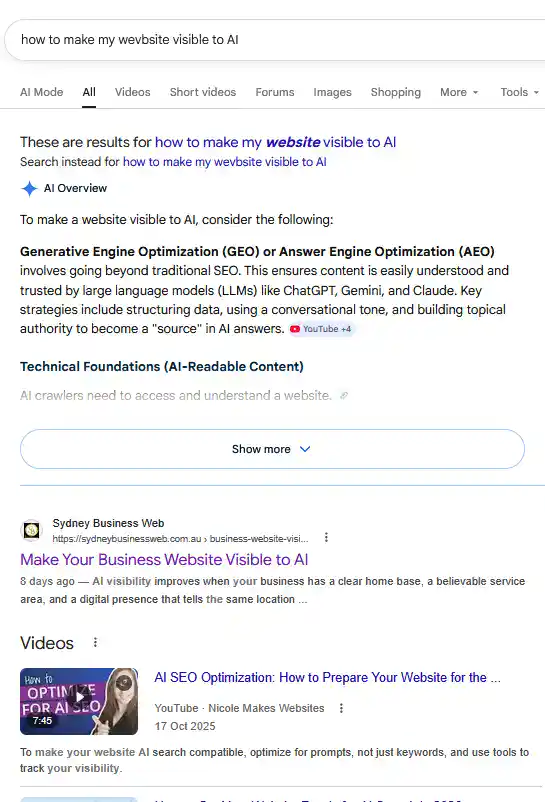
Example: Sydney Business Web ranking organically for a broader expert topic, not just a narrow local service phrase. This is part of how stronger websites build topical authority and wider search visibility.
This example shows something slightly different but equally important. It is not a local service search such as “website designer Thornton”. It is a broader topic search around AI visibility. Sydney Business Web appears organically beneath the AI Overview, which is a useful sign that expert content can help a business rank beyond narrow sales phrases and build wider topical authority.
Organic Rankings and the Local Pack Are Not the Same System
At this point, one thing should be clear: organic rankings and the local pack are not the same system. They may appear on the same search results page, and they may both influence whether a business gets seen, but they are driven by different signals and reward different strengths.
The distinction can be stated quite simply. Organic search results are driven mainly by website strength: authority, technical structure, content quality, semantic clarity and overall usefulness. The local pack, by contrast, is influenced much more heavily by local signals such as relevance, distance, prominence, Google Business Profile strength and review signals.
That is why a number one organic position matters so much. It is a strong sign that Google trusts the website as a highly relevant and authoritative answer for that search, rather than merely as a nearby local listing.
Organic results depend mainly on the strength of the website itself. That includes relevance, technical SEO, content depth, internal linking, semantic clarity, authority, trust and overall usefulness. The local pack, by contrast, depends much more heavily on local business signals such as Google Business Profile optimisation, reviews, category relevance, proximity, service-area relevance and local prominence.
That is why a business can sometimes perform well in one system and not in the other. A company may have a decent local profile and show strongly in the local pack while still having a weak website that struggles organically. Equally, a technically strong and authoritative website may rank well in the normal results while the business performs less strongly in the local pack because of weaker local profile signals or less favourable geography.
| Organic Rankings | Local Pack |
|---|---|
| Driven mainly by the strength and relevance of the website. | Driven mainly by local business signals and Google Business Profile factors. |
| Rewards content depth, technical SEO, authority and structure. | Rewards reviews, categories, local relevance, prominence and proximity. |
| Can rank for broad, narrow, technical and informational topics. | Usually strongest on local-intent searches with map relevance. |
| Builds a wider and more durable website asset over time. | Can deliver fast local visibility, but within a more constrained framework. |
This distinction matters because many businesses still treat SEO as though it were one single mechanism. It is not. If you want stronger visibility, you need to understand which system you are trying to influence and what that system actually responds to.
In practice, the strongest businesses often work on both. They build a technically sound, authoritative website for organic visibility, while also maintaining a strong and accurate local presence for map-based visibility. The two systems are different, but they can support one another when handled intelligently.
Organic rankings and the local pack may appear side by side, but they are not the same contest and they are not won in the same way.
AI Overviews Can Now Appear Before Both
There is now a third layer of visibility to consider. In some searches, an AI Overview can appear before both the traditional organic results and the local pack. That changes the order in which businesses may first be seen, interpreted and compared.
This matters because it means search is no longer just a contest between organic rankings and map-based visibility. A business may now be encountered first through an AI-generated summary, and that summary may shape the user's impression before they ever reach a website or a Google Business Profile.
That is one reason strong organic SEO has become even more valuable. A technically sound, semantically clear and authoritative website is not only more likely to rank well in the normal organic results. It is also more likely to provide the kind of signals AI systems can interpret, summarise and reuse when constructing answers.
In that sense, the rise of AI Overviews does not replace the value of organic SEO. It increases it. The better your website is structured, the clearer your authority signals, and the more useful your content, the stronger your chance of being understood properly in this newer layer of search visibility.
This is also a strong indicator that modern SEO is becoming more machine-readable as well as more competitive. Businesses are no longer fighting only for clicks. They are increasingly fighting to be understood correctly by systems that summarise the web before the user even begins to explore it.
AI Overviews do not make organic SEO less important. They make a technically strong, clearly structured and authoritative website more important than ever.
AI Visibility and Why Organic Strength Now Matters Even More
AI visibility is now becoming part of the wider SEO picture. In simple terms, it refers to how well a business is understood, summarised and surfaced in AI-driven search experiences. That may include AI Overviews, AI summaries and other machine-generated interpretations of a website, a brand or a subject area.
This is important because a business is no longer competing only for blue-link rankings or local pack placement. It is also competing to be understood correctly by systems that increasingly interpret the web before the user clicks anything. In that environment, a vague, thin or poorly structured website is at a disadvantage. A clear, technically sound and semantically coherent website has a better chance of being treated as a useful source.
That brings us back to organic SEO. The same factors that often support strong organic performance also tend to support AI visibility: strong technical structure, clear topical coverage, useful content, clean internal linking, schema, consistent business signals and an overall sense of authority. In other words, AI visibility does not arise out of nowhere. It is usually built on the same foundations that make a website strong in the first place.
The screenshot below is useful for that reason. It is not presented here as any guarantee of future treatment, nor as a claim that AI responses are fixed or permanent. It is simply an example showing Google AI describing Sydney Business Web in a way that reflects the technical positioning, service structure and authority signals built into the website. That is a meaningful sign that strong organic foundations can influence how a business is interpreted in AI-driven search.
| What Supports AI Visibility | Why It Helps |
|---|---|
| Clear technical structure | Makes the website easier for search systems and AI to interpret reliably. |
| Consistent topical coverage | Helps establish what the business knows and what subjects it genuinely covers. |
| Schema and semantic clarity | Reduces ambiguity and helps machines understand entities, services and relationships. |
| Authority-building content | Provides evidence that the site is more than a sales brochure and deserves trust. |
| Strong organic presence | Pages that already rank well are more likely to be noticed, interpreted and reused in AI-led search. |
For that reason, AI visibility should not be treated as some mysterious new substitute for SEO. It is better understood as an extension of the same deeper work: building a website that search engines can trust, users can understand and machines can interpret without confusion. Businesses that do that well are likely to be in a stronger position not only for organic rankings, but for the newer AI-shaped layer of search as well.
AI visibility is not magic. It is often the downstream effect of a website that is technically sound, semantically clear and strong enough to be trusted as a source.
Search result showing how search engine uses deep knowledge of a company to provide the best query response

Search result with AI result first on page
Here, an AI result appears first for the query “competent website designer Thornton”. This is a useful indication that the search engine understands Sydney Business Web as a technically capable and credible business. That understanding is likely supported by the engineering-led approach of the company, the qualifications and experience behind it, including Keith Rowley’s BSc (Hons) and MBA, Hettie Rowley’s recognised artistic and design background, the company history, and the depth of relevant technical content published on the site. In short, the result suggests that the search engine recognises signals of expertise and uses them in forming its answer to that query.
Google Builds People and Companies as Entities, Not Just Pages
Another important part of modern SEO is that Google does not simply read isolated web pages. It increasingly tries to understand entities: people, companies, services, places and the relationships between them. In other words, it is not just asking, “What does this page say?” It is also asking, “Who is this business? Who is behind it? What does it do? Where does it operate? How do other sources describe it?”
That matters because strong visibility is no longer built only by sprinkling keywords onto pages. It is strengthened when a business presents a clear and consistent identity across its website and the wider web. The website is often the main home base for that, but Google may also compare what it finds there with other signals such as business profiles, citations, reviews, linked profiles, mentions, authorship signals and other corroborating sources.
For a business like Sydney Business Web, this means the website should do more than sell services. It should clearly identify the business, the people behind it, the services offered, the regions served, the technical approach taken and the experience supporting the work. When those things are stated clearly and consistently, Google has a better chance of building a reliable understanding of the company as a real business entity rather than just a collection of sales pages.
| Entity Signal | Why It Helps |
|---|---|
| Clear business identity on the website | Helps Google understand who the company is and what it actually does. |
| Named people with real credentials | Supports credibility and helps connect expertise to the business. |
| Schema and structured data | Helps machines understand relationships between the business, people, services and pages. |
| Consistent service and location signals | Reduces ambiguity about what the business offers and where it operates. |
| Corroboration from other sources | When other trusted sources broadly align with the website, confidence in the entity can increase. |
This is one reason expert websites tend to outperform thin brochure sites. A stronger site provides far more context. It explains the business, demonstrates its knowledge, identifies the people involved, connects services to real places and shows a coherent body of work. All of that can help Google build a clearer entity picture, and that in turn can support both organic rankings and AI visibility.
So when we talk about authority, we are not talking only about backlinks or a vague sense of reputation. We are also talking about recognisable identity. A business that is well defined, well structured and consistently described is easier for search engines to trust, easier for AI systems to interpret and easier for potential customers to believe.
Modern SEO is not only about ranking pages. It is also about helping search engines understand the people, company and expertise behind those pages as real entities.
Which Matters More: Organic Ranking or the Local Pack?
For most businesses, the honest answer is both matter, but they do not matter in exactly the same way. The local pack can be excellent for immediate local visibility, especially when a searcher is clearly looking for a nearby provider. Organic rankings, however, often build the stronger long-term asset because they depend on the quality, depth and authority of the website itself.
If a business relies heavily on local intent, phone calls and quick comparison by nearby searchers, the local pack can be extremely valuable. If a business wants broader visibility, stronger authority, more topic coverage and a website that can rank for many related searches, organic SEO is usually the more powerful long-term play.
For a business like Sydney Business Web, the picture is especially clear. The local pack has value, but strong organic ranking can do more. It can rank for local commercial phrases, broader technical topics, regional service pages, expert content and increasingly support AI visibility as well. In that sense, organic SEO often produces a wider and more durable return.
| If Your Priority Is... | Then This Matters Most |
|---|---|
| Fast visibility for local-intent searches | Local pack |
| Building a stronger long-term website asset | Organic ranking |
| Ranking across broader expert topics | Organic ranking |
| Capturing nearby searchers ready to act quickly | Local pack |
| Supporting AI visibility and machine-readable authority | Organic ranking and site strength |
| The strongest overall search presence | Both, working together |
So the real choice is not usually one or the other. It is a matter of emphasis. A business that wants durable search strength should aim to build a technically strong, authoritative website while also maintaining a well-managed local presence. But if forced to choose where the deeper long-term value often lies, the answer will frequently be organic SEO.
The local pack can win attention quickly, but strong organic SEO usually builds the bigger asset, the wider visibility and the more durable authority.
Actions Required for Organic SEO and the Local Pack
If you want stronger search visibility, the practical work needs to be separated properly. Some actions mainly support organic ranking. Others mainly support the local pack. Some support both, but in different ways. The table below sets that out more clearly.
| What You Want | Actions for Organic SEO | Actions for the Local Pack |
|---|---|---|
| Higher visibility for local service searches | Build strong regional and service pages, improve internal linking, strengthen local relevance in headings, copy, schema and supporting content. | Optimise the Google Business Profile, choose the correct primary and secondary categories, define service areas properly, maintain accurate business details and strengthen review quality and review velocity. |
| Better rankings for broader expert topics | Publish expert content, build topic clusters, improve technical SEO, strengthen semantic clarity, add schema and develop deeper supporting pages around the main services. | Usually limited direct effect, although a strong and active profile may still reinforce overall business credibility. |
| More trust and authority | Show real expertise, credentials, technical depth, business history, case studies, helpful articles and clear information about the people behind the business. | Earn genuine reviews steadily over time, respond to reviews, keep the profile complete, add authentic local photos and maintain regular profile updates where appropriate. |
| Better machine-readable understanding | Use schema, strong internal linking, clear entity signals, clean site architecture, consistent service descriptions and technically sound pages. | Keep business details aligned with the website, maintain category accuracy, ensure location/service-area clarity and avoid profile inconsistency. |
| More enquiries from ready local buyers | Create persuasive service pages with clear offers, proof, testimonials, strong calls to action and content that matches local buying intent. | Strengthen review count and freshness, use good local photos, keep services accurate, encourage engagement and improve prominence within the practical limits of proximity. |
| A stronger long-term search asset | Invest in the website itself: technical quality, topic depth, supporting content, authority pages, entity clarity and broader organic reach. | Maintain the profile carefully, but recognise that local pack visibility remains more dependent on local conditions such as proximity, relevance, prominence and profile engagement. |
| Stronger AI visibility | Build semantically clear pages, structured data, expert topical coverage, strong entity signals and a technically sound site that is easy for machines to interpret. | Support with consistent business identity, aligned profile details and credible corroborating business signals, but recognise that AI visibility is usually driven more by website strength than by profile activity alone. |
| Better local pack performance specifically | Support with locally relevant landing pages and clear website trust signals, but accept that the website alone will not control the outcome. | Focus on the real local levers: relevance, distance/proximity, prominence, steady review growth, quality local photos, profile completeness, correct categories and sensible regular updates/posts. |
The point is simple. Organic SEO is usually won by building the stronger website. The local pack is influenced much more by local relevance, proximity, prominence and the quality and activity of the Google Business Profile. Confusing the two leads businesses to work hard on the wrong things.
Organic ranking is mainly earned by building a stronger website. Local pack performance depends much more on proximity, prominence, profile strength, review growth and local engagement signals.
Actions Required for Organic SEO and the Local Pack
If you want stronger search visibility, you need to separate the work properly. Organic SEO is largely about building a stronger website and a clearer body of knowledge. The local pack is influenced much more by local relevance, proximity, prominence and the strength of the Google Business Profile. Some actions support both, but many do not.
| What You Want | Actions for Organic SEO | Actions for the Local Pack |
|---|---|---|
| Local visibility for a service area | Build strong regional pages, service pages and hub-and-spoke location pages linked sensibly from broader hub pages. Use clear local relevance in headings, copy, schema and internal links. | Optimise the Google Business Profile, define service areas properly, choose accurate categories, keep all details consistent and improve local relevance signals within the profile. |
| Higher rankings for broader expert topics | Create topic clusters, knowledge silos and supporting technical posts around the core services. Build content breadth so the site becomes an expert resource, not just a sales brochure. | Little direct effect. A strong profile may support trust, but broader expert-topic rankings are mainly won on the website itself. |
| Better site authority | Organise content into coherent silos, link related pages together, support service pages with expert articles, case studies, technical explainers and regional pages, and make the whole site easier for search engines to understand as a body of work. | Build prominence with genuine reviews, steady review velocity, profile completeness, good photos and visible local activity. |
| Clearer machine-readable understanding | Use strong site architecture, crawlable internal links, descriptive URLs, schema and consistent entity signals so Google can understand the relationships between people, services, regions and content topics. | Keep the profile aligned with the website, categories, services and business identity so the local signals corroborate the same story. |
| More enquiries from ready local buyers | Strengthen the key money pages: service pages, local landing pages, proof elements, calls to action, trust signals and conversion structure. | Improve reviews, review freshness, profile engagement, local photos, services, Q&A, completeness and practical visibility within the limits of proximity. |
| A stronger long-term search asset | Build the website like an organised knowledge asset: core service hubs, spoke pages for regions, supporting expert articles, technical depth, clear navigation and deliberate internal linking between related subjects. | Maintain the profile carefully, but recognise that the deeper long-term asset is usually the website, not the profile alone. |
| Stronger AI visibility | Publish semantically clear expert content, connect it properly to service pages and entity pages, and make the site easy for machines to interpret as a coherent expert system. | Support with consistent business identity, aligned profile details and corroborating local/business signals, but recognise that AI visibility is more likely to be driven by website strength than by GBP activity alone. |
| Better local pack performance specifically | Support with local landing pages and trust signals, but accept that the website alone will not control the result. | Focus on the real local levers: relevance, proximity, prominence, review velocity, review quality, authentic local photos, profile completeness, correct categories and sensible regular updates. |
The practical distinction is this: organic SEO usually rewards the better organised and more authoritative website, while the local pack responds much more to local relevance, profile strength, review growth, proximity and local prominence. Businesses that confuse these systems often work hard on the wrong things.
Organic SEO is not just page optimisation. It is the organised building of a credible knowledge asset. The local pack is far more influenced by proximity, prominence, review momentum and Google Business Profile strength.
Site Architecture: Why Hubs, Spokes and Content Silos Matter
One of the least understood parts of strong organic SEO is site architecture. Many businesses think ranking is mainly about writing a page, inserting a keyword and waiting. In reality, Google often responds far better to a site that is organised logically, with related subjects grouped together and linked together in a way that makes sense.
This is where content silos, hub pages and spoke pages become valuable. A hub page usually targets a broader commercial or topical subject. Spoke pages then support that hub by covering narrower services, regions, subtopics or related technical questions. When done properly, this structure helps both users and search engines understand how the site is organised and which pages are central to the business.
For example, a broader service hub might target business websites or SEO services in a wider regional sense. Supporting spoke pages might then target specific locations such as Thornton, Maitland or Newcastle, while other supporting spokes might cover technical subjects such as schema, site speed, AI visibility, email reliability or WooCommerce performance. All of these pages reinforce one another when they are internally linked with purpose.
| Architecture Element | Role in Organic SEO | Why It Matters |
|---|---|---|
| Hub page | Targets a broad service, topic or region. | Acts as a central authority page and passes relevance to related supporting pages. |
| Spoke page | Targets a narrower service, region or subtopic. | Captures more specific searches and supports the authority of the hub. |
| Content silo | Groups related pages into a coherent topical area. | Helps search engines see subject depth and topical authority more clearly. |
| Internal linking | Connects related pages and indicates which ones matter most. | Improves crawl paths, passes contextual relevance and strengthens semantic relationships. |
This matters because Google does not just assess single pages in isolation. It also tries to understand the broader structure around them. A local page supported by a relevant regional hub, related expert posts and clear internal links is usually stronger than a lonely page sitting on its own with no wider context. In the same way, a technical article linked properly to service pages and entity pages can do more than rank by itself. It can strengthen the site's overall authority on that subject.
That is why stronger websites often outperform thin competitors. They do not merely contain pages. They contain systems of pages. Their content is organised. Their service pages are supported by explanatory pages. Their local pages are supported by broader regional pages. Their technical posts support their commercial positioning. Their internal linking reflects real subject relationships rather than random blog clutter.
For businesses trying to improve organic visibility, this is a major advantage. It allows the website to rank not only for narrow money phrases, but also for adjacent informational and expert-led searches. Over time, that strengthens the site as a whole and gives Google more reasons to trust it as an authority rather than just another business shouting for leads.
In practical terms, this is one reason organic SEO can become a much deeper and more durable asset than the local pack. A Google Business Profile may help with local map visibility, but it cannot replace a properly structured website with strong hubs, intelligent spokes, coherent silos and purposeful internal linking.
Strong organic SEO is often built not from isolated pages, but from a well-organised system of hubs, spokes and content silos that make the website easier for both humans and search engines to understand.
Local Pack Rankings Can Be More Volatile Than Organic Rankings
Another practical difference is that local pack rankings can be more volatile than organic rankings. That does not mean organic positions never move, because they certainly do. But local pack visibility is often more sensitive to changing local conditions such as proximity, searcher location, competitor activity, review growth, profile engagement, category relevance and other Google Business Profile signals.
Organic rankings, by contrast, are often tied more closely to the underlying strength of the website itself: its content, structure, authority and technical quality. Because of that, strong organic positions can sometimes prove more durable over time once they are properly earned.
This matters for businesses because the local pack can be valuable, but it is often a more shifting environment. A strong website, on the other hand, can become a longer-term asset that supports visibility across many searches, not just the map-based results of the moment.
The local pack can deliver strong visibility, but it is often more volatile. Strong organic rankings usually rest on a deeper and more durable asset: the website itself.
What Should a Business Prioritise First?
Once the distinction between organic SEO and the local pack is understood, the practical question becomes obvious: where should a business put its effort first? The answer depends on the type of business, the market, the geography and the maturity of the website, but there is a strong general principle here. If the website is weak, thin, badly organised or technically poor, then improving the website usually has the greater long-term value. If the website is already reasonably strong but the local presence is neglected, then strengthening the Google Business Profile and its local signals may produce worthwhile gains more quickly.
For many small and medium-sized businesses, the mistake is to treat the local pack as the whole game because it is visible and easy to notice. That can lead to too much focus on profile activity and not enough focus on the underlying web asset. A profile is important, but a profile is not a substitute for a strong website. The website is where deeper authority is built, where broader topic coverage lives, where technical structure can be strengthened, and where long-term organic reach is won.
That does not mean the local pack should be neglected. Far from it. If a business depends on local enquiries, it should absolutely maintain a strong Google Business Profile, encourage genuine reviews, keep its categories accurate, add relevant photos, describe services properly and keep the profile aligned with the website. But those activities should usually sit alongside the deeper work of building the site into a stronger authority asset.
| Business Situation | What to Prioritise First | Why |
|---|---|---|
| Weak or outdated website | Organic SEO foundations and website rebuild/improvement | A poor website limits authority, trust, organic reach, AI visibility and conversion power. |
| Good website but poor local profile | Local pack optimisation | The business may already have website strength but be underperforming in local map visibility. |
| Competitive local market | Both, but with strong website differentiation | When many businesses compete locally, a stronger website can become the deeper differentiator. |
| Service-area business covering multiple regions | Organic architecture first, then local support | Regional hubs, spoke pages and content structure can often do more than relying narrowly on local pack visibility. |
| Need for quick local leads | Local pack improvements, while strengthening the website in parallel | The local pack may help faster, but the website remains the stronger long-term asset. |
The deepest answer is that a business should usually prioritise the asset it actually owns and controls most fully: the website. Google can change the look of the local pack, shift local visibility, alter proximity effects or reshape AI interfaces. A strong website, however, remains a durable asset that can support organic rankings, regional visibility, entity understanding, AI interpretation and conversions across many types of search.
So the practical order is often this: build the website properly, structure its content intelligently, support it with regional and expert pages, strengthen its entity signals and technical clarity, and then make sure the local profile is managed well enough to support the same story. That is a more serious approach than chasing one visibility feature at a time.
For most serious businesses, the website should be treated as the primary long-term asset, with the local pack as an important but more dependent and more volatile layer of visibility.
Service Area Businesses Have a Different Local SEO Problem
Service area businesses such as gardeners, tradies, plumbers, electricians, mobile service providers, consultants and website designers often face a more complicated local SEO problem than businesses with a clear public storefront. They may serve a wide region, travel to clients, or operate from a base that is not intended for walk-in traffic. That means their visibility in the local pack can be shaped by a different set of practical constraints.
The first challenge is obvious: proximity still matters. Even when a service area business clearly serves multiple suburbs, towns or regions, it may still be harder to appear consistently across all of them in the local pack. Google may understand the stated service area, but searchers in different places can still see different results depending on where they are, which competitors are nearby, and which businesses have stronger local prominence in that immediate area.
The second challenge is that a service area business often has to work harder to prove local relevance without relying on a shopfront. That usually means the website becomes even more important. Strong regional pages, hub-and-spoke location pages, supporting local content, clear service descriptions, good entity signals, real project evidence and sensible internal linking all help fill the gap. In other words, a service area business cannot safely rely on the local pack alone. It usually needs a stronger organic strategy than a simple storefront business.
This is especially true for businesses such as website designers or higher-end technical service providers. A person searching for a gardener in a suburb may be happy to act quickly from the local pack. A person considering a website designer, engineering-led web firm or specialist consultant is often making a slower, more considered decision. That type of searcher is more likely to read, compare, assess authority and move through several pages before enquiring. For those businesses, the website often carries more weight than the profile alone.
| Challenge for a Service Area Business | Why It Matters | Best Response |
|---|---|---|
| No public storefront | The business may have fewer obvious local signals than a premises-based competitor. | Strengthen the website, entity clarity, regional pages, service descriptions and trust signals. |
| Wide service area | Visibility may vary heavily by suburb, town or searcher location. | Use hub-and-spoke regional architecture, local proof, service-area relevance and realistic targeting. |
| Harder local-pack consistency | Proximity effects can make local pack performance more volatile and uneven. | Treat the local pack as valuable but not sufficient; build stronger organic visibility in parallel. |
| High-ticket or slower sales cycle | Fewer completed jobs or projects means reviews naturally arrive more slowly. | Run a disciplined review-request process and collect genuine reviews steadily rather than sporadically. |
That last point deserves special attention. Businesses selling high-ticket services at several thousand dollars a sale often face a structural disadvantage in review generation. A café, retailer or busy low-cost home service may complete many transactions each week and naturally accumulate reviews at a faster pace. A website designer, builder, consultant or specialist B2B provider may complete far fewer projects, even if each one is far more valuable. That means review velocity can become an issue in practical terms.
This does not mean a serious business should try to game reviews, pressure clients or chase artificial volume. It means the business must be more deliberate. If projects close slowly and customers buy only occasionally, then a review request cannot be left to chance. It needs to become part of the delivery process: at the right moment, with the right wording, and with enough consistency that genuine reviews continue to appear over time rather than in long silent gaps.
For a high-ticket service area business, the local pack may therefore demand more discipline than people realise. You may not have the sales frequency to generate constant review momentum naturally, yet freshness and ongoing activity still matter in practical terms for trust, prominence and conversion. A profile that receives no new reviews for a long period can begin to look stale beside competitors who appear more visibly active.
That is why the answer is usually twofold. First, build a proper review process so that every completed job or project has a fair chance of producing a genuine review. Secondly, do not put too much weight on the local pack alone. A business with slower sales and slower review flow should invest heavily in the website, because organic SEO can build authority, regional reach and expert credibility in a way that is less dependent on constant profile activity.
In short, service area businesses often need to be smarter than storefront businesses. They must accept the realities of proximity, work harder to establish regional relevance, manage reviews with discipline, and build a stronger website so that organic rankings help carry the load where local pack visibility may be inconsistent.
For service area businesses, especially high-ticket ones, local pack visibility can be harder to sustain. That makes disciplined review gathering and a stronger organic website strategy even more important.
Service Area Businesses Must Be Honest About How They Operate
There is also a compliance issue here that businesses should take seriously. If you are a service area business and do not genuinely operate from a premises where customers can arrive, be served during stated hours and identify the business clearly, then you should not try to present yourself to Google as a normal storefront business.
If there is no true walk-in, walk-out premises, no permanent staffed customer-facing setup and no clear on-site signage, then the safer and more accurate route is usually to be listed as a service area business and to hide the address. That is especially relevant for many tradies, gardeners, mobile services, consultants and website designers working from a non-public base.
Trying to force a storefront presentation when the business is really a service area business is not a clever shortcut. It creates risk. Google expects businesses to represent themselves accurately, and profiles that do not comply with the guidelines can be suspended or disabled. Even if a profile survives for a while, that does not make the setup sound.
In plain English, if your business is really an SAB, list it as an SAB. Do not try to look like a staffed public storefront if that is not what you actually are.
If you are truly a service area business, represent yourself honestly as one. A misleading storefront setup is not a long-term strategy. It is a compliance risk.
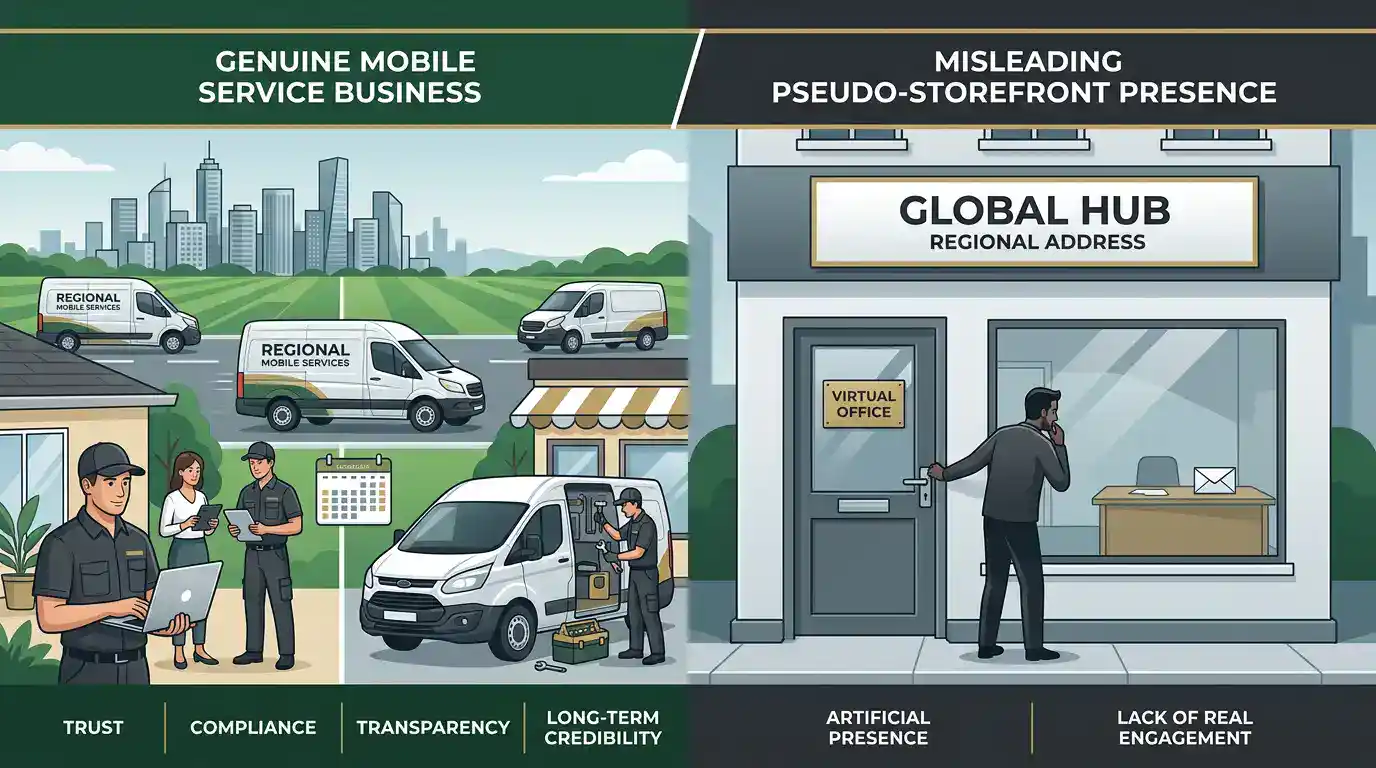
Illustration: a genuine service area business operates transparently across its region, while a misleading pseudo-storefront creates compliance risk and weaker long-term trust
The Smartest Strategy Is to Make Organic SEO and Local SEO Support Each Other
After all the distinctions made in this article, it is worth stating the practical conclusion very clearly: the best strategy is usually not to choose between organic SEO and the local pack as though they were enemies. The smarter strategy is to understand that they are different systems and then make them support one another deliberately.
A strong website helps the local side in several ways. It gives the business a believable home base, strengthens entity signals, supports service relevance, reinforces trust and provides the deeper content a serious customer often wants to see after first noticing a profile. If the Google Business Profile wins the first glance, the website often wins or loses the enquiry.
At the same time, a strong local presence can support the wider organic picture. Reviews, profile engagement, local relevance, consistent business information and visible real-world activity all help confirm that the company is genuine, active and worth trusting. They may not directly create organic authority in the same way that a strong website does, but they can support the total picture Google builds of the business.
| Website Helps the Local Side | Local Presence Helps the Website Side |
|---|---|
| Clear service pages help justify what the business actually offers. | Reviews and profile activity reinforce that the business is real and active. |
| Regional hub and spoke pages support service-area relevance beyond one suburb. | Accurate categories and profile details help corroborate service focus. |
| Technical SEO, schema and entity clarity make the business easier to interpret. | Local prominence can strengthen overall trust signals around the brand. |
| Expert posts and technical articles build authority beyond narrow money terms. | Fresh reviews and local engagement can improve conversion confidence. |
| A strong website gives serious buyers somewhere convincing to land. | A strong profile can improve first impressions before the site is visited. |
The businesses that often perform best in search are not those that obsess over one narrow metric. They are the ones that build a coherent system. Their Google Business Profile tells the same truth as the website. Their service pages support the same services listed in the profile. Their regional pages reflect the same areas they genuinely serve. Their reviews reinforce the same positioning their website claims. Their technical structure helps search engines and AI systems make sense of all of it together.
That coherence matters because modern search is no longer just a page-ranking exercise. It is also an exercise in consistency, corroboration and machine-readable understanding. If the website, the profile, the service descriptions, the entity signals and the broader content all point in the same direction, the business becomes easier for Google to trust and easier for customers to believe.
So the strongest approach is usually this: build the website as the main long-term authority asset, then use the local profile to reinforce the same story at the local level. Do not treat them as isolated tasks. Treat them as two layers of one credible business presence.
The best search strategy is not organic SEO alone or local SEO alone, but a coherent business presence in which the website and the local profile strengthen the same truth.
Conclusion: Organic SEO Builds the Deeper Asset
The central conclusion is now fairly plain. Organic SEO and the local pack are not the same system, they are not won in the same way, and they do not create the same kind of business asset. Both matter. Both can generate enquiries. Both can strengthen visibility. But they do different jobs, and one usually builds something deeper than the other.
The local pack can be extremely valuable. It can place a business in front of local searchers quickly, generate calls and clicks, and create immediate visibility for people ready to act. But it is also more constrained. It is more exposed to proximity, profile strength, review momentum, local prominence, competitor movement and changing local conditions. For service area businesses in particular, that can make it useful but uneven.
Organic SEO, by contrast, usually demands more. It asks for a stronger website, better structure, clearer entity signals, more useful content, better technical implementation, stronger internal linking and a more serious long-term approach. But that extra difficulty is precisely why it often creates the more durable asset. A strong website can rank for local service pages, regional pages, technical topics, expert questions and adjacent subjects that a local profile alone will never cover properly.
That matters even more now because search is no longer confined to blue links and map listings. AI visibility, entity understanding and machine-readable trust are increasingly part of the picture. A well-built website can influence how a business is interpreted, summarised and surfaced across several layers of search. A profile can help, but the website remains the deeper source of meaning, authority and structure.
| Core Issue | Main Conclusion |
|---|---|
| Organic SEO vs local pack | They are separate systems with different ranking drivers and different strategic value. |
| Speed of visibility | The local pack can sometimes produce faster local visibility. |
| Depth of asset built | Organic SEO usually builds the deeper, broader and more durable asset: the website itself. |
| Volatility | The local pack is often more volatile and more affected by proximity, reviews and profile conditions. |
| Authority and expertise | Organic rankings reward stronger site architecture, better content, clearer expertise and more organised authority. |
| AI visibility | Strong organic foundations increasingly help a business be understood and surfaced in AI-driven search experiences. |
For that reason, the wisest approach for most serious businesses is not to obsess over one layer of search in isolation. It is to build a coherent system in which the website, the Google Business Profile, the regional pages, the expert content, the entity signals and the reviews all reinforce the same business reality. The more consistently those elements align, the easier it becomes for Google to understand the business and the easier it becomes for customers to trust it.
If there is a hierarchy, it is this: build the website first as the long-term authority asset, then strengthen the local profile so it supports the same story. A weak website cannot be fully rescued by a good profile. A strong website, however, can support organic rankings, regional reach, entity trust and AI visibility in ways that extend well beyond the local pack.
| If You Want... | Then Your Best Long-Term Move Is... |
|---|---|
| More stable authority | Build a technically stronger, better organised website. |
| Better regional reach | Develop hub-and-spoke location pages and stronger internal linking. |
| Visibility beyond narrow money terms | Publish expert supporting content and build topic depth. |
| Stronger local conversion support | Keep the profile accurate, active and review-rich, while directing users to a convincing website. |
| A business Google can understand properly | Align the website, entity signals, service descriptions, regions served and business profile into one consistent picture. |
So the final judgement is straightforward. The local pack matters. Organic SEO matters more deeply. And the businesses that tend to do best are those that treat the website not as a brochure, but as the central authority asset from which the rest of their search visibility can grow.
The local pack can win attention, but strong organic SEO builds the deeper authority, the broader reach and the more durable business asset. The smartest businesses make both support the same truth.
External References
| Reference | Why It Matters Here |
|---|---|
| Google SEO Starter Guide | Useful grounding for crawlability, structure, content quality and the fundamentals of organic SEO. |
| Google: Helpful, Reliable, People-First Content | Supports the point that stronger organic performance is tied to useful, credible content rather than shallow page stuffing. |
| Google: Introduction to Structured Data | Relevant to schema, machine-readable meaning, entity clarity and richer understanding of pages. |
| Google: Structured Data Types Supported in Search | Useful for understanding which schema types can support richer visibility in search. |
| Google SEO Guide for Developers | Supports the technical side of the article: site quality, implementation and developer-facing SEO basics. |
| Google Business Profile: Tips to Improve Your Local Ranking | Directly relevant to the local pack discussion and the role of relevance, distance and prominence. |
| Google Business Profile: Guidelines for Representing Your Business | Important for the SAB compliance section and honest representation of premises and service areas. |
| Google Business Profile: Manage Service Areas | Useful for service-area business setup and limits of regional/local visibility. |
| Google: Structured Data Guidelines | Supports the point that schema must be accurate, consistent and policy-compliant. |
Internal Sydney Business Web Links
| Internal Reference | Why It Fits This Article |
|---|---|
| Business Website Visible to AI | Strong fit for the AI visibility and machine-readable authority parts of this article. |
| What Is Technical SEO (2025)? | Supports the technical SEO, structure, schema and site-quality sections. |
| How SEO Works | A foundational internal reference for readers wanting the broader SEO picture. |
| SEO Gains in Decibels | Useful authority-building companion piece on how SEO gains accumulate rather than appearing as magic. |
| SEO Is Not a One-Off for Maitland Businesses | Supports the long-term asset argument and the need for ongoing work rather than one-shot optimisation. |
| Rich Snippets: Critical for Business Ranking | Good supporting link for schema, search appearance and structured data relevance. |
| Business Website Not Getting Leads | Fits the conversion and visibility discussion nicely. |
| Drop in Impressions SEO | Useful for the volatility and interpretation side of search performance. |
| SEO Case Study: Google Ironwood TPU | Supports technical authority and topical breadth beyond narrow sales pages. |
| GPTBot Scanning Your Website | Relevant to AI-era crawling, machine interpretation and modern search behaviour. |
| Grok Reviews: Limitations of AI | Useful balancing piece for the AI section, especially where caution is needed. |
| Critical Website Emails Fail: An Engineered Delivery Solution | Shows technical depth and real-world engineering approach behind the business. |
| SEO Scams Australia | A useful trust-oriented supporting piece for readers comparing SEO providers. |
| Is SEO Dying? | Relevant to the wider discussion of changing search behaviour and AI overlays. |
| An SEO Discussion with ChatGPT | Useful supporting discussion piece for the AI/search crossover theme. |
| SEO: Seven Insights on Search Engine Optimisation and Online Advertising with Google | A broader strategic supporting piece for readers wanting wider search context. |
Frequently Asked Questions
What is the real difference between organic SEO and the local pack?
Organic SEO is mainly about the strength of the website itself: its content, structure, authority, internal linking, technical quality and overall usefulness. The local pack is much more influenced by local business signals such as relevance, proximity, prominence, profile strength, reviews and local engagement. Both matter, but they are not the same contest and they are not won in the same way.
Why does a number one organic ranking matter so much?
A number one organic position is a strong sign that Google sees the page as a highly relevant and authoritative answer for that query. That is different from simply appearing as a nearby local option. It suggests the website has earned trust through content, organisation, technical clarity and subject relevance rather than relying mainly on map-based visibility.
Can the local pack be more volatile than organic rankings?
Yes, often it can. Organic rankings certainly move, but local pack visibility is usually more exposed to searcher location, proximity, competitor movement, review growth, category relevance, profile completeness and other local conditions. That makes the local pack very valuable, but often less stable than a strong organic position built on a serious website.
Can AI Overviews appear before both organic results and the local pack?
Yes, and that changes the search landscape. It means a business may now be interpreted and presented through an AI layer before the user reaches either the traditional blue links or the map results. That is one reason technical structure, entity clarity and strong organic foundations matter more than they used to.
Does schema really help with organic SEO and AI visibility?
Schema is not a magic ranking button, but it does help search engines understand the meaning of pages, entities, services, organisations, authors and other relationships more clearly. On a strong website, that reduction of ambiguity can be very useful. It also fits naturally with the wider move towards machine-readable search and AI-driven interpretation.
Why is site architecture so important for organic rankings?
Because strong organic SEO is rarely built on isolated pages. Google responds better when related pages are organised logically into hubs, spokes and content silos. A broader service page can support narrower regional pages. Technical articles can support service pages. Internal links can show subject relationships clearly. All of this helps Google understand the site as a coherent body of knowledge rather than a loose pile of pages.
What is a hub-and-spoke SEO structure, and why does it matter?
A hub-and-spoke structure means you build broader central pages around important services, topics or regions, then support them with narrower spoke pages that target specific locations, subtopics or related expert questions. This helps with crawlability, semantic clarity, internal linking and topical authority. It is one of the ways a serious website becomes easier for search engines and AI systems to understand.
Why do service area businesses often need stronger organic SEO than storefront businesses?
Because service area businesses are often more constrained in the local pack. They may serve a wide region, but still be affected by proximity and local prominence in uneven ways. Without a public storefront, they often need the website to do more of the heavy lifting: regional relevance, entity clarity, trust, topic depth, proof and broader visibility across multiple areas.
Why is review velocity harder for high-ticket service businesses?
If you sell a service at several thousand dollars a project, you naturally close fewer jobs than a café, retailer or fast-turnover trade service. That means reviews do not arrive as frequently. The answer is not manipulation. It is discipline. Each completed project should have a genuine, well-timed review request built into the delivery process so that reviews continue to appear steadily rather than in long dry spells.
Can a service area business get into trouble by pretending to be a storefront?
Yes. If a business does not genuinely operate from a customer-facing premises with proper in-person service during stated hours, it should not try to present itself as a normal storefront. A misleading setup may create compliance risk with Google Business Profile rules. The honest and safer approach is to list the business as a true service area business when that is what it really is.
Can a strong Google Business Profile replace a strong website?
No. A strong profile can help with local visibility, trust and quick actions, but it cannot replace a serious website. The website is where authority is built, expertise is demonstrated, topic depth is organised, service areas are explained, internal links create structure and AI-readable signals can accumulate. The profile may win the first glance, but the website often wins or loses the enquiry.
Do people and companies need to be understood as entities now, not just pages?
Very much so. Modern search increasingly tries to understand who the business is, who is behind it, what services it offers, where it operates and how that picture is corroborated across the web. That is why named people, real credentials, coherent service descriptions, structured data and consistency between website and profile all matter more than they once did.
If a business has limited time and budget, what should it strengthen first?
In most cases, strengthen the website first if it is weak, thin or badly organised. That is usually the deeper long-term asset. Then make sure the Google Business Profile supports the same story with accurate categories, service areas, reviews, photos and profile completeness. A weak website cannot usually be rescued fully by a good profile, but a strong website can support many forms of search visibility over time.
What is the smartest overall strategy for a serious business?
Build the website as the main authority asset, then make the local profile reinforce the same truth. The strongest businesses tend to have coherent service pages, regional hub-and-spoke structures, technical depth, clear entity signals, genuine reviews, accurate local representation and a profile that aligns with the website rather than contradicting it. That coherence is often what makes the whole system stronger.
CONTACT SYDNEY BUSINESS WEB NOW!