

Why Your Business Website Not Getting Leads Is a Matter of Expectations (and Other Misunderstandings)
It is a most incontestable truth that when a business website is not getting leads, the blame is immediately distributed with great enthusiasm and very little accuracy.
Business website not getting leads is the complaint; the rest is usually theatre.
Google is accused. The market is indicted. The economy is summoned as a character witness. Occasionally, a nephew with a laptop is consulted.
Rarely is the website itself invited to the examination.
This is unfortunate, because the website is often the principal offender. Not through malice, but through a most lamentable misunderstanding of its own occupation.
Many websites labour under the impression that their purpose is to informationalise the visitor into spontaneous admiration. They describe, elucidate, elaborate, and occasionally congratulate themselves — all while assuming that enquiries will emerge naturally, like flowers after rain.
This is a most luxuriant fantasy.
A website is not employed to be agreeable. It is not retained for its politeness. It is certainly not paid to wait patiently and hope for the best. It is engaged for results — a concept which, while unfashionable, remains stubbornly relevant.
When a site performs none of these duties and yet continues to occupy its position without consequence, the silence that follows should not be regarded as mysterious. It is simply the sound of expectations being mislaid.
“A website that explains everything and achieves nothing has mastered communication, but forgotten employment.” — Keith Rowley
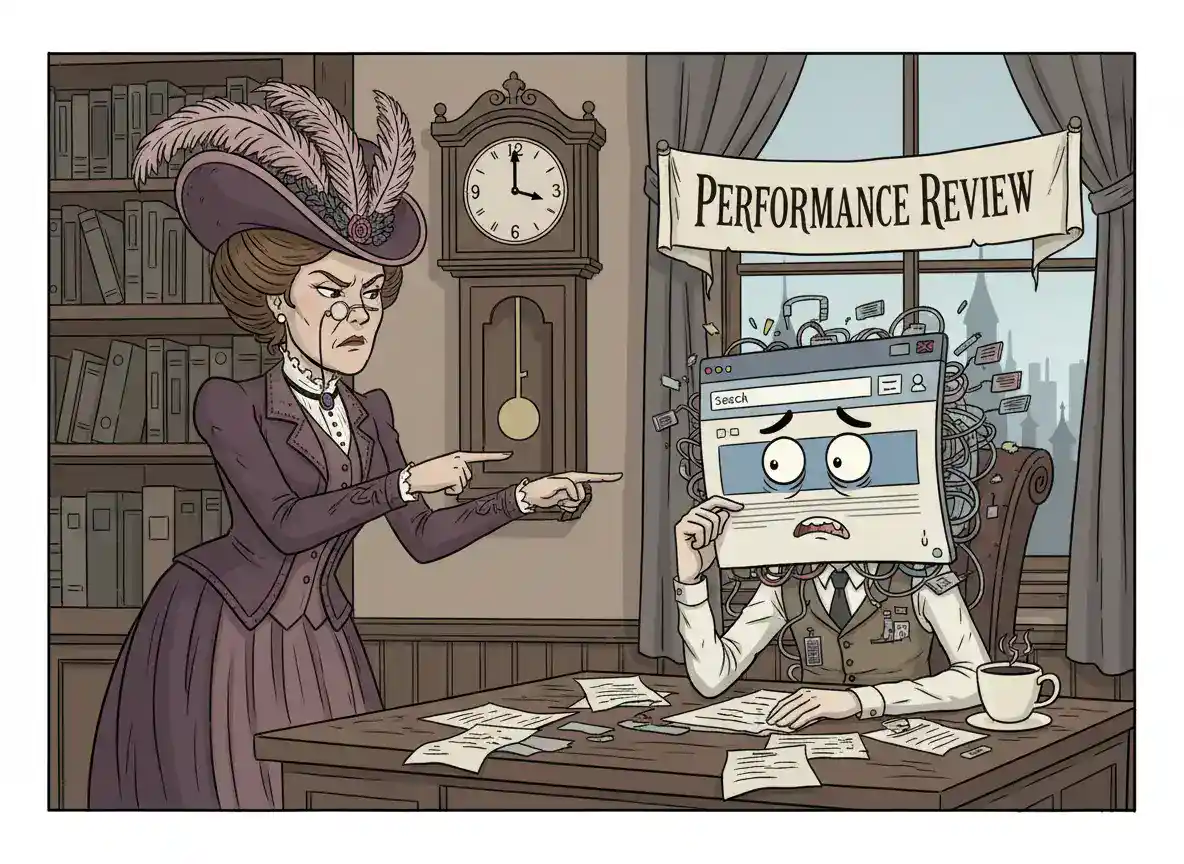
The Staff Member Test (A Most Instructive Comparison)
Permit me, for a moment, a comparison of the most illuminating simplicity.
If your website were a member of staff, how long would it last?
Imagine an employee who arrives each morning, straightens their desk, and announces — with considerable confidence — that anyone requiring assistance is perfectly free to approach them at their leisure.
They do not initiate conversation. They do not ask questions. They do not guide customers. They do not suggest next steps. They merely exist, attractively, and wait.
This employee would not be described as unlucky. They would be described as surplus.
Yet this is precisely how many business websites behave. They sit prominently, consume resources, and regard all outcomes as the responsibility of the visitor. If an enquiry occurs, it is treated as a pleasant surprise. If none occurs, the explanation is said to be external, seasonal, or philosophical.
A functioning website, like a competent employee, understands its duties. It engages. It clarifies. It reassures. It advances the conversation. Above all, it recognises that being present is not the same as being useful.
When these responsibilities are neglected, the result is not mystery. It is underperformance.
“A website that waits to be approached has mistaken employment for decoration.” — Keith Rowley
Traffic vs Conversion: A Distinction Too Frequently Ignored
At this juncture, it is necessary to pause for a moment of corrective clarification.
When a business website not getting leads is discussed, two entirely different ailments are often bundled together under one most convenient complaint. This is a diagnostic error of the first order.
The first problem is traffic. If nobody arrives, nobody enquires. This is not mysterious, nor is it cruel. A website cannot converse with an empty room.
In the early stages, visitors are usually conveyed by advertising, referrals, Google Business Profile clicks, email signatures, social posts, or the ancient and still-effective method known as “someone mentioned your name”. Search engine optimisation, meanwhile, proceeds at its own unhurried and faintly aloof pace.
This arrangement is perfectly normal.
The second problem, however, is conversion — and it is here that expectations most often meet their demise.
Conversion concerns what happens after someone arrives. Are they guided? Are they reassured? Are they assisted toward a sensible next step? Or are they presented with a tasteful wall of information and left to form their own conclusions, like a guest abandoned in the hallway?
Confusing traffic problems with conversion problems leads to heroic but futile efforts. More advertising is purchased. More visitors arrive. And then, having been offered no direction whatsoever, they depart.
The website, meanwhile, remains blameless in its own estimation.
“Sending more visitors to a site that cannot guide them is not marketing; it is repetition.” — Keith Rowley
The Moment the Website Must Do Something
At some point, explanation must cease.
There arrives in every sensible transaction a moment of unavoidable decisiveness — the very pineapple of sales achievement, if you will — where one party must advance matters beyond polite observation.
A business website not getting leads frequently behaves as though this moment were indelicate, premature, or in some way morally questionable. Asking for an enquiry is treated as forward. Suggesting a next step is regarded as vulgar.
So the website continues to explain. It reassures. It contextualises. It adds further paragraphs for clarification, illumination, and general ornamental confidence — all in the hope that action will occur spontaneously, like an unsolicited compliment.
This is not refinement. It is administrative cowardice.
People do not enquire because they are impressed. They enquire because the next step is made obvious, reasonable, and timely. Someone — or something — must say, with appropriate confidence and minimal apology: “Shall we proceed?”
A website that never reaches this moment has not failed creatively, strategically, or even technologically. It has failed procedurally.
“The failure to ask for action is not subtlety; it is the mismanagement of opportunity.” — Keith Rowley
What To Fix First (A Practical Checklist, Mercifully)
When a business website not getting leads becomes the standing complaint, the temptation is to look for clever solutions. Resist it. The causes are usually plain, observable, and fixable.
This checklist covers the fundamentals I review first whenever a business website not getting leads is brought to my attention.
1) Confirm what kind of problem you actually have
A business website not getting leads can be suffering from a traffic problem, a conversion problem, or both.
- Traffic: Are people visiting at all? (Search Console, Analytics, GBP clicks, ads.)
- Conversion: Are visitors taking a next step once they arrive?
- Rule: If traffic is near zero, fix distribution. If traffic exists but enquiries don’t, fix the site.
2) Make it obvious what you do — immediately
One of the most common reasons a business website not getting leads fails is simple confusion.
- State who you help, what you do, and where you operate in plain language.
- Remove slogans that say nothing.
- Put clarity above the fold.
3) Give the visitor one clear next step
If a business website not getting leads offers no obvious action, visitors will invent one — usually leaving.
- Choose one primary action per page.
- Repeat it calmly and consistently.
- Use direct language: “Get a Quote”, “Book a Call”, “Request a Callback”.
4) Reduce friction, especially on mobile
Many cases of a business website not getting leads can be traced to unnecessary friction.
- Check mobile speed.
- Shorten forms.
- Make phone and email tap-ready.
5) Replace adjectives with evidence
A business website not getting leads often relies on claims instead of proof.
- Add real testimonials with context.
- Show work, case studies, FAQs, screenshots.
- Make business details obvious and verifiable.
6) Remove brochure behaviour
When a business website not getting leads behaves like a brochure, action disappears.
- Cut long self-descriptions.
- Move secondary content down.
- Structure pages for scanning.
7) Build a simple lead path
A functioning website follows a path. A business website not getting leads usually does not.
- Problem → Solution → Proof → Action.
- If the homepage skips this, enquiries usually follow suit.
8) Confirm someone actually responds
It is astonishing how often a business website not getting leads is simply not being answered.
- Test forms.
- Test phone numbers.
- Add a basic confirmation reply.
9) Only then increase traffic
If a business website not getting leads converts poorly, more traffic will only produce more disappointment.
- Fix conversion first.
- Then scale traffic with SEO, GBP, or ads.
“When a business website not getting leads is fixed, it is rarely by cleverness — it is fixed by doing the obvious things properly.” — Keith Rowley
FAQ: Business Website Not Getting Leads
Useful internal links (more SBW reading)
Handy next steps on WooCommerce performance, bot mitigation, and real-world conversion work.
Useful external links (contemporary + authoritative)
The links below aren’t “thought leadership” or trend pieces. They’re practical references I actually use when diagnosing performance, visibility, and conversion issues on real eCommerce sites.
CONTACT SYDNEY BUSINESS WEB NOW!
get started online NOW with your ONLINE BUSINESS ENGINEERING