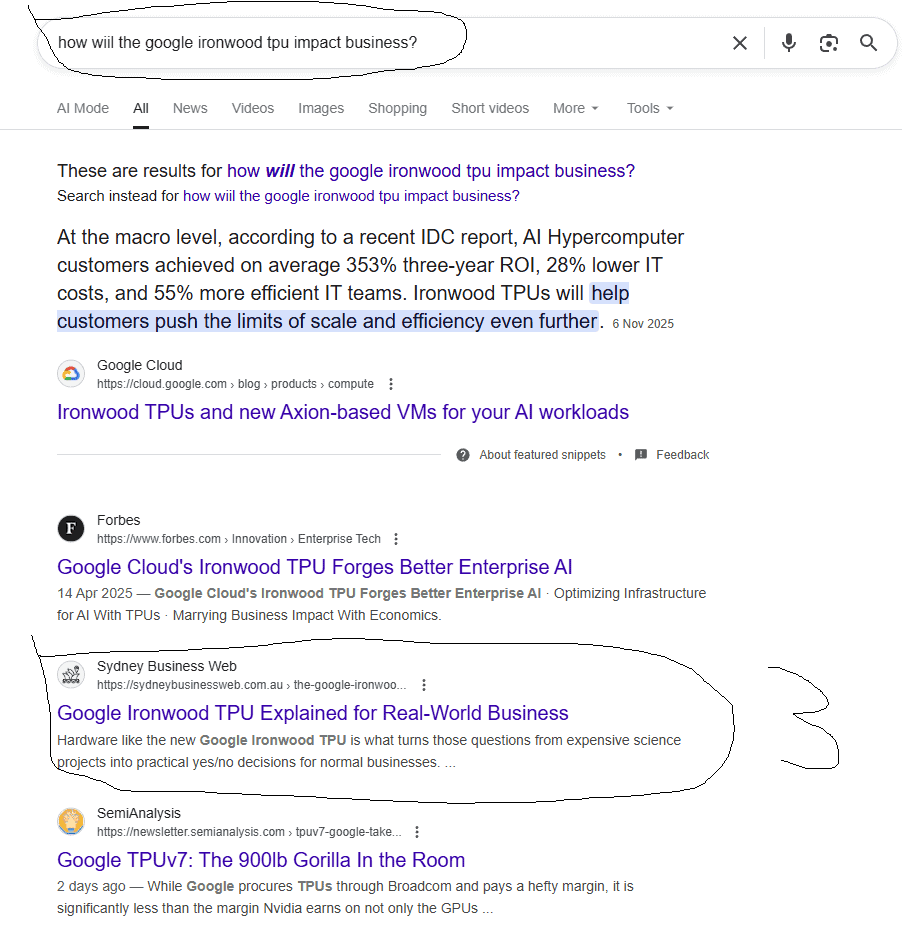
Goole Serch Results showing Sydney Business Web post at posiiton 3
SEO Case Study: From Fresh Blog Post to Page-One Ranking in 48 Hours
Every website owner hears stories about overnight SEO success, but very few get to see the numbers on their own screen. This SEO case study walks through how a single long-form article on the new Google Ironwood TPU went from “publish” to a top-of-page-one Google ranking in around 48 hours – outranking major tech sites – for a business like yours.
At Sydney Business Web, we work as a website designer Thornton, Maitland, Newcastle and across Australia, so this isn’t a theory piece. It’s a practical SEO case study based on a real result for our own site. The article in question is Google Ironwood TPU Explained for Real-World Business , a 5,700-word deep dive written for normal business owners, not chip designers.
Within two to three days of publishing, anonymous searches from a Sydney VPN showed that article sitting just below Google Cloud’s own blog and above international publishers like Forbes and CNBC for queries such as “how will the Google Ironwood TPU impact business?”. For a brand-new topic with almost no search history, that’s a powerful demonstration of what focused content and solid technical SEO can do.
In this SEO case study, we’re going to break down the process we used step by step – from choosing the topic and building a long, helpful article, to adding structured FAQ schema and tying everything back to our core positioning as a website designer Thornton, Maitland, Newcastle. If you run a small business website and want Google to treat your site as a genuine authority in your niche, this is exactly the kind of approach that works.
Before we dive into the details, here’s what this case study will cover:
- Why we chose the Google Ironwood TPU as the centrepiece for this SEO case study
- How long-form content and FAQ schema helped Google understand the page quickly
- Where locality and business intent (“small business websites in Australia”) fit into the strategy
- What this means for service businesses in Thornton, Maitland and Newcastle that rely on organic search
The goal of this SEO case study is simple: to show you, with real data and a real example, that a well-planned article and a clear SEO process can move the needle fast – even in 2025 – when most people think SEO is “too slow” to bother with.
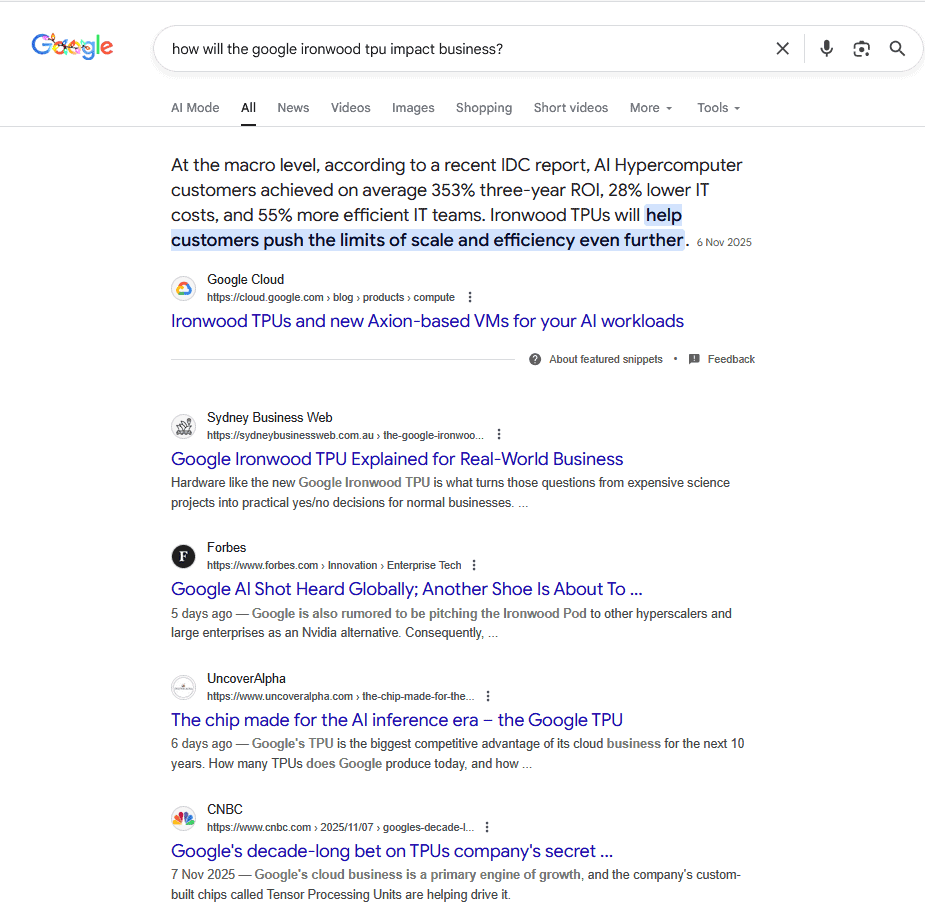
SYDNEY BUSINESS WEB POST at Position 2 on Google for the query shown
Why This Topic Worked So Well for an SEO Case Study
The first question any sensible business owner asks is: why on earth write about the Google Ironwood TPU at all? For this SEO case study, the choice was deliberate. We wanted a topic that was:
- Brand new – so we weren’t fighting years of entrenched competition
- Important – something Google clearly cares about and will promote heavily
- Business-focused – not just technical noise for engineers
The Google Ironwood TPU article was written specifically to answer one core question: “How will this new Google hardware actually affect real-world businesses and their websites?” That angle matters. We weren’t trying to outrank chip analysts on transistor counts; we were speaking directly to owners of small and medium businesses who need plain-English answers.
From an SEO point of view, that gave us a strong position: a fresh topic plus a clear business intent. Google is actively looking for high-quality content that helps normal people understand advanced technology. By framing the piece as a practical guide for business owners – and reinforcing that this was written by a website designer Thornton, Maitland, Newcastle with real-world experience – we lined it up perfectly for those “how will this affect my business?” searches.
That combination – a genuinely useful, detailed article and a clear audience – is at the heart of this SEO case study. Instead of chasing vague keywords like “AI” or “SEO tips”, we focused on one specific emerging topic and answered it thoroughly for a specific market: Australian businesses that rely on their websites to bring in leads and sales.
In the next part of this SEO case study, we’ll look at how we structured the article itself: the 5,700-word main body, the hidden FAQ schema, and the internal linking that helped Google understand, index and trust the page fast.
How We Structured This SEO Case Study for Fast Results
Good rankings don’t happen because of magic plugins. In this SEO case study, the real engine under the bonnet was how we structured the content itself. The Google Ironwood TPU article was built very deliberately to give Google every possible signal that it was a complete, authoritative answer to the business questions people would ask.
First, we went long – about 5,700 words – but not for the sake of it. The article is broken into clear, scannable sections that follow a simple logic:
- Explain in plain English what the Google Ironwood TPU actually is
- Show how it fits into Google’s wider AI and data centre strategy
- Translate that into practical business impact for websites and marketing
- Spell out what it means for small business owners in Australia right now
That’s important in an SEO case study because Google isn’t just counting words – it’s checking whether a page covers the likely intent behind a search. By organising the article around the real questions business owners ask, we made it easy for Google to recognise that this page is a strong match for anything like “how will the Google Ironwood TPU impact business?” or “what does Ironwood mean for my website?”.
Behind the scenes, we then added a set of hidden FAQ-style answers in structured data. Those FAQs mirrored the main content but in short, direct question–and–answer form: how Ironwood affects hosting, what it might do to ad platforms, what it means for costs, and how it ties into everyday websites. In other words, this SEO case study page doesn’t just talk about Ironwood once; it quietly answers 20+ related questions in a way Google can read quickly.
We also made sure the article sat naturally inside the rest of the site. Internal links from our main service pages and related blogs tell Google that Sydney Business Web is not just writing about hardware for fun – we are an experienced website designer Thornton, Maitland, Newcastle using this knowledge to serve real clients. That blend of topical depth and local business relevance is a key reason this SEO case study produced such quick, strong results.
In the next part of this SEO case study, we’ll look at how the FAQ schema, internal linking and local signals combined to move the article into the top positions within just a couple of days.
FAQ Schema, Local Signals and Why Google Trusted the Page So Quickly
So how did this SEO case study page go from “just published” to the top of page one in such a short time? A big part of the answer lies in two things that most small business sites either ignore or underuse: FAQ schema and clear local signals.
Behind the visible content of the Google Ironwood TPU article we added a block of FAQ-style structured data. Each question and answer is tightly focused on what business owners might actually type into Google:
- How will the Google Ironwood TPU impact small business websites?
- Does Ironwood change the way I should think about hosting and performance?
- What does Ironwood mean for AI tools my business already uses?
- How does this affect businesses in Australia in practical terms?
In this SEO case study, those FAQs are doing two jobs at once. For readers, they reflect and support the main article. For Google, they act like a structured index, telling the search engine “this page answers all of these questions clearly and directly”. That makes it far easier for Google to test the page high up in the results for related queries and see how users respond.
On top of that, we made sure the article carries subtle but consistent local signals. We reference our role as a website designer Thornton, Maitland, Newcastle, and tie the discussion back to Australian businesses rather than speaking in vague global generalities. That tells Google this isn’t just another generic tech piece – it’s guidance grounded in the reality of local small business websites.
When anonymous searches from a Sydney VPN started showing the Ironwood article at or near the top of the results, this SEO case study had its proof. Google had recognised the page as:
- Highly relevant to “Ironwood + business impact” style queries
- Authoritative enough to sit beside or above major international publishers
- Locally useful for people searching from Australia, especially New South Wales
In the next part of this SEO case study, we’ll step away from the technical details and talk about what this actually means for small business owners in Thornton, Maitland and Newcastle – and how you can apply the same process to your own website.
What This SEO Case Study Means for Small Business Owners
It’s easy to look at an SEO case study like this and think, “That’s nice, but my business is different.” In reality, what happened with our Google Ironwood TPU article is exactly the sort of result small business owners in Thornton, Maitland and Newcastle can benefit from – just with topics that fit your world.
The core lesson from this SEO case study is simple: you don’t need fifty shallow blog posts; you need a few carefully planned, targeted pieces that:
- Answer real questions your best customers are already asking
- Go deep enough that Google can clearly see you as an authority
- Use FAQ schema and internal links so search engines understand the page fast
- Connect that expertise back to your local area and services
That’s exactly how we work at Sydney Business Web. As a website designer Thornton, Maitland, Newcastle, we build or rebuild sites so they have a solid technical base, then layer on content and schema like you’ve seen in this SEO case study. The goal is not just “more traffic”, but more of the right people finding you when they’re ready to talk, book or buy.
If a single, well-structured article about a new Google technology can move into the top positions in under three days, imagine what a series of focused, well-written pieces could do for your own niche – whether you’re a local service business, a specialist trade, or a professional practice. That’s the real takeaway from this SEO case study: with the right strategy, even a smaller local business can compete head-on with much larger players.
In the final part of this SEO case study, we’ll outline a simple, repeatable process you can follow – or ask us to handle – to give your own website the best chance of similar results.
A Second SEO Case Study: Trademark Hijack Article That Keeps Ranking
The Ironwood example shows how fast a well-built page can move. But a good SEO case study also needs to prove staying power. For that, we can look at another article on our site: Trademark Scam Australia: How They Hijack Your Business Name .
This piece was written months ago, yet anonymous searches such as “business name hijacked for trademark” still show it sitting right at the top of the organic results, directly under Google’s AI overview box. In other words, even as Google experiments with AI summaries, it continues to trust this Sydney Business Web article as a primary authority on the topic.
Just like the Ironwood TPU article, this SEO case study page follows the same pattern:
- It answers a very specific, painful question in plain English
- It goes into enough depth to be genuinely useful for business owners
- It uses clear headings, structure and schema so Google can parse it easily
- It ties the advice back to real Australian businesses, not generic theory
For a small, locally focused company like ours – a website designer Thornton, Maitland, Newcastle – this second SEO case study shows that the approach is repeatable. When you combine a focused topic, detailed but readable content, and solid on-page SEO, Google is willing to reward that page not just in the first week, but month after month.
Taken together, the Ironwood TPU article and the trademark hijack guide form a powerful double example: one SEO case study for rapid results on a brand-new topic, and another for long-term stability on an ongoing problem businesses face. In the next section, we’ll turn these lessons into a simple process you can apply to your own website.
How to Apply This SEO Case Study Approach to Your Own Website
By now, this SEO case study has shown two live examples: the new Google Ironwood TPU article that climbed quickly, and the older trademark hijack guide that keeps its rankings over time. So how do you turn this into a practical plan for your own business website?
Here’s the simple, repeatable process we use at Sydney Business Web as a website designer Thornton, Maitland, Newcastle:
- Pick one real problem or question. Start with something your best customers are already worried about: scams, new regulations, new technology, or confusing industry changes. That problem becomes the focus of your next SEO case study article.
- Write the “definitive” answer in plain English. Aim for depth, not fluff. Break the article into clear sections, use headings, and explain what it means for normal people – not just insiders.
- Add FAQ schema that mirrors the article. Turn the key points into short, direct questions and answers in FAQ structured data, just as we did for the Ironwood TPU SEO case study. This helps Google understand the page quickly and match it to more searches.
- Connect it to your services and location. Make sure the article makes sense coming from your business: reference your role, your local area, and the kinds of clients you help. That’s how a specialist website designer Thornton, Maitland, Newcastle turns expertise into local visibility.
- Support it with internal links and time. Link to the article from your key service pages and related blogs. Then give it a little room to work – Google needs data from real visitors before it locks in rankings.
Follow this process a handful of times and you don’t just have “blog posts” – you have a library of SEO case study pages that demonstrate expertise, attract the right visitors, and keep working month after month.
If you’d like help planning or building this kind of content for your own business, we do exactly that every day as a specialist website designer Thornton, Maitland, Newcastle. Get in touch and we can map out a simple SEO content plan based on the same approach that powers both the Ironwood TPU article and the trademark hijack guide.
Before This SEO Case Study Will Work: A Quick Website Health Checklist
There’s one important caveat to this SEO case study approach: even the best article in the world will struggle if the website underneath it is slow, broken or untrusted. For Google to take your content seriously, the site itself has to meet some basic standards. Here’s a simple checklist for business owners to review before expecting Ironwood-style results.
- Speed & performance
- Your pages load quickly on mobile and desktop (aim for under 3 seconds).
- Images are compressed and not enormous “straight from the camera”.
- Caching is set up properly so returning visitors see fast pages.
- Technical basics
- Your site uses HTTPS with a valid SSL certificate.
- No obvious “mixed content”, PHP warnings or broken layout issues.
- Core pages return a clean 200 status – not 404s or endless redirects.
- Mobile friendliness
- The site is responsive and easy to read on a phone.
- Buttons and menus are large enough to tap without zooming.
- Google compliance & trust
- No obvious spammy tactics (keyword stuffing, hidden text, doorway pages).
- Clear contact details, ABN and real business information.
- Privacy policy and basic legal pages are present and accessible.
- Content & structure
- Each page has a unique title, meta description and clear main heading.
- Your main services and locations are easy to find from the home page.
- Internal links connect related pages, not just “orphaned” blog posts.
- Local & off-site signals
- Your Google Business Profile is set up correctly and active.
- Name, address and phone number are consistent across key directories.
- You’re slowly building genuine reviews and a few good-quality links.
If most of these boxes are ticked, an article built like the Ironwood TPU SEO case study has a real chance to perform well. If not, the first step is fixing the foundations – which is exactly the kind of work we do every day as a website designer Thornton, Maitland, Newcastle. Only then can your great content get the visibility it deserves.
Ready to Build Your Own SEO Case Study?
This SEO case study isn’t theory – it’s exactly how we run our own website at Sydney Business Web and how we help clients in the Hunter and beyond. When your site is technically sound, trusted by Google, and backed by focused content like the Ironwood TPU article and our trademark hijack guide, SEO stops being mysterious and starts becoming predictable.
If you’d like to map out a similar content strategy for your own business – or you’re not sure whether your current website is strong enough to support it – get in touch with Sydney Business Web. As a specialist website designer Thornton, Maitland, Newcastle, we can review your site, fix the foundations, and help you create the kind of deep, useful articles that Google actually wants to rank.
FAQ (SEO Case Study – Thornton)
Internal references (more SBW reading)
If you want to follow the exact method used in this SEO case study (topic selection, long-form depth, technical trust signals, schema, and internal linking), these SBW posts/pages are the most relevant next steps:
External references (official docs + genuinely useful reading)
These are the best “authority anchors” for Ironwood and for the schema/technical SEO principles referenced in this case study.
CONTACT SYDNEY BUSINESS WEB NOW!
get started online NOW with your ONLINE BUSINESS ENGINEERING