Antigravity web design
Antigravity Web Design: The Death of Digital Drudgery
Every decade or so, a technology arrives that doesn’t just update the toolkit—it completely rewires the industry. Google Antigravity is that lightning strike.
Most modern web agencies are run by "pretty picture sellers." They build fragile, bloated sites that look shiny on top but run like molasses underneath. I don't operate that way. My background is rooted in high-stakes systems: military hardware, marine radio networks, engineering arrays, and robust business systems.
To an engineer, a website isn't a digital art project. It’s an active structural machine. It has data load paths, security weak points, strict tolerances, and hard performance limits. That is why Antigravity changes everything.
This isn't generic AI spitting out lazy, copy-paste layouts. That isn't innovation; it’s just a faster way to build a digital mess. The real breakthrough is agentic execution.
Antigravity acts as an elite technical co-pilot. For developers who actually understand the mechanics of the web—Linux VPS architecture, Cloudflare R2 bucket asset routing, WooCommerce database hierarchies, and manual JSON-LD schema injection—this tool shifts the entire landscape. It completely eliminates the exhausting, mind-numbing grunt work of web development.
I don’t tolerate drudgery, and neither should you. Hours spent manually scrubbing messy client spreadsheets, formatting thousands of media filenames, and hand-coding repetitive schema templates don't add creative value. Value comes from engineering judgment, flawless architecture, rigorous diagnostic testing, and knowing exactly how to command Google's search visibility.
To a sailor, a new horizon is a promise of open water ahead. To a paratrooper standing at the open door of an aircraft, it’s the exact moment preparation turns into raw velocity. That is what advanced AI means for serious web deployment.
It’s not a shortcut for amateurs. It’s a massive competitive leap forward for veterans who have already done the hard yards.
"Antigravity will never make a weak agency strong. But it makes a technically disciplined developer faster, sharper, and extremely difficult to compete against."
What Is Google Antigravity? (Hint: It’s Not a Chatbot)
"Agentic development" sounds like just another piece of passing Silicon Valley jargon. But the reality behind it is simple: instead of begging an AI tool for a lazy snippet of code, you hand a defined, complex task to an autonomous agent and let it plan, execute, test, and report back while you do something else.
Google Antigravity is a standalone desktop command center where specialized agents operate simultaneously across your editor, terminal, and browser surfaces. This matters immensely because serious web engineering doesn’t happen in a tidy, theoretical text box. Code must be written, executed locally, inspected via live server terminals, and violently tested in a browser before it can ever be trusted on a production Linux VPS.
For professional web deployment, this completely flips the leverage model.
Instead of losing days to the dull, repetitive friction of a major build, Antigravity functions as a parallel crew. It runs automated page-structure audits, reviews deep code diffs, batch-prepares pristine schema trees, profiles ecommerce checkout paths, and manages complex data sanitization entirely in the background.
But let's be entirely clear about the word "assist."
Antigravity is not a magic escape hatch for the incompetent. It will not rescue a weak developer, nor will it magically transform vague client ideas into an authoritative, secure business asset. It is a velocity multiplier reserved strictly for engineers who already possess a flawless understanding of what they are building.
In the hands of an expert who understands the raw mechanics of WordPress hooks, WooCommerce databases, Cloudflare R2 routing, and technical SEO, Antigravity becomes a lethal competitive edge. In the hands of an amateur, it simply manufactures catastrophic mistakes at a much faster rate.
"Antigravity is never the engineer. It is the high-velocity power tool locked in the master craftsman’s hand."
A Mandatory Warning: Keep the Robot Out of Your Machine Room
Before anyone gets blinded by the shiny promise of automated speed, let’s issue a hard, non-negotiable boundary: Never, under any circumstances, turn an AI agent loose on a live production server. Doing so without ironclad constraints is digital roulette.
Google Antigravity is a powerhouse precisely because it commands your local editor, system terminal, and browser engine simultaneously. That is exactly why it demands absolute professional respect. A system with the autonomy to execute terminal lines, alter codebases, and manipulate files can save you a month of manual labor—or it can vaporize a client's multi-million dollar business asset in three seconds if given reckless access.
Google didn't build their permission architecture for decoration. Antigravity is wrapped in strict, project-level security boundaries, explicit token limits, sandboxed allowlists, and mandatory terminal-command approval checks. These guardrails exist because agentic AI executes real actions in real-world environments.
The amateur workflow is pointing an AI agent at a live corporate website and saying, "Fix this bug." That isn't development; it's a suicide mission.
True engineering is disciplined, controlled, and intentionally boring. The bulletproof protocol is simple: Keep it local. You isolate the codebase on a local staging environment, back it up to high heaven, enforce restricted permissions, and maintain absolute human oversight. Let the agent analyze, script, propose, and run automated QA behind the safety glass. Never give an autonomous script unmonitored execution authority over a live, money-making system.
This baseline rule becomes a matter of survival when managing a production Linux VPS running heavy WordPress and WooCommerce arrays. A single unvetted, reckless terminal command can break database tables, corrupt PHP hooks, drop image paths, leak API credentials, halt client orders, ruin search visibility, or take an enterprise asset completely offline.
My operations rule is absolute: AI is an unparalleled force multiplier for architecture, data formatting, template building, and QA testing. But deployment to the production server belongs strictly to the human director.
That isn't a fear of technology. It’s an unyielding respect for systems engineering.
"An automated agent should be treated like a brilliant apprentice wielding an industrial plasma cutter: exceptionally fast, highly effective, and never left unsupervised in the server room."
The Real Impact: Typing Is No Longer the Bottleneck
The true disruption of Google Antigravity isn’t that it can spit out lines of code. Basic AI autocomplete has been doing that for years. The seismic shift here is the evolution from single-task prompts into a fully orchestrated, agentic workflow.
Traditional web development is a slow, sequential crawl: you inspect a bug, open a file, write the fix, manually refresh the browser, check the error logs, document the patch, and move to the next ticket. Antigravity obliterates this sequence. It introduces a parallel matrix where multiple specialized sub-agents execute, test, and audit different layers of the infrastructure simultaneously under your direct command.
For high-performance web deployment, this changes everything.
An enterprise-grade business asset is never just a visual design file. It is a complex, multi-tiered engine running WordPress core mechanics, WooCommerce database arrays, server-level caching, Cloudflare network rules, external R2 object buckets, strict schema trees, and bulletproof transactional email pathways.
The vast majority of the labor required to build and secure that engine isn’t intellectually demanding—it’s just mercilessly time-consuming. Scrubbing massive ecommerce inventories, mapping relational product data, batch-compressing video assets, validating structured data, and testing multi-step conversion forms will devour weeks of manual clicking.
Antigravity’s true power is that it completely strips the friction out of that technical drudgery.
This doesn't make a skilled systems engineer obsolete; it makes them indispensable. The machine still requires a director who knows exactly what instructions to issue. It requires an expert eye to audit the results and judge whether the code is fast, secure, search-optimized, compliant, and commercially lethal.
"Antigravity permanently shifts the development bottleneck. Production speed is no longer dictated by how fast the engineer can type. It is driven entirely by how deeply the engineer can think, strategize, test, and judge."
This technology is about to rip open a massive chasm between serious technical professionals and low-grade agencies.
If an agency’s primary skill is merely arranging attractive design blocks on a screen, they are in a difficult position. AI has already made surface-level decoration cheap, generic, and automated. Anyone can generate a pretty layout or paste generic copy now.
But the real battleground of web development isn't making a page look acceptable on a desktop. The real battleground is engineering the invisible system underneath.
Does the architecture hold up under massive traffic spikes? Does WooCommerce process thousands of skus cleanly? Is the custom schema flawlessly mapped for search engines? Are the media assets radically optimized before they hit the cloud? Are server security permissions tightly locked down? Are the forms airtight and the server redirects immaculate?
This is where Antigravity becomes fatal to weak agencies and an absolute weapon for strong ones. It won't hand an amateur the technical judgment they lack, but it grants a veteran developer an unbeatable speed advantage.
"AI will continue to make digital decoration a cheap commodity. It will make elite systems engineering infinitely more valuable."
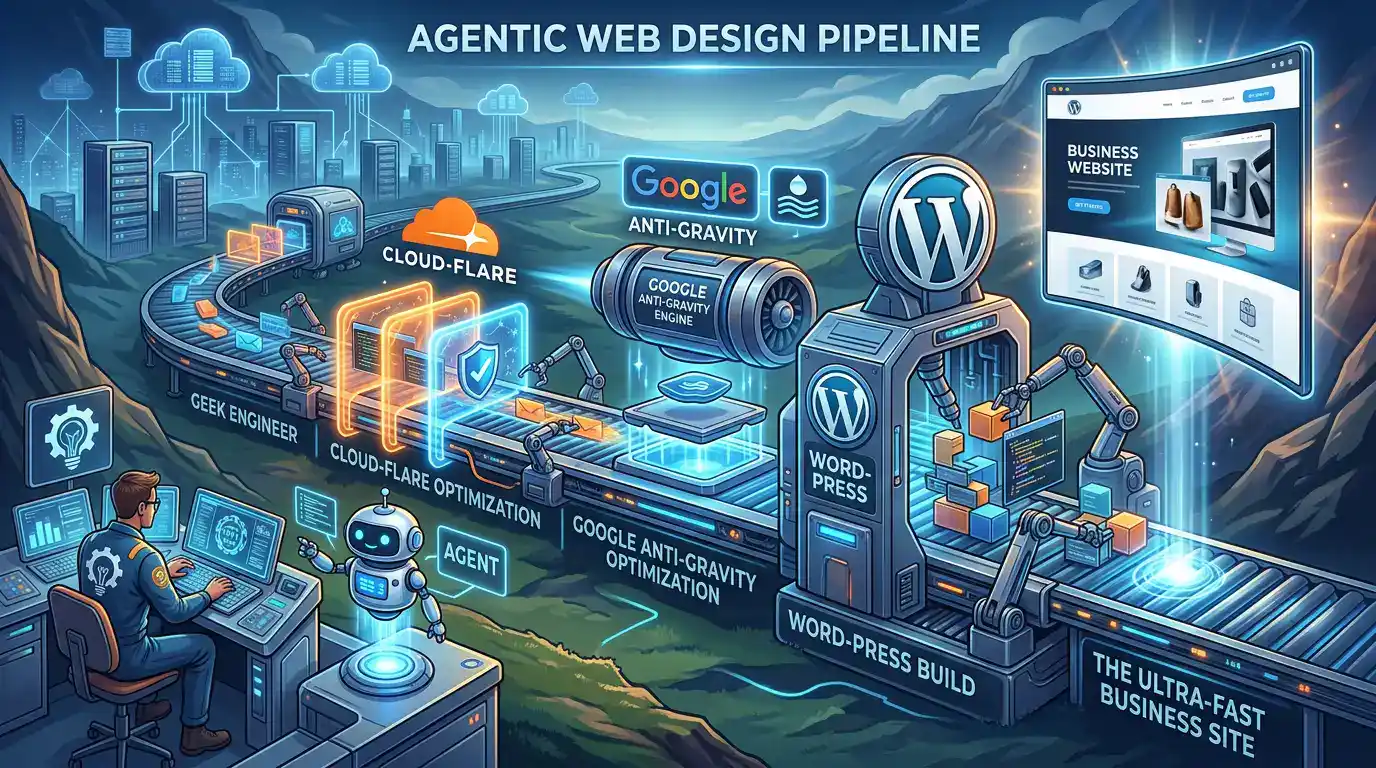
For Sydney Business Web, this is the ultimate competitive horizon. The goal isn't to change our proven, high-performance stack—it’s to supercharge it. We deploy WordPress and WooCommerce for robust commercial utility, Cloudflare R2 for blazing-fast decoupled media asset delivery, HandBrake and ShortPixel for strict image/video optimization, and dedicated, hyper-secure Linux VPS environments for pure hosting performance. We then unleash autonomous local AI agents to handle the tedious technical execution that slows traditional developers to a crawl.
When used properly, Antigravity acts as the ultimate digital right hand: not the brain, not the conscience, and certainly not the architect—but a highly disciplined, lightning-fast execution engine trapped inside an expert’s operating system.
The Developer Must Stay in Command: The Commander-in-Chief Rule
The single greatest point of failure for agencies adopting Google Antigravity will be treating it as an autonomous, independent genius rather than a strictly managed asset. They will let the machine make decisions. I will not.
An automated agent does not possess commercial instinct. It does not understand local market nuances, client vulnerabilities, or the risk profile of a live business listing. The systems engineer must always set the architecture. The engineer dictates the stack, establishes what is permitted, defines what is forbidden, enforces relentless human review, and blocks the machine from ever touching a production asset without direct, manual authorization.
"The commercial objective is never to let the AI take over the ship. The objective is to give an already elite captain more hands on deck, more eyes on the radar, and unstoppable forward velocity."
Google Guardrails: Eradicating Low-Grade AI Sludge
There is a critical search-quality reason this disciplined framework is non-negotiable: it must align perfectly with Google’s published search expectations for helpful, original, people-first content. Anything less actively endangers a website's visibility.
Unchecked AI can pump out mountainous heaps of generic text, chaotic code, and bloated structures in seconds. But without rigorous engineering oversight, thorough diagnostic testing, and real-world human expertise, that output is utterly worthless. Mass-produced, lazy AI content is not a business strategy—it is digital pollution that search engines are actively hunting down and penalizing.
For Sydney Business Web, the purpose of deploying advanced AI is never to flood the internet with hollow words, but rather to accelerate cold, hard technical execution. We use it to build deep, flawless schema trees, engineer cleaner page execution paths, streamline complex ecommerce checkouts, generate precise technical documentation, and enforce aggressive speed testing.
"AI must be weaponized to systematically eliminate development friction and waste—never to manufacture more of it."
Where This Becomes Practical: Weaponizing the Stack
The true genius of this platform isn’t found in high-level theory. It shows up in the absolute trenches of development—annihilating the tedious, non-creative friction that traditionally drags projects out for months.
When deployed across core web architectures, the practical leverage is immense:
- For Advanced Ecommerce: Instead of spending weeks manually scrubbing chaotic client inventory spreadsheets, the agents ingest raw data, resolve relational database fields, clean category hierarchies, flag formatting errors, and export pristine, import-ready WooCommerce datasets in minutes.
- For Complex Legacy Migrations: Instead of copy-pasting a 67-page corporate footprint item by item, local agents crawl the old architecture, extract raw text, isolate structural assets, map out permanent redirects, and assemble a clean WordPress framework behind the scenes.
- For Deep Search Visibility: The agent acts as a technical SEO analyst—batch-drafting flawless custom JSON-LD schema strings, plotting internal linking matrixes, structuring clean FAQ page frameworks, and running technical optimization audits before a single page goes live.
- For Velocity & Performance Infrastructure: It enforces total media discipline. The agent integrates seamlessly with a workflow of HandBrake video compression and ShortPixel optimization, writing clean hooks to offload heavy assets directly to Cloudflare R2 storage buckets, ensuring your Linux VPS delivers blazing-fast, sub-second load times.
"The breakthrough isn't that an AI can generate a string of text. The breakthrough is that it systematically strips the operational friction out of enterprise-grade engineering."
The Problem for Pretty-Picture Agencies
Agencies that survive mainly by selling shiny, attractive-looking frontends now have a serious problem.
Basic AI tools can already generate handsome layouts, smooth grids and pleasant copy. Visual charm is becoming easier to manufacture. That does not make design worthless, but it does make shallow design easier to copy.
What remains difficult is the invisible engineering underneath: fast hosting, clean caching, reliable WooCommerce data, correct schema, sensible security, disciplined media handling, working forms, clean redirects and a search structure that Google and AI systems can actually understand.
This does not mean design is unimportant. Good design still matters enormously. The point is that design alone is no longer enough.
"AI will make surface-level decoration cheaper. It will make serious web engineering more valuable."
The agencies that thrive will be the ones that combine design with speed, structure, security, search visibility, automation and technical judgement.
"Google Antigravity does not eliminate the requirement for technical competence. It eliminates the excuse for delivering anything less than disciplined, well-tested work."
FAQ: Antigravity Web Design, AI Agents and Serious Website Engineering
Is Antigravity web design just AI building websites automatically?
No. That is the shallow version of the idea, and it is not how I use it. Antigravity web design means using Google Antigravity as an accelerator inside a controlled technical stack. The human developer still defines the architecture, reviews the work, tests the output and decides what is safe to deploy.
Why does Antigravity matter if we already have WordPress page builders?
Page builders help arrange visible content. Antigravity works at a deeper level. It can assist with code review, schema preparation, data formatting, testing, documentation, browser inspection and workflow automation. In other words, it helps with the machinery underneath the page, not just the appearance of the page.
Will AI replace web developers?
It may replace some low-grade production work, but it will not replace technical judgement. AI can generate layouts, text and code quickly, but it still needs direction. The better question is not whether AI replaces developers, but which developers know enough to use it properly.
Why is this dangerous in the hands of an amateur?
Because agentic tools can touch real files, commands, code and development environments. A poorly supervised AI agent can make mistakes very quickly. That is why live production servers should not be treated as playgrounds. Local development, staging, backups, restricted permissions and human review are essential.
Where does Cloudflare R2 fit into this framework?
Cloudflare R2 helps move heavy media assets away from the main website server. That matters for speed and reliability. When videos, images and large files are handled through a disciplined cloud-storage workflow, the VPS can focus on serving the website rather than dragging heavy assets behind it.
Why use HandBrake if Cloudflare and R2 are already fast?
Because delivery speed does not excuse lazy media preparation. A badly compressed video is still a badly compressed video, even if it is served from a fast network. HandBrake helps reduce video weight before upload, which improves loading, bandwidth use and visitor experience.
What role does ShortPixel play in an AI-assisted stack?
ShortPixel helps keep images under control. AI can assist with workflows, checks and structure, but image weight still matters. Compressing and converting images properly remains one of the most practical ways to improve website speed, especially on image-heavy business websites.
How can Antigravity help with WooCommerce?
WooCommerce stores often involve messy product data, category structures, product descriptions, image handling, schema, stock fields and import spreadsheets. Antigravity can help prepare, check and organise this work faster. The developer still needs to understand WooCommerce properly, but the dull manual preparation can be greatly reduced.
Does Google allow AI-assisted website content and development?
Google’s concern is not whether AI was used. The real issue is whether the result is helpful, original, reliable and made for people rather than search manipulation. In this framework, AI is used to accelerate real technical work, not to flood the web with generic content.
Why will this hurt agencies that only sell pretty designs?
Because attractive layouts are becoming easier to generate. The harder work is now in speed, structure, hosting, schema, ecommerce reliability, security, clean media handling and search visibility. Agencies that only decorate pages will find that AI has made decoration cheaper. Agencies that engineer serious business websites will become more valuable.
Is Antigravity web design a replacement for experience?
No. It is a multiplier of experience. That is the central point. In skilled hands, it removes drudgery and accelerates serious work. In unskilled hands, it can create fast, confident mistakes. The tool is powerful, but the judgement still has to come from the developer.
External References
These external references support the technical framework discussed in this article: agentic development, responsible AI use, search quality, structured data, performance, media optimisation and secure development discipline.
Google Antigravity: Agentic Development Platform
Google’s own developer announcement for Antigravity, describing the shift from ordinary code assistance to agentic development where agents can plan, execute and verify tasks across development surfaces.
Google I/O 2026: Antigravity and Agent-First Development
Google’s I/O 2026 developer highlights expand the Antigravity ecosystem and describe its role as an agent-first development platform for turning ideas into production-ready applications.
Google Search Guidance on Generative AI Content
Google explains that AI-assisted content is not automatically a problem. The real issue is whether the content is useful, original, reliable and created for people rather than search manipulation.
Google Search Spam Policies: Scaled Content Abuse
This is the important anti-sludge reference. Google’s spam policies warn against scaled content abuse: large amounts of unoriginal or low-value content created primarily to manipulate rankings.
Google Structured Data Guidelines
Google’s structured data policies are essential when using AI to assist with schema. Schema must accurately represent visible page content and must not be used as a manipulative decoration.
Core Web Vitals: Google’s Performance Quality Signals
Core Web Vitals provide a practical benchmark for serious performance work. They help connect technical decisions about hosting, media, caching and code quality with real user experience.
Cloudflare R2 Object Storage
Cloudflare R2 supports the media-delivery side of this stack: scalable object storage for web content, cloud-native applications and heavy assets, without the usual egress-fee problem.
WordPress Performance Optimisation
The official WordPress advanced administration handbook explains why WordPress and the server should be optimised to run efficiently. This supports the article’s argument that serious web design is systems work, not decoration.
HandBrake Documentation: Quality and Compression
HandBrake’s official documentation supports disciplined video preparation before upload. Fast delivery networks help, but badly prepared video is still badly prepared video.
ShortPixel Image Optimisation for WordPress
ShortPixel’s WordPress plugin reference supports the image-optimisation layer of the stack, including compression and next-generation formats such as WebP and AVIF.
Schema.org for Structured Data
Schema.org is the core vocabulary behind much modern structured data. It underpins the article’s argument that AI-assisted web work still needs clear entity structure and disciplined markup.
OWASP Top 10 for Large Language Model Applications
This is the serious security reference. OWASP highlights risks such as prompt injection, insecure output handling, sensitive information exposure and excessive agency — exactly the kind of concerns that matter when AI tools can interact with code and systems.
Internal References
These related Sydney Business Web pages expand on the technical, regional and ecommerce themes discussed in this article.
Business Websites Hunter Valley
A regional overview of our business website services across the Hunter Valley, including performance, structure, SEO and practical online business systems.
Website Designer Maitland
Our Maitland regional page, focused on practical website design, local business visibility, technical structure and long-term performance.
Website Designer Newcastle
Our Newcastle page for businesses that need more than a decorative website, including performance, ecommerce capability, hosting and SEO-aware structure.
Website Designer Lower Hunter
A Lower Hunter regional service page covering business websites, local search visibility, technical foundations and structured web development.
Website Design Thornton 2322
Our Thornton regional page, connecting Sydney Business Web’s local base with technical website design, performance and business-focused development.
Business Websites, Ecommerce and SEO
A broader article explaining how business websites, ecommerce structure and SEO work together when a site is built as a commercial system rather than a brochure.
CONTACT SYDNEY BUSINESS WEB NOW!