

Old Father SEO isn’t being retired. AI Visibility is taking him into the future.
Search has changed. SEO has company.
AI Visibility and SEO: Old Father SEO Walks Into the Future
Old Father SEO is not dead, redundant or being packed off to a retirement village. He remains the foundation. But AI Visibility and SEO now need to walk together because search is no longer just ranking blue links—it is interpreting, summarising, comparing and sometimes recommending businesses inside the answer itself.
Google’s current guidance is refreshingly free of magic: established SEO fundamentals still apply, and there is no secret AI markup required for Google Search. Correct. But “there is no secret trick” does not mean “there is nothing new to measure.”
AI-assisted search can retrieve information from several pages, connect businesses with people and services, compare competing evidence and assemble a response before the familiar organic results receive their turn. A website must still be crawlable, useful and technically sound—but it must also present a business identity that machines can retrieve, connect and interpret accurately.
Sydney Business Web approached that problem as engineering rather than incantation. Can recognised systems retrieve useful business content? Does the whole website form one coherent structured identity? After faults are repaired, can a completely fresh analysis verify the improvement? Those questions led to the AI Observatory, Schema Gorilla and the AI Identity Diagnostic.
Observed search evidence · 28 August 2026
Google Said It Plainly. We Checked the Engineering.
AI visibility is now a critical, core component of modern SEO. Google Search AI response to the question: Is AI visibility now a strong component in SEO?
That is a striking answer—but it is not a ranking guarantee, a new Google commandment or permission to throw conventional SEO into the nearest skip.
AI-generated answers can change, contain errors and reflect the sources available at that particular moment. We therefore treat this as an observed machine response, not official Google policy.
The useful part is how clearly the response recognised the new relationship: sound SEO remains essential, while AI Visibility extends the job into retrieval, entity understanding, supporting evidence and representation inside generated answers.
The customer journey has split
The Ten Blue Links Have Acquired a Rather Talkative Front Desk
A customer may still click a conventional search result. They may also read an AI-generated summary, open one cited source—or accept a shortlist assembled before visiting anybody’s website.
Page rankings and AI Visibility therefore overlap, but they are not interchangeable. A page can rank without appearing in a generated answer. A machine can retrieve a website without representing the business accurately. A strong business may also be overlooked when its identity and supporting evidence remain fragmented.
This is why Sydney Business Web treats making a business website visible to AI as a connected systems problem rather than a fashionable new name for ordinary keyword work.
No sorcery required · instruments still advisable
No Magic Schema. No Secret Tunnel. Still Plenty to Measure.
Google is right to warn businesses against invented AI hacks, mysterious scores and anyone claiming privileged access to its internal systems. That warning does not make legitimate measurement, structural analysis or diagnostic engineering unnecessary.
What Google actually says
Avoid Unsupported AI Tricks
Google says generative AI search does not require special Schema.org markup,
Google Search does not currently use llms.txt, and publishers do not
need to rewrite every page into artificial little “AI chunks.”
Google also warns that no third-party tool can access its internal ranking or AI systems. Instead, website owners should use established SEO practices and Google’s own Generative AI performance reporting in Search Console.
What legitimate tools can establish
Measure the Website-Controlled Layers
AI Observatory records qualifying retrieval activity reaching the website at the Cloudflare network edge. It does not claim access to an AI platform’s internal decisions.
Schema Gorilla reconstructs the website’s own structured information as a whole-site entity graph and exposes fragmentation that isolated page tests can miss.
The AI Identity Diagnostic interprets that evidence, guides defined repairs and uses completely fresh analysis to verify whether the structural problem was actually corrected.
“Think of a job interview. There is no magic formula that guarantees you will be hired. But if your qualifications, experience, skills, attitude and references appear as disconnected—or contradictory—fragments, the interviewer cannot form a clear picture of the whole person.
Connecting and verifying those pieces does not guarantee the job. It gives the decision-maker a coherent candidate to assess. SEO helps get you into the interview. AI Visibility helps ensure the interviewer meets the whole candidate—not a pile of unrelated paperwork.”
— Keith Rowley, BSc (Hons), MBA
Founder & Principal Engineer, Sydney Business Web
Machine interpretation · followed by human correction
Google Reconstructed the Stack. It Also Got Some Engineering Details Wrong.
Instead of treating SEO like a creative or marketing exercise, their framework addresses Generative Engine Optimisation as a connected systems engineering problem. Google Search AI response after being asked about Sydney Business Web’s three technologies, observed 28 August 2026
Google identified the central idea correctly: AI Visibility is not one task, one score or one schema block. Each layer answers a different technical question. However, the response also simplified several product functions—so here is the engineer-checked version.
AI Observatory
The question: Are recognised AI and search systems genuinely retrieving useful public content from the website?
The correction: This is not conventional post-event server-log analysis. AI Observatory records qualifying retrieval telemetry at the Cloudflare network edge and filters machine noise and unverified identities before activity is counted.
Schema Gorilla
The question: Does the structured information across the entire website connect into one coherent business identity?
The correction: Schema Gorilla reconstructs and analyses the whole-site entity graph. It exposes duplication, fragmentation and weak relationships; it does not automatically repair them or guarantee that an external AI system will understand them.
AI Identity Diagnostic
The question: What does the graph evidence reveal, what requires repair, and did a completely fresh analysis verify the correction?
The correction: The diagnostic interprets evidence extracted from the website’s structured identity. It does not peer inside an LLM or claim to reveal precisely what a proprietary model “sees.”
A real unbranded search · not a victory lap in disguise
The Search Did Not Mention Us. The Answer Did.
On 28 August 2026, Sydney Business Web tested the unbranded Google query “Show me competent providers of AI visibility in New South Wales.” The query contained neither our business name nor the names of our products.
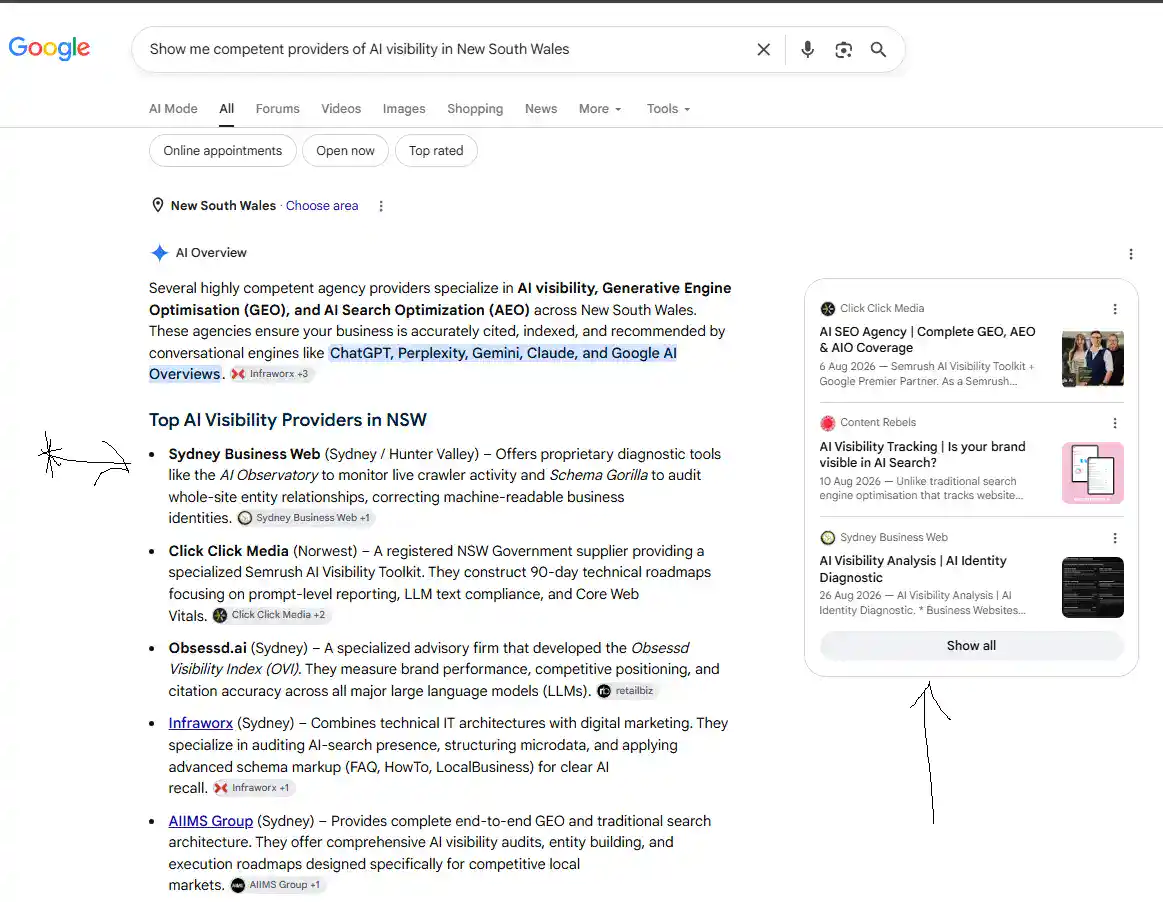
What the observation shows
Business, Category and Products Were Connected
The AI Overview listed Sydney Business Web first within its displayed provider list. Its description named AI Observatory and Schema Gorilla, while the accompanying source panel surfaced the AI Identity Diagnostic.
Our reasonable interpretation is that Google had connected Sydney Business Web with the AI Visibility service category and could associate the business with its named technologies at that point in time.
“E-E-A-T is not a badge you paste onto a website. It is the difference between claiming expertise and showing your work. We develop the technology, test it on our own production website, publish the evidence—and correct the machine when it gets carried away.”
— Keith Rowley, BSc (Hons), MBA
Founder & Principal Engineer, Sydney Business Web
Identity explains who you are · evidence supports why it matters
Machines Need a Skeleton. Trust Needs a Footprint.
A business identity without supporting evidence is merely an assertion. Evidence that is not connected to the correct business, people and services is a filing cabinet with the labels removed. Useful AI Visibility requires both.
The structural layer
Intelligent Entity Skeleton
This is the connected machine-readable structure linking the organisation, people, services, locations, expertise, content and stable identifiers that belong together.
It helps prevent a substantial business from appearing as a collection of unrelated pages and anonymous claims.
The corroboration layer
AI Credibility Footprint
The credibility footprint connects genuine qualifications, experience, authorship, case studies, reviews, professional history and independent references with the business claims they support.
It does not manufacture authority. It makes authentic evidence easier to associate with the correct entity—and exposes contradictions that weaken the overall picture.
The practical consequence
What Must a Modern SEO Brief Include Now?
Do not throw away keyword research, technical SEO, useful content, page experience or earned authority. Widen the brief.
Conventional SEO still helps a page become crawlable, indexable, relevant and competitive. Modern AI Visibility asks what happens beyond that point: whether machines retrieve the information, connect it to the correct business, find sufficient supporting evidence and represent it coherently inside an answer.
That is where specialist tools earn their keep. They do not manufacture relevance or force an AI recommendation. They expose whether the website-controlled parts of the process are functioning—or whether the business is relying on hope and a cheerful collection of green plugin lights.
This broader approach is explored further in our comparison of traditional SEO and AI Visibility Engineering .
This is why specialist tools matter
You Cannot Maintain What You Cannot See
Conventional SEO tools can report rankings, clicks, broken links and page-level technical problems. They do not, on their own, show whether recognised AI and search systems are retrieving useful business content—or whether the identity and supporting evidence spread across the whole website still agree.
Sydney Business Web developed purpose-built tools for those missing layers. AI Observatory checks qualifying machine retrieval. Schema Gorilla examines the complete website as a connected entity structure. AI Identity Diagnostic identifies fragmentation, contradictions and relationships requiring attention.
Those findings can then be compared with the business’s AI Credibility Footprint : the qualifications, experience, authorship, case studies, reviews and external evidence supporting what the business claims about itself.
Only Sydney Business Web’s connected toolset brings these particular checks together as one defined engineering process. The tools do not manufacture credibility or guarantee selection. They reveal when genuine credibility is inaccessible, disconnected, contradictory—or simply invisible to the systems trying to assess it.
“Traditional SEO optimises the page competing for the click. Modern SEO must also connect the business behind the page, the evidence supporting it and the machine-mediated answer that may appear before the click.”
— Keith Rowley, BSc (Hons), MBA
Founder & Principal Engineer, Sydney Business Web
A buyer’s shortcut
Before You Buy “AI SEO,” Ask Four Awkwardly Useful Questions
AI Visibility is attracting new services, new acronyms and some gloriously confident dashboards. A business owner should not need a computer-science degree to discover what is actually being measured.
A competent provider should explain which part of the problem each tool examines, show evidence that can be inspected and state clearly what remains outside anybody’s control.
Terms such as SEO, AEO, GEO, retrieval, entity graph and AI citation are explained in our AI Visibility Glossary .
From link wars to real-world business identity
The Old SEO War Was Over Links. The New Battle Is Over Identity.
Since SEO began, search engines and manipulators have been locked in an arms race. Search engines created signals intended to identify useful, important pages. Scammers immediately began manufacturing the signals.
Links Changed Search—and Attracted Industrial-Scale Cheating
Links became one of the most influential signals in search. Then came paid links, link farms, automated exchanges, content spinners and private blog networks—entire collections of websites built primarily to make other websites appear more important than they really were.
Links have not become irrelevant. Google still says PageRank remains part of its core ranking systems and that links help it understand pages and judge which may be useful. A genuine editorial link from a credible source can still be valuable.
But Google also classifies links created primarily to manipulate rankings as link spam. Its current policies also address expired-domain abuse, scaled low-value content and attempts to borrow another site’s reputation. The war never ended; the weapons merely acquired better branding.
An intelligent model—in geek-speak, a “graph”—that understands real-world entities and their relationships: things, not strings. Google, introducing the Knowledge Graph in 2012
That phrase marked an enormous change in direction. Search was no longer concerned only with matching words on one page. It was increasingly trying to understand the real person, organisation, place or product behind those words—and how those things relate to one another.
AI-generated search makes that direction impossible to miss. To construct an answer, a system may need to identify the business, connect it with its people and services, examine supporting information and decide whether the pieces describe one credible organisation or a collection of unrelated claims.
Why links alone cannot answer the new questions
A Link Can Point at a Business. It Cannot Prove the Business Makes Sense.
A collection of backlinks cannot show whether recognised AI systems successfully retrieved the website. It cannot reveal that the same founder has accidentally become four disconnected people in the site’s structured information. It cannot determine whether qualifications, authorship, services, case studies and reviews are attached to the correct business identity.
This is why specialist AI Visibility tools matter. AI Observatory checks qualifying machine retrieval. Schema Gorilla examines the whole-site entity structure. AI Identity Diagnostic identifies fragmentation and misalignment, while the AI Credibility Footprint connects the business with the real evidence supporting its claims.
Google does not publish a single “credible business entity score,” and we do not pretend that one exists. The broader direction is nevertheless clear: away from relying on easily manufactured signals and towards understanding real entities, relationships, original expertise and corroborating evidence.
“Links may still help establish importance. But an AI answer must also work out who the business is, what it does and whether its claims hang together. Old SEO fought to win the vote. AI Visibility helps ensure the candidate is real, coherent and properly introduced.”
— Keith Rowley, BSc (Hons), MBA
Founder & Principal Engineer, Sydney Business Web
SEO remains essential · the job has become larger
Find Out What Machines Can Retrieve, Connect and Verify
Start with the evidence your current SEO reports cannot provide. Investigate the relevant layer, preserve what already works and repair only what the findings justify.
Explore AI Visibility Services and PricingFrequently asked · properly answered
No Magic Markup Does Not Mean No Engineering
Google is correct: there is no special AI schema that guarantees admission to an AI answer. But that does not mean every website gives machines an equally clear account of who the business is, what it does and why its claims should be trusted.
Is AI Visibility replacing SEO?
No. AI features in Google Search are built upon Google’s existing search index, ranking and quality systems. Technical SEO, content, links, crawlability and ordinary rankings therefore remain essential.
AI Visibility extends the job by examining whether machines can retrieve, connect and accurately represent the business behind those pages.
If no special AI schema is required, why organise the website as an entity?
Because “not required” is very different from “not useful.” A business scattered across disconnected pages, inconsistent identities and unsupported claims gives machines a harder interpretation problem.
A coherent entity structure connects the business, its people, services, expertise and evidence. It does not force an AI system to choose the business—but it gives that system a clearer and more complete business to evaluate.
Does entity building help ordinary Google Search too?
Yes. Google says structured data helps it understand page content and gather information about the people and companies described on the web. Organisation markup can help Google disambiguate a business and influence elements shown in Search results and knowledge panels.
Clear internal relationships also help Google make sense of the website, while eligible structured data can produce richer and more attractive conventional search results. None of this guarantees a ranking increase—but it can improve understanding, presentation and the opportunity to earn the click.
Can a better-organised competitor outshine us?
Absolutely. An AI system may know that two businesses exist while knowing considerably more about one of them.
If a competitor presents clearer services, stronger authorship, genuine qualifications, case studies, reviews and consistent external corroboration, the machine has more usable evidence from which to describe, compare or recommend that competitor.
Why are specialist AI Visibility tools needed?
A website can pass ordinary page-level tests while still presenting a fragmented whole-site identity. That problem is difficult to see without tools designed to examine the additional layers.
AI Observatory checks qualifying AI and search retrieval. Schema Gorilla examines the business entity structure across the entire website. The AI Identity Diagnostic interprets those findings and guides repair and fresh verification.
These tools cannot manufacture credibility or guarantee selection. They can reveal when genuine business information and the AI Credibility Footprint are missing, disconnected, contradictory or being retrieved incorrectly.
Can anybody guarantee an AI recommendation?
No. Results vary by query, location, available sources and the system producing the answer. The honest objective is to make the real business clearer, better supported and easier to retrieve—not promise control over somebody else’s machine.
How often should SEO and AI Visibility be reviewed?
After meaningful changes to the business, website or search environment—and periodically enough to detect genuine deterioration. Both are maintained disciplines, but neither requires pointless weekly tinkering or ceremonial invoices.
Sources · technology · further reading
References and Supporting Material
The conclusions in this article combine official Google documentation with Sydney Business Web’s engineering methods, production testing and observed search evidence.
Official Google Sources
- Optimising for Generative AI Features on Google Search
- How Structured Data Helps Google Understand Content and Entities
- Organisation Structured Data and Business Disambiguation
- Google Search Ranking Systems
- Google’s Link and Internal Linking Guidance
- Google Search Spam Policies
- Google Knowledge Graph: Things, Not Strings
SBW Technology and Services
Methods, Evidence and Definitions
Editorial note: External references were reviewed on 28 August 2026. Search systems and AI-generated answers continue to change. Dated screenshots record what was observed at that moment; they do not imply endorsement, guaranteed ranking or permanent inclusion by Google.