
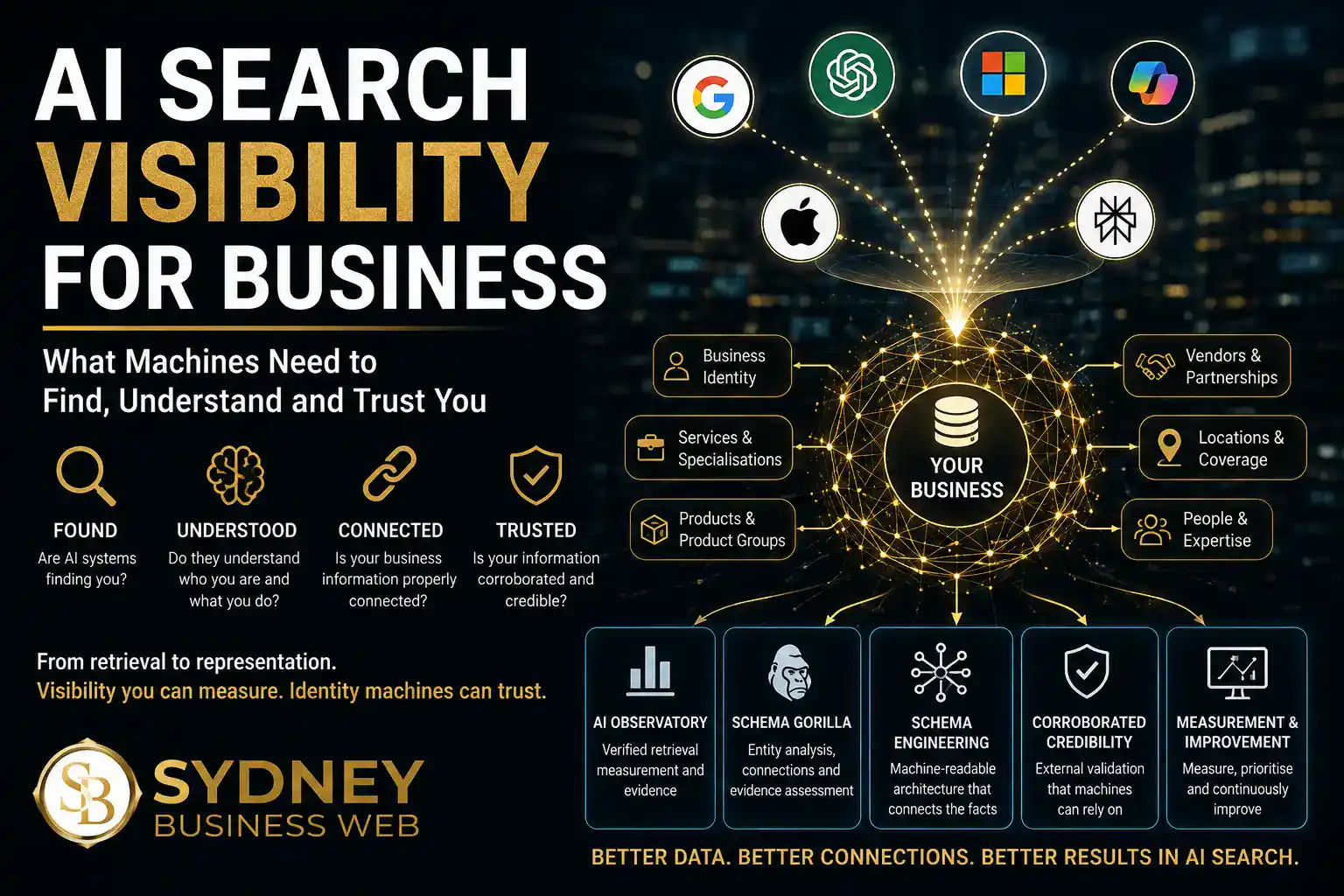
AI Search Visibility depends on more than being indexed. Machines must be able to retrieve, understand, connect and corroborate the information that defines a business.
AI Search Visibility for Business: What Machines Need to Find, Understand and Trust You
A machine may now need to determine:
Who is this business?
What does it actually do?
Which products, services, people, locations and capabilities belong to it?
Can those facts be connected?
Can they be corroborated?
Is there enough reliable evidence for the machine to confidently represent the business in an answer?
That changes what a business website needs to accomplish.
A business increasingly needs to be found, understood, connected and trusted by machines.
AI Search Visibility for Business Is an Engineering Problem
A website can contain hundreds or thousands of pages and still leave an AI system with an incomplete understanding of the organisation behind them.
A large product catalogue does not automatically establish what a company specialises in. A service page does not automatically connect that service to the organisation, the people who provide it, the locations it serves or the evidence supporting the claim.
And technically valid schema does not necessarily mean the website presents one coherent business identity.
FOUND
Are recognised search and AI systems actually retrieving useful information from the website?
UNDERSTOOD
Does the website contain enough factual information for a machine to determine who the business is and what it does?
CONNECTED
Are the organisation, people, services, products, brands, locations and expertise connected into one coherent business identity?
TRUSTED
Is there enough on-site and external evidence to corroborate the claims being made?
These are related problems, but they are not the same problem. That distinction led us to develop a different approach to AI Visibility engineering at Sydney Business Web.
First Question: Can AI Actually Retrieve the Business?
Before worrying about whether AI understands a website, there is a more basic question:
Server logs can contain enormous quantities of automated traffic, but simply counting bots tells us remarkably little. A useful measurement system needs to distinguish between background automated activity and retrievals that actually matter.
This is why we developed the AI Observatory.
The AI Observatory records qualifying retrieval activity from recognised AI and search systems and examines what they are requesting from the website.
That includes evidence such as:
- recognised AI and search systems observed;
- successful business-information retrievals;
- failed retrieval attempts;
- machine-discovery resource requests;
- retrieval success rates;
- differences between systems; and
- changes in activity over time.
Not: “How many bots visited?”
But: “What did recognised machines attempt to retrieve, and did those retrievals succeed?”
A website can appear perfectly healthy to a human visitor while an important crawler repeatedly encounters failures, inaccessible resources or broken discovery paths. Conversely, a low number of visits from a particular AI crawler does not necessarily indicate a technical fault.
Measurement gives us evidence before we start changing things. That is why the Observatory is an activity recorder, not a bot counter.
Second Question: Can AI Understand the Business Behind the Pages?
Successful retrieval does not guarantee successful understanding. A machine might retrieve hundreds of pages from a website and still fail to establish a clear picture of the organisation behind them.
This is where the problem changes from retrieval to business identity.
A machine may encounter:
- the organisation name;
- trading and legal identities;
- services and specialisations;
- industries served;
- products and product groups;
- manufacturers and brands;
- vendors and commercial relationships;
- locations and service areas;
- founders and key people;
- technical expertise;
- articles and knowledge;
- certifications or memberships; and
- other business evidence.
The engineering problem is determining whether these pieces form one coherent entity. That led to the development of Schema Gorilla.
Schema Gorilla Looks at the Whole Business — Not Just Individual Pages
Most schema checking occurs page by page. That is useful for finding syntax errors, but it is not sufficient for finding identity errors.
A JSON-LD block can be perfectly valid while still contributing to a fragmented or contradictory representation of the business.
Schema Gorilla therefore analyses the website as a connected business-identity graph. It looks for problems such as:
- duplicate or competing entity identities;
- conflicting identifiers;
- fragmented representations of the same organisation;
- inconsistent Person entities;
- unresolved internal references;
- relationships that point to the wrong entity;
- important facts that exist visibly but are not connected structurally;
- claims that lack sufficient supporting evidence; and
- business relationships that machines have no reliable way to associate.
What Our First Full-Site Production Test Found
Schema Gorilla exposed five root findings:
- malformed JSON-LD;
- a conflicting Person identity;
- a fragmented business entity;
- competing Person IDs; and
- broken internal entity references.
Some could be seen individually. Others only became obvious when the entire website was analysed as one connected graph.
Schema Cannot Invent Business Evidence
Schema describes and connects evidence.
If a business wants machines to understand that it specialises in a particular industry, technology or service, there must first be credible information supporting that claim.
Adding a line of JSON-LD saying that the business is an expert in something does not make the underlying evidence exist.
The correct engineering sequence is therefore:
Before building or repairing structured data, we need to ask whether the fact is genuinely stated and supported, whether it belongs to the correct business entity, whether other evidence corroborates it, and whether another part of the site contradicts it.
Only after those questions have been answered should schema be used to express the relationships.
Structured Data Should Connect the Evidence
Once genuine business evidence exists, schema engineering becomes extremely powerful.
Structured data can connect the organisation to the people, services, products, brands, locations, areas served, expertise and supporting entities that accurately describe the real business.
The exact relationships depend on what the website can legitimately support. This is why we increasingly treat schema as entity architecture, not merely markup.
The purpose is not to obtain a green tick from a validator. The purpose is to help machines understand how genuine business facts relate to one another.
External evidence can also matter. A business website naturally describes itself, but credible manufacturers, suppliers, professional organisations, authoritative directories, media, regulatory records and other independent entities may help corroborate important claims.
The objective is not to manufacture citations. It is to make genuine business identity easier for machines to connect and verify.
Why Plugin-Generated Schema Is Often Only the Starting Point
WordPress SEO plugins perform an important job. They can generate useful baseline schema for pages, articles, organisations, breadcrumbs, products and other common website elements.
But a plugin does not necessarily understand the commercial structure of a complex business. It may not know:
- which services define the company's market position;
- which people belong to which expertise;
- which product groups reinforce particular specialisations;
- which external organisations corroborate important relationships;
- whether two identifiers actually represent the same person;
- whether an entity referenced on one page exists elsewhere; or
- whether the overall graph accurately describes the business.
Those are business-architecture questions, not simply schema-generation questions. That is where engineering begins.
Measurement and Interpretation Must Be Separated
One of the principles behind our approach is that measurement and interpretation should not be confused.
AI OBSERVATORY
What are machines actually retrieving?
SCHEMA GORILLA
What can machines understand from the information available?
ENTITY ARCHITECTURE
How should genuine business facts be connected?
CORROBORATION
What evidence supports and reinforces those facts?
Schema engineering then expresses the resulting architecture in a form machines can process. Each layer solves a different problem. Together they create an evidence-driven AI Visibility system.
The AI Visibility Engineering Loop
We increasingly see AI Visibility as a continuous engineering process.
This replaces guesswork with observation.
This Is Not About “Gaming” AI
Good AI Visibility engineering should not involve inventing claims, manufacturing expertise or pretending that structured data can force an AI system to recommend a business. It cannot.
Search engines and AI systems remain independent. Their behaviour changes and their algorithms are outside our control. No legitimate engineer can guarantee that a particular AI system will cite, rank or recommend a business.
What we can engineer is the information environment. We can make it easier for machines to retrieve the website, identify the business, distinguish its entities, understand its capabilities, connect its facts, find supporting evidence and encounter fewer contradictions.
That is a much more defensible objective.
Evidence That This Can Affect Machine Understanding
We have been applying these principles to Sydney Business Web itself.
Unbranded AI Discovery
In one unbranded Google AI search for competent AI Visibility providers in New South Wales, the query did not mention Sydney Business Web.
Google's AI response nevertheless surfaced Sydney Business Web and described our engineering-led AI Visibility, entity mapping and schema work.
Connected Business Identity
A separate business-identity query connected Sydney Business Web with our technical engineering approach and proprietary concepts including Schema Gorilla, the Intelligent Entity Skeleton and the AI Credibility Footprint.
These are not controlled scientific experiments and they do not guarantee equivalent results for another business. But they are important observations.
They demonstrate something beyond keyword ranking:
That is exactly the behaviour our AI Visibility engineering is intended to support.
From Retrieval to Representation
AI Search is changing the question businesses need to ask about their websites.
A machine can successfully retrieve and understand a business without necessarily selecting it for an answer, supplier suggestion or recommendation. AI Visibility engineering cannot force selection. What it can do is improve the quality, consistency, connectivity and corroboration of the evidence from which that independent selection may be made.
The old question was largely:
The emerging questions are much broader:
- Can machines retrieve my business information?
- Can they determine who the business actually is?
- Can they connect what we do to the right organisation, products, people and locations?
- Can they corroborate important claims?
- When an AI system constructs an answer, is the business represented accurately enough to be considered?
That requires more than SEO.
That is the engineering problem we have been building Sydney Business Web's AI Visibility technology to solve.
What Should a Business Do Now?
The starting point should not be to add more schema or produce more content simply because AI Search has arrived. The first step is to establish what machines can already retrieve, understand and verify.
The principle is simple: diagnose first, engineer second. Changes should follow evidence rather than assumptions about what an AI system might want.
Want to Know What AI Can Actually See?
Sydney Business Web has developed two complementary AI Visibility systems.
Can AI retrieve your business?
and
Can AI understand and corroborate it?
Related Sydney Business Web Resources
These articles examine the individual engineering, evidence and measurement layers discussed in this article in greater detail.
Primary Technical References
Independent technical documentation relevant to structured data, business entities and recognised machine retrieval.
Frequently Asked Questions About AI Search Visibility
What is AI search visibility for business?
AI search visibility for business is the ability of search and AI systems to retrieve useful information about a business, understand its identity and capabilities, connect the relevant facts and encounter enough credible evidence to represent the business accurately in AI-assisted search.
Is AI Visibility the same as traditional SEO?
No. Traditional SEO remains important for crawling, indexing and search visibility, but AI Visibility adds another problem: whether machines can understand the business behind the pages, connect its entities and corroborate important business facts.
How can a business tell whether AI systems are actually retrieving its website?
Useful evidence comes from observing recognised search and AI systems at the website or infrastructure level and recording what resources they request and whether those retrievals succeed. Sydney Business Web developed the AI Observatory specifically to record this type of retrieval evidence rather than simply count bots.
What is the difference between AI Observatory and Schema Gorilla?
AI Observatory measures retrieval activity: which recognised systems reach the website, what they request and whether retrieval succeeds. Schema Gorilla analyses understanding: whether the available business evidence, entities and structured-data relationships form a coherent and corroborated business identity.
Can structured data make an AI system recommend a business?
No. Structured data cannot force an AI system to cite, select or recommend a business. It can help express genuine business facts and relationships clearly, but those facts must exist and be supported by real evidence first.
What should a business improve first for AI Search?
Start with diagnosis rather than adding more schema blindly. Establish whether machines can retrieve the site, determine whether the business identity is clear, identify missing or conflicting evidence, strengthen legitimate corroboration where needed, and then connect the resulting facts through appropriate entity and schema engineering.