Facebook Ads vs Google Ads: What’s the Difference (and Which Should You Use First)?
If you’re comparing facebook ads vs google ads, you’re usually trying to answer one practical question: where should I put my money first to get leads or sales?
Here’s the cleanest way to think about it:
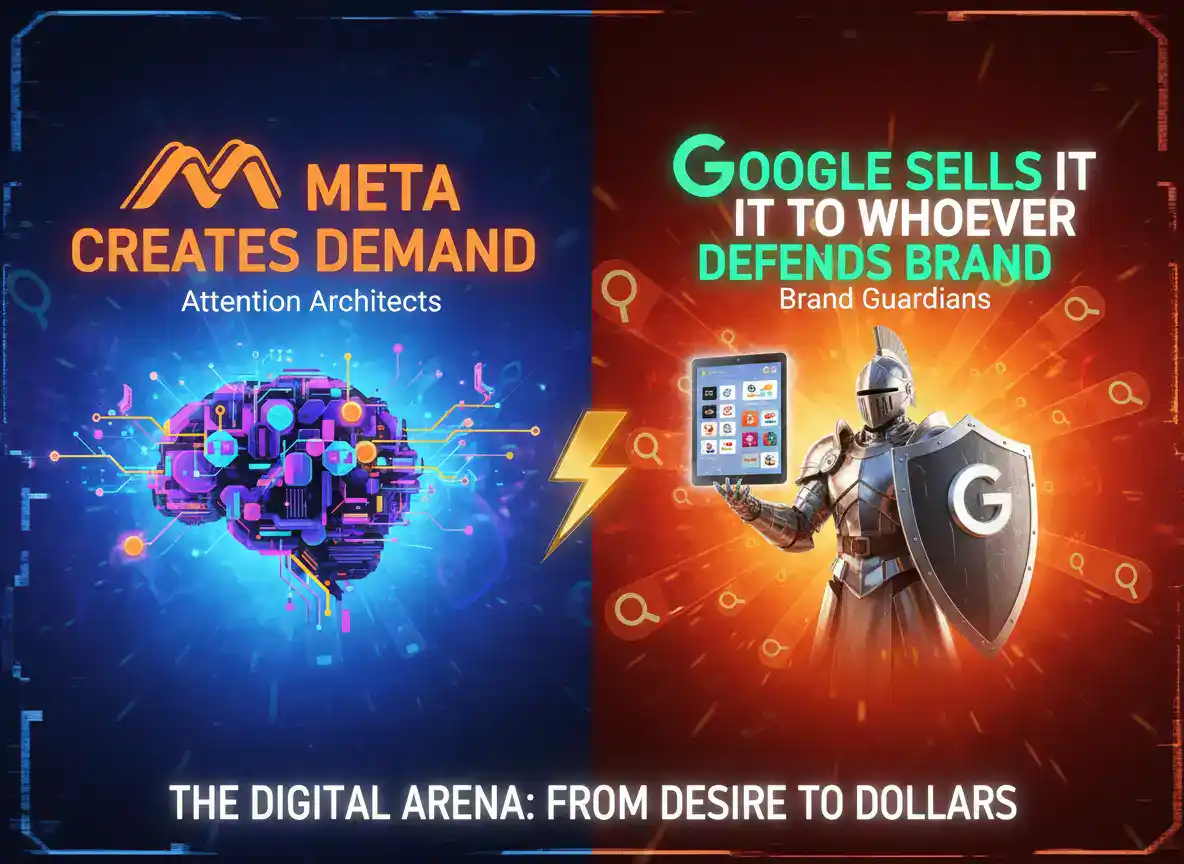
- Facebook (Meta) Ads are generally best at creating demand: putting your offer in front of people who weren’t actively searching for it yet, using targeting and creative to spark interest.
- Google Ads are generally best at capturing demand: reaching people who are already searching with intent (they’re closer to a decision) and placing you in front of them at the moment they’re ready to act.
That’s the “why” behind the common pattern you see in the real world: Meta often drives awareness and curiosity, then Google harvests the high-intent searches and closes the deal.
Quick Comparison: Facebook Ads vs Google Ads
| Category | Facebook (Meta) Ads | Google Ads |
|---|---|---|
| User mindset | Scrolling / discovering (low immediate intent) | Searching / deciding (higher intent) |
| Best for | Awareness, demand creation, remarketing | Leads and sales from active searches, brand defence |
| Strength | Creative + targeting can “manufacture” interest | Shows up at the moment of intent (high conversion potential) |
| Weakness | Cold traffic often needs warming before it converts | Competitive auctions can be expensive without a clear strategy |
| Typical cost behaviour | Often cheaper to reach lots of people (good for TOF) | Often more expensive per click, but higher intent |
So which should you use first? If you need immediate leads, Google can be the faster path because intent is already there. If you need more demand (or you sell something people don’t search for yet), Meta can be a better starting point. Most growing businesses eventually use both — but the order, and the budget split, depends on what your market is doing right now.
In plain English: Meta is usually where you create interest. Google is usually where you convert intent. The mistake is running one without understanding what the other is doing to your customers at the last step.
Facebook Ads vs Google Ads: The Hidden Funnel Costing You Sales
A lot of people compare Facebook Ads vs Google Ads as if they’re competing ways to get the same result.
In practice, they often work as a two-stage system — even for small businesses with low lead volume:
- Meta creates awareness while people are scrolling (they notice you, remember you, maybe engage… but don’t always act).
- Google captures intent later, when they’re in “decision mode” and they search your business name, your service, or “reviews”.
This is why Meta can look like it has “meh ROI” on paper, while Google looks like the hero: Meta often plants the idea, and Google collects the click.
The catch? If you don’t own the Google “last mile” (especially branded searches), you can end up creating demand on Meta and letting someone else intercept it at the point of action.
Meta creates the interest. Google decides who gets paid.
The Invisible Funnel Most Businesses Never See
Here’s what actually happens in the real world — and why so many businesses misread their results.
-
You run Meta ads
You show your service or product to people while they’re scrolling. They notice you. Some click. Most don’t — but they remember. -
The idea sits in their head
This is the part no dashboard shows clearly. The person might be at work, distracted, or just not ready to act — but the seed is planted. -
Later, they go to Google
When they’re ready, they don’t go back to Facebook. They search your business name, your service, or something close to it. -
Google becomes the decision point
This is where intent is highest. They’re no longer browsing — they’re evaluating, comparing, and deciding who to trust. -
And this is where things go wrong
The top of the page is often filled with Sponsored results — Google Ads and Shopping listings. If competitors are bidding on your brand name or offering similar services, they can appear above you. -
The click goes to whoever controls the top
Most people click the first credible result they see. They don’t analyse. They don’t scroll far. They act.
So you can end up in a situation where you created the awareness… but someone else captures the action.
It’s not obvious. It’s not reported clearly. But once you see it, you start recognising it everywhere.
You paid to create the interest — but whoever owns the top of Google often gets the sale.
Why Google Looks Like the Winner (Even When It Isn’t)
When people compare facebook ads vs google ads, they often come to a simple conclusion: Google “works better”.
And on the surface, the data seems to back that up.
- Google shows the click
- Google shows the conversion
- Google gets the credit
But here’s the problem — Google is usually the last step, not the first.
By the time someone searches, they’ve often already:
- Seen your Meta ad
- Recognised your name
- Decided you’re worth checking out
That earlier influence doesn’t show up cleanly in most reports. It’s why Meta can look underwhelming, while Google looks like the hero.
This is known as a last-click attribution bias — the platform that gets the final click gets all the credit, even if another channel created the demand in the first place.
So when people argue about facebook ads vs google ads, they’re often comparing:
- The platform that creates the interest
- With the platform that captures the action
They’re not competitors in most cases — they’re different stages of the same journey.
And if you don’t understand that, you’ll end up turning off the very thing that’s feeding your best conversions.
Google gets the credit. Meta often did the work.
How Competitors Steal Your Sales on Google
This is where the facebook ads vs google ads discussion stops being theoretical — and starts costing real money.
Let’s say someone has seen your Meta ad. They remember your name. They’re interested.
Later, they go to Google and search for you.
At that exact moment, you would assume you’ve already “won” the customer.
You haven’t.
Here’s what can actually happen next:
-
Your potential customer searches your brand name
This is high-intent traffic — the best kind. They already know you. -
Google shows Sponsored results at the top
These are paid ads — often including Google Shopping listings with images and prices. -
Your competitors are bidding on your name
Google allows this. Other businesses can target your brand as a keyword and appear for your searches. -
They are often offering very similar alternatives
This isn’t always a completely different service or product. In many cases, competitors are selling something that looks, sounds, or functions almost the same — sometimes cheaper, sometimes positioned as a better deal. -
To the customer, it looks like the same thing
At a glance, the difference isn’t obvious. The images, wording, and offer can feel interchangeable — especially in Shopping ads or short text ads. -
The customer clicks the first credible option
Most people don’t analyse deeply. They click what’s visible and looks right. -
The sale goes elsewhere
Not because your product or service wasn’t good — but because someone else controlled the top of the page.
This is known as brand bidding or brand hijacking, and it’s extremely common.
It’s also why the facebook ads vs google ads debate is often misunderstood — because without defending your position on Google, your Meta ads can end up feeding your competitors.
You create the awareness. You generate the interest. And at the final step, someone else steps in and captures the conversion.
If your offer can be mistaken for another, the top of Google decides who wins.
How to Fix It (Simple, Practical Defence)
Once you understand the problem, the fix is surprisingly straightforward.
The mistake in most facebook ads vs google ads setups isn’t the choice of platform — it’s failing to protect the final step.
Here’s what you need to do:
-
Run a branded Google Ads campaign
Target your own business name, product names, and key variations. This ensures you appear at the very top when someone searches for you. -
Keep it simple and focused
You’re not competing broadly here — just defending your own name. These campaigns are usually low cost and highly efficient. -
Control the message
Your ad should clearly reinforce that the searcher has found the right business — your brand, your offer, your site. -
Consider Shopping or Performance Max (if relevant)
If you sell products, make sure your own listings appear in those visual “Sponsored” sections as well. -
Monitor who else is showing up
Regularly search your own brand. If competitors are appearing above you, you’ll see it immediately.
This isn’t expensive marketing. In most cases, it’s cheap insurance.
And it changes the entire outcome of the facebook ads vs google ads equation — because now, the demand you create actually comes back to you.
It costs very little to defend your brand — and a lot if you don’t.
Facebook Ads vs Google Ads: It’s Not Either/Or
The more useful way to think about facebook ads vs google ads isn’t as a choice — it’s as a sequence.
One creates the opportunity. The other captures it.
If you rely only on Google, you’re competing for existing demand — often at higher cost.
If you rely only on Meta, you risk creating demand that leaks away at the point of decision.
The strongest results come when both are working together:
- Meta builds awareness and interest
- Google captures intent and converts it
- Branded campaigns protect the final step
-
They are often offering very similar alternatives
This isn’t always a completely different service or product. In many cases, competitors are selling something that looks, sounds, or functions almost the same — sometimes cheaper, sometimes positioned as a “better deal”. -
To the customer, it looks like the same thing
At a glance, the difference isn’t obvious. The images, wording, and offer can feel interchangeable — especially in Shopping ads or short text ads.
Once you see this clearly, the debate around facebook ads vs google ads changes completely.
It’s no longer about which platform is “better”. It’s about whether you control the full journey — from first impression to final click.
And in a world where most decisions are just one search away, that final step matters more than most people realise.
Meta creates the demand. Google decides who gets paid — unless you take control.
Frequently Asked Questions
Is Facebook Ads vs Google Ads really a fair comparison?
Not really. In most cases, Facebook Ads and Google Ads serve different roles. Meta creates awareness and interest, while Google captures intent when people are ready to act. Comparing them directly often leads to the wrong conclusions.
Why does Google Ads often look more effective than Meta Ads?
Google usually gets the final click, so it gets the credit. This is known as last-click attribution. In reality, Meta Ads often influenced the decision earlier, but that contribution isn’t always visible in standard reports.
Can competitors really advertise on my business name?
Yes. Google allows advertisers to bid on competitor brand names as keywords. This means other businesses can appear in the Sponsored results when someone searches for your brand.
What is a branded search campaign?
A branded search campaign is a Google Ads campaign that targets your own business name and key variations. It ensures you appear at the top of the page when people search specifically for you.
Are branded Google Ads expensive?
No. Branded campaigns are usually very low cost because your business is highly relevant to those searches. They are often one of the most cost-effective forms of advertising.
Do small businesses need both Facebook Ads and Google Ads?
In many cases, yes. Even with low lead volume, Meta Ads can build awareness while Google captures intent. The key is ensuring you control the final step, so your marketing efforts convert into real enquiries or sales.
External References
| Source | What it supports | Link |
|---|---|---|
| Google Ads Help (official) | How Search ads work, why ads appear above organic results, and campaign basics. | Google Ads Help Centre |
| Think with Google | High-level advertising strategy, intent, and how people move from awareness to action. | Think with Google |
| Meta Business Help Centre (official) | Meta objectives and measurement (why awareness campaigns don’t always show immediate conversions). | Meta Business Help Centre |
| Search Engine Land | Industry-grade PPC and SERP coverage (brand bidding, Shopping, Performance Max changes). | Search Engine Land |
| Optmyzr | Practical Google Ads optimisation insights from people who manage campaigns daily. | Optmyzr |
Internal Sydney Business Web Links
| Page | Why it’s relevant | Link |
|---|---|---|
| SBW Archive Hub | Your master index for business websites, ecommerce and SEO posts (this article belongs in this cluster). | Business Websites, eCommerce & SEO |
| Business Website Not Getting Leads? | Lead-generation framing that pairs well with the “invisible funnel” concept in this post. | Business Website Not Getting Leads? |
| Rich Snippets for Local Ranking | Reinforces why SERP real estate matters — and how visibility changes click behaviour. | The Criticality of Rich Snippets |
| What Is Technical SEO – 2026 | Supports the “Google is the decision point” argument and the mechanics behind winning that moment. | What Is Technical SEO (2026) |
| SEO Case Study | A concrete example from your site showing how Google visibility can move fast when you do things properly. | Ironwood TPU Case Study |
| Facebook Pixel Hijacking | Adjacent “marketing leakage” topic: losing value because tracking/data/control is compromised or misused. | Facebook Pixel Hijacking |
| Web Developer Thornton Maitland Newcastle | Soft internal bridge back to your territory strategy without geo-targeting this post. | Web Developer Thornton Maitland Newcastle |
CONTACT SYDNEY BUSINESS WEB NOW!