When a dashboard says your AI visibility has collapsed, ask for the prompts, the evidence, and the method before you reach for your wallet.
AI Visibility Scores: Don’t Buy the Panic
AI visibility scores are becoming the latest shiny object in digital marketing. In theory, they are useful. If potential customers are asking Google AI Overviews, ChatGPT, Grok, Gemini, Copilot or Perplexity for recommendations, then a business owner has every right to ask a simple question:
Does my business appear when people ask AI systems for a business like mine?
That is a perfectly sensible question. At Sydney Business Web, we take it seriously. We have spent months improving our website structure, regional pages, technical SEO, schema, internal linking, content depth and AI readability. We already test our visibility manually in Google and other AI-assisted tools because we do not believe serious business decisions should be made from guesswork.
But recently I saw something that made me angry enough to write this post.
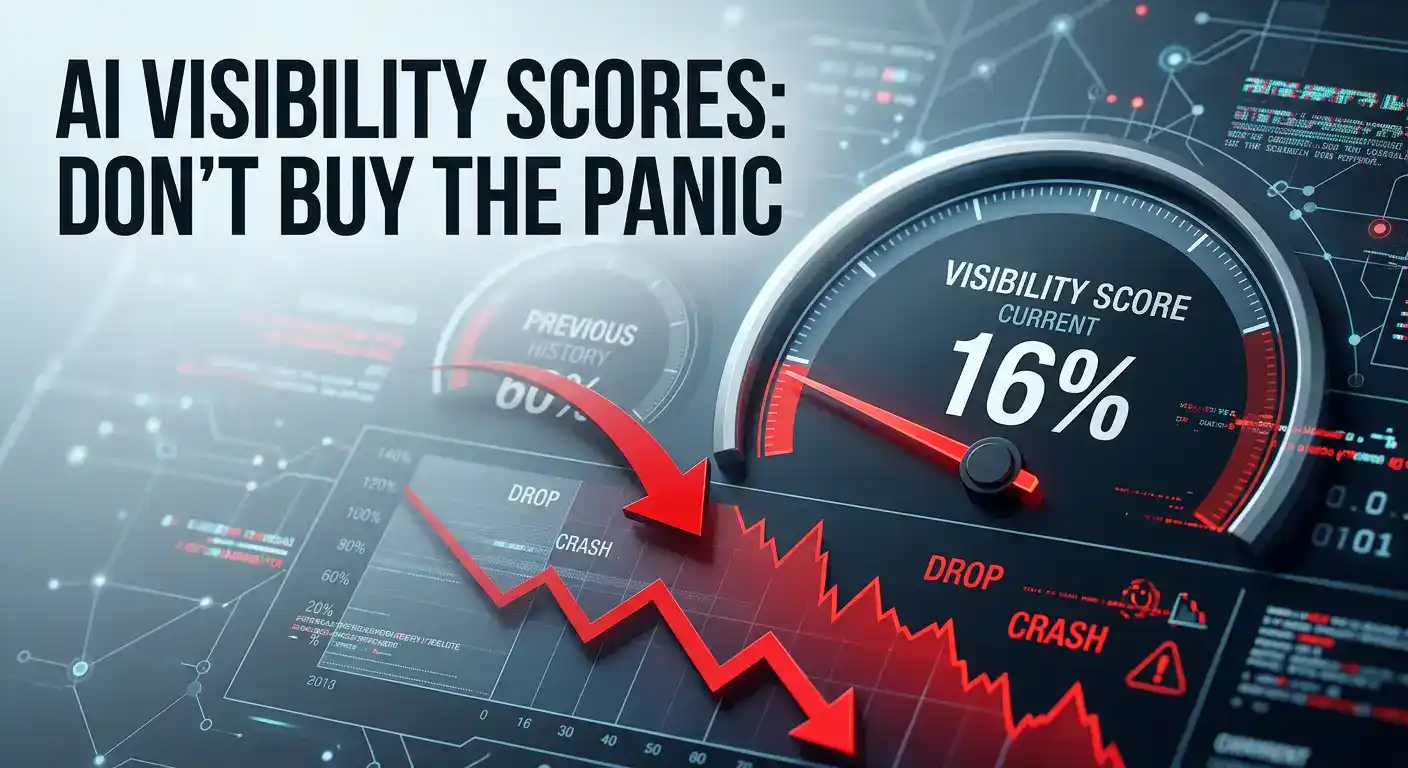
I had a free account with an online marketing platform that included an AI visibility score. Until very recently, that score showed our AI visibility at around 60% across two AI/search engines. Then, without any meaningful change to our website, our content, our schema, or the wider platform landscape that I could see, a sales email arrived urging users to check their AI visibility.
Suddenly, our score had collapsed to around 16%.
That is not a normal wobble. That is not a mild update. That is a cliff fall. And when a frightening score collapse appears at the same time as a sales message, any experienced business owner should stop and ask a very blunt question:
Was my visibility really measured, or was my anxiety being sold back to me?
Why This Matters to Small Business Owners
This article is not about naming and shaming one platform. We are not going to name the company. The point is bigger than that.
The point is that small business owners are constantly being pressured by dashboards, scores, warnings and automated reports that claim something is suddenly wrong. Your SEO has collapsed. Your website is unhealthy. Your competitors are beating you. Your AI visibility is poor. Your business is invisible. Click here. Upgrade now. Book a call. Buy the fix.
Sometimes those warnings are real. Often they are not. The danger is that a business owner who does not know how to test the claim may panic and spend money fixing a problem that has not been properly proven.
In our case, the real-world evidence did not match the dashboard panic. Our organic search visibility remained strong. We were still holding good positions for important searches, including regional website design searches around Thornton, Maitland, Newcastle, the Lower Hunter and wider NSW. We also tested actual AI-style questions directly in Google AI and Grok, and the results still showed Sydney Business Web very clearly.
So this post is not an argument against AI visibility measurement. Far from it. AI visibility matters. We write about it, test it, and build websites with AI readability in mind.
This post is an argument against black-box AI visibility scores being used as fear-based sales tools.
A serious AI visibility report should show the prompts, the engines, the locations, the dates and the actual answers. A panic score by itself is not evidence.
The Sales Email Was the Tell
The number itself was suspicious enough. But the timing made it worse.
For a while, the free account had shown our AI visibility at around 60% across two AI/search engines. Then came the sudden sales push: an urgent email telling users to check their AI visibility scores.
That is when the score had supposedly crashed to around 16%.
Now, if a website really loses visibility, there are usually signs. Rankings weaken. Search impressions shift. AI answers stop mentioning the business. Pages disappear from discovery. Competitors start replacing you in the answers. Something in the real world starts to line up with the warning.
But that was not what we saw.
Our own visibility remained strong. Our regional pages were still performing. Our organic rankings remained healthy. AI tools were still identifying Sydney Business Web accurately for the very things we have worked hard to be known for: business websites, WordPress, WooCommerce, technical SEO, schema, speed, and regional web design across Thornton, Maitland, Newcastle and the Hunter.
So the question was not “what has gone wrong with our visibility?”
The better question was:
Why did the score collapse at exactly the moment the platform wanted to sell AI visibility as an urgent problem?
That Is Not Measurement. That Is Pressure.
I am not suggesting that every AI visibility score is worthless. A properly built visibility report could be useful. In fact, I think AI visibility testing is going to become increasingly important for small businesses.
But a serious report needs to show its workings.
If a company claims your AI visibility has collapsed, it should be able to show the exact questions it asked, the engines it tested, the locations used, the dates of the tests, the answers received, and whether your business was mentioned, cited, linked or absent.
Without that, the business owner is being asked to trust a hidden calculation. And when that hidden calculation suddenly produces a frightening result during a sales campaign, trust is exactly what disappears.
In my view, this is where ordinary marketing becomes unethical. A small business owner may not have the technical background to challenge the score. They may see the drop, panic, and assume they need to buy help immediately.
That is the danger. The score may not be measuring a collapse in visibility. It may simply be creating the emotional conditions needed to sell the solution.
If the evidence is hidden but the fear is loud, you are probably not looking at a diagnostic tool. You are looking at a sales funnel.
Our Real Visibility Did Not Match the Panic Score
Because we work in this field, we did not accept the dashboard result at face value. We checked the real evidence.
At the time of writing, Sydney Business Web continued to hold strong visibility for important regional searches. That included searches connected with website design in Thornton, website design in Maitland, website design in Newcastle, website design in the Lower Hunter and business websites in the Hunter Valley.
We also tested direct AI-style discovery questions. One simple test was:
Who are good website designers near Thornton NSW?
Google’s AI result listed Sydney Business Web first.
Grok also listed Sydney Business Web first.
That is not a business disappearing from AI visibility. That is top-of-answer visibility for a natural local discovery question.
The descriptions were also aligned with the way we intentionally present the business: Thornton-based, focused on business websites, WordPress, WooCommerce, SEO, hosting, performance, and long-term growth.
That matters. AI visibility is not just about appearing. It is about whether the business is understood correctly. In this case, the real-world AI results were doing exactly what we would want them to do.
When Google AI and Grok both show the business clearly, but a hidden dashboard says visibility has collapsed, the dashboard needs to explain itself.
How to Test AI Visibility Without Being Fooled
The first rule is simple: do not test as yourself.
If you are logged into Google, ChatGPT, Grok, Gemini or any other AI/search system, the result may be influenced by your account, your history, your location, your previous searches, your saved preferences, or your relationship with the website being tested.
That does not make the result useless, but it does make it less clean.
If you want to know whether a stranger might find your business through AI-assisted search, test like a stranger. Use a private or incognito browser window. Log out where possible. Do not include your business name in the question. Ask normal customer-style questions, not technical prompts designed to force the answer you want.
The purpose is not to trick the AI system into mentioning you. The purpose is to see whether your business appears naturally when someone asks a realistic buying question.
If you want to test real visibility, ask as a stranger, not as the business owner.
Questions You Can Ask to Test Your Own AI Visibility
Here are some practical test questions a business owner can adapt. Replace the service, suburb, region and specialty with your own business details. The important thing is to ask questions a real customer might ask before choosing a supplier.
Local Discovery Test
Ask:
Who are good [service] near [suburb]?
Example:
Who are good website designers near Thornton NSW?
Regional Service Test
Ask:
Which companies provide [service] in [region]?
Example:
Which web design companies serve the Hunter Valley?
Major City Test
Ask:
Who builds [type of service/product] in [city]?
Example:
Who builds business websites in Newcastle NSW?
Specialist Capability Test
Ask:
Who offers [specialist service] in [state or region]?
Example:
Who offers technical SEO and schema-focused website design in NSW?
Problem-Based Test
Ask:
Who can help with [specific problem] for [type of business]?
Example:
Who can help a small business improve website speed, SEO and AI visibility?
Comparison Test
Ask:
What should I look for when choosing a [service provider] in [location]?
Example:
What should I look for when choosing a website designer in Newcastle NSW?
For each test, write down what actually happened. Did your business appear? Was it first, second, third, or absent? Was it linked or cited? Was the description accurate? Did the AI system understand your location, services and strengths correctly? Which competitors appeared instead?
This is not a perfect scientific test, but it is honest, repeatable and visible. That already makes it more useful than a mystery score with no raw evidence behind it.
A useful AI visibility test does not begin with a score. It begins with a real question and a visible answer.
What to Record When You Run the Test
If you want to make the test more useful, keep a simple record. You do not need complicated software. A spreadsheet, document or notebook is enough.
Record these details:
- The date and time of the test.
- The AI or search tool used.
- Whether you were logged out.
- Whether you used private/incognito browsing.
- Your approximate test location or region.
- The exact question asked.
- The businesses mentioned.
- Whether your business appeared.
- Whether your business was linked or cited.
- How accurately your business was described.
- Which competitors appeared.
Do the same test more than once, on different days, and across more than one AI/search system. AI answers can vary. One result is interesting. A repeated pattern is much more useful.
This is also why dramatic dashboard scores need to be treated with caution. A serious visibility tool should be able to show the same kind of evidence: prompts, engines, dates, locations, answers and changes over time.
If the platform cannot show you the questions and answers behind the score, do not let the score frighten you.
What Genuine AI Visibility Work Actually Looks Like
Real AI visibility work is not magic, and it is not achieved by watching a coloured score bounce around inside a marketing dashboard.
It starts with the same things that have always mattered in serious website work: clear services, clear locations, strong page structure, useful content, fast loading, technically sound SEO, consistent business information, and a website that search engines can understand without guesswork.
For Sydney Business Web, that means building and maintaining strong service and regional pages such as our pages for website design in Thornton, website design in Maitland, website design in Newcastle, website design in the Lower Hunter and business websites in the Hunter Valley.
Those pages do not exist just to chase keywords. They help explain where we work, what we do, who we help, and why our business is relevant to customers in those areas.
That matters because AI-assisted systems are not only looking for words. They are trying to understand entities, relationships and relevance. A business website needs to make those relationships clear.
AI visibility is not built by chasing a score. It is built by making the business easier to understand, easier to verify and easier to recommend.
Why Schema Matters, But Is Not a Magic Wand
Schema is an important part of this work, but it is often misunderstood.
Schema does not force Google, ChatGPT, Grok or any other AI system to recommend a business. It does not guarantee rankings. It does not make weak content strong. It does not turn a thin website into a trusted authority.
What schema can do is help clarify the structure of a website and the identity of the business behind it. It can help connect a website, a business, a service, a person, a location, an article, a FAQ section and other important entities in a cleaner machine-readable way.
That is why we treat schema as part of a broader technical SEO and content strategy, not as a gimmick. It supports the rest of the work. It does not replace it.
The same is true of AI visibility. A business needs real substance behind the structure: useful pages, clear service descriptions, visible experience, strong regional relevance, sensible internal links, and content that answers the questions real customers actually ask.
Schema helps machines understand the business. It does not excuse the business from being worth understanding.
What to Ask Before Trusting an AI Visibility Score
If a tool gives you an AI visibility score, do not reject it automatically. But do not worship it either.
Ask the practical questions first:
What prompts were used?
If you cannot see the exact questions asked, you cannot know whether the test reflects real customer behaviour.
Which AI tools were tested?
A score based on one or two engines is not the same as a broad AI visibility test across multiple systems.
Was the test local?
For local businesses, location matters. A national test may miss strong local visibility.
Was the user logged in?
Logged-in results can be influenced by history, account behaviour and personalisation.
What changed?
If your score suddenly collapsed, ask whether the platform changed its scoring model, prompts or weighting.
Where are the raw answers?
A trustworthy report should show what each AI system actually said, not just a dramatic percentage.
If the platform cannot answer these questions clearly, the score may still be interesting, but it should not be treated as a reliable business diagnostic.
The more frightening the score, the stronger the evidence should be.
Do Not Let Fear Replace Judgement
Small business owners are easy targets for panic marketing because most do not have time to investigate every technical claim thrown at them.
That is exactly why digital marketing companies need to be careful. If a platform shows a frightening collapse in AI visibility, then uses that fear to sell urgency, it has a responsibility to show its workings.
Otherwise, the business owner is not being informed. They are being pressured.
In our case, the panic score did not match the evidence. Our organic visibility remained strong. Our regional pages remained visible. Google AI and Grok both identified Sydney Business Web clearly for a direct Thornton website designer query. Our broader content and schema work continued to support the same business positioning we have been building for months.
So no, we did not panic. We tested.
That is what every business owner should do before buying anything based on a scary dashboard number.
Do not buy the panic. Test the claim.
Final Thought: Evidence Beats Theatre
AI visibility matters. I do not dismiss it. In fact, I think it will become more important as customers increasingly use AI-assisted search to compare businesses, ask for recommendations and understand who can help them.
But that makes honest measurement more important, not less.
An AI visibility score can be useful if it is transparent, repeatable and backed by visible evidence. It can help identify whether a business is being mentioned, cited, linked and described accurately.
But a score that suddenly collapses without clear explanation, especially during a sales push, deserves scepticism.
Before paying for help, ask for the prompts. Ask for the engines. Ask for the locations. Ask for the raw outputs. Ask whether the scoring method changed. Then run your own tests.
If the evidence shows a real problem, deal with it. If the evidence does not match the panic, keep your wallet closed.
A frightening number is not evidence. Evidence is evidence.
Frequently Asked Questions About AI Visibility Scores
AI visibility is worth taking seriously, but business owners should be careful before trusting a single score from a platform that does not show its method.
What is an AI visibility score?
An AI visibility score is usually a platform’s attempt to measure whether a business appears in AI-assisted answers, AI search results or AI-generated recommendations. It may be useful if the platform shows the prompts, tools, dates, locations and actual answers behind the score.
Should I trust an AI visibility score?
You should treat it as a signal, not as proof. If the platform does not show how the score was calculated, you should not make business decisions from the number alone.
Why might an AI visibility score suddenly collapse?
A score may fall because your real visibility changed, but it may also fall because the platform changed its prompts, engines, weighting, location settings or scoring method. That is why you should ask for the raw evidence before panicking.
How can I test my own AI visibility?
Use a private or incognito browser window, log out where possible, avoid mentioning your own business name, and ask normal customer-style questions. Record which businesses appear, whether your business is cited or linked, and whether the description is accurate.
Do I need schema for AI visibility?
Schema can help search engines and AI systems understand the structure, identity and relationships on a website. It is not a magic ranking tool, but it can support good content, technical SEO, local relevance and clear business positioning.
What should I ask before paying for AI visibility help?
Ask for the exact prompts tested, the AI engines used, the test locations, the dates, the raw outputs, whether your business was linked or merely mentioned, and whether the platform recently changed its scoring method.
If a company wants to sell you AI visibility work, it should be able to show you the evidence behind the problem.
Related Sydney Business Web Articles and Pages
These Sydney Business Web pages expand on the regional visibility, AI search testing, schema work and technical SEO issues discussed in this article.
Business Websites, eCommerce and SEO Blog
Our main blog archive covering website design, SEO, AI visibility, schema, technical fixes and small business website strategy.
Schema and AI Citations
A deeper look at what structured data can and cannot do for AI visibility, AI citations, search understanding and website clarity.
Make Your Business Website Visible to AI
A practical article on making a business website easier for AI-assisted systems and search engines to understand, trust and describe.
A Chat with Grok on Schema and AI Visibility
A real example of how an AI system described Sydney Business Web, our schema work, our technical positioning and our visibility signals.
Business Websites Hunter Valley
Our regional hub page for Hunter Valley businesses looking for practical, technically sound business website design.
Website Designer Thornton
Our local Thornton page, directly relevant to the AI visibility checks discussed in this article.
Website Designer Maitland
Our Maitland regional service page for businesses looking for strong website design, local SEO and technical structure.
Website Designer Newcastle
Our Newcastle page, supporting visibility in one of the most competitive nearby regional search markets.
Website Designer Lower Hunter
Our Lower Hunter page, built to clarify the regional service area and connect local business website work with technical SEO and visibility.
Good visibility comes from consistent signals, useful content, strong structure and evidence — not from chasing panic scores.
External References
These external resources are useful for business owners who want to understand search visibility, AI-assisted search, SEO and structured data from primary sources.
Google: AI Features and Your Website
Google’s guidance on AI Overviews, AI Mode and how website content can appear in AI-assisted search experiences.
Google: Optimizing for Generative AI Search
Google’s official guide for site owners thinking about visibility in generative AI search features.
Google SEO Starter Guide
A useful baseline for understanding how Google describes search-friendly website practice, crawling, indexing and useful content.
Google Structured Data Introduction
Google’s introduction to structured data and how it helps classify page content for search systems.
Google Local Business Structured Data
Google’s documentation for local business structured data and how businesses can provide clearer information to Google Search.
Google: Do You Need an SEO?
Google’s own advice on choosing SEO help and understanding what a genuine SEO professional should and should not do.
Schema.org LocalBusiness
The Schema.org reference page for the LocalBusiness type used to describe a local business entity.
Schema.org BlogPosting
The Schema.org reference page for BlogPosting, useful for understanding how article and blog post entities are described.
Schema.org FAQPage
The Schema.org reference page for FAQPage, useful when marking up visible question-and-answer content on a page.
When in doubt, compare dashboard claims with primary documentation, real search results and visible AI outputs.
CONTACT SYDNEY BUSINESS WEB NOW!